

It might be best known for its legendary Note series, but the past few years have seen Xiaomi slowly and steadily making inroads into the premium smartphone market in India. The brand launched the Xiaomi 12 Pro in India in 2022, followed by the Xiaomi 13 Pro last year, and this year, it has come with the Xiaomi 14.

Although Xiaomi will be bringing the Xiaomi 14 Ultra to the Indian market, too, it will do so in limited numbers (from what we have been told). The Xiaomi 14 will be its main flag bearer in the flagship wars. Its blend of a compact, premium design and high-end specs, topped off with Leica photographic magic, makes it a formidable proposition, but does it pack enough to ward off competition from the likes of the OnePlus 12 and the iPhone 15? The answer depends on how much you value that one word on the back of the camera unit. Leica.
Table of Contents
Xiaomi 14 design and appearance: Compact, understated…and premium
We had covered the design of the Xiaomi 14 in detail in our first cut of the device earlier. The Xiaomi 14 is relatively compact at 152 mm in height. This is still slightly taller than the likes of the iPhone 15, the Pixel 8, and the Galaxy S24, but it is still way more handy than most phones these days, which are in the palm-stretching range of 160 mm.
At 193 grams, it seems heavy for its size but is comfortingly solid with a Corning Gorilla Glass Victus front, an aluminum frame, and a Corning Gorilla Glass back. Xiaomi has opted to go with a flat display and straight sides, although the back of the phone is slightly curved (to provide a better grip, we are told). The back is also the home of a large square-shaped camera unit, with Leica branding on top and some intricate (alas, near-microscopic) etching on the base.
Our black unit with a matte finish on the back fits snugly into our hands and pockets and is quietly elegant. Some might prefer the jade green shade, but we prefer the black, as the black camera unit blends right in with the black back. In the style stakes, the Xiaomi 14 is more Bond than Barbie – understated and elegant rather than sparkling and spectacular. It is pretty tough, too, and comes with an IP68 dust and water resistance, which means it can go swimming, too.
Xiaomi 14 spec sheet: Ticking the flagship boxes

Within the compact frame of the Xiaomi 14 comes some very flagship-level hardware. The phone runs on the Qualcomm Snapdragon 8 Gen 3 processor, which is seen in the likes of the Galaxy S24 Ultra and the OnePlus 12, and comes with 12 GB LPDDR5X RAM and 512 GB of UFS 4.0 storage, giving it the keys to unlock beast-level gaming, if need be. The 6.36-inch LTPO AMOLED display might be a little small compared to the 6.6-6.8 inch displays seen on many smartphones today, but it comes with a 1.5K (2670 x 1200px) resolution that gives it an excellent pixel density of 460 ppi and has a 120 Hz refresh rate that can vary from 1-120 Hz base on the content being shown on it. It is a ProHDR display with support for Dolby Vision, with a peak brightness of 3000 nits. Also on board are very good stereo speakers with support for Dolby Atmos.
The 4610 mAh battery might seem small in comparison to some of the 5000 mAh batteries seen on other devices, but then it has to power a smaller display and comes with support for 90W fast charging (with a 120W charger in the box) and 50W wireless charging. Once again, that might seem a little slower in comparison with some of the three-figure charging speeds on other devices, but the difference it makes is marginal. The phone runs on Xiaomi’s new HyperOS out of the box on top of Android 14 and comes with an assurance of four years of Android OS and five years of security updates.
All said and done, the Xiaomi 14 is every inch a flagship, be it in terms of style or specs. And that is when we have not even mentioned the cameras on it. This, of course, brings us to the little – or rather big – matter of the photographic prowess of the Xiaomi 14.
Xiaomi 14 cameras: Marvellously Leica-ble magic

It might boast a premium design and high-end specs, but the real USP of the Xiaomi 14 is its cameras, which (as in the Xiaomi 13 Pro) are made in collaboration with one of the most respected names in photography, Leica. The main stars of the show are the three 50-megapixel cameras on the back, which comprise a main camera with a Light Fusion 900 image sensor with OIS, a 75 mm ‘floating telephoto’ camera, and an ultrawide camera. A 32-megapixel camera handles selfies, but those three cameras on the back are the biggest reason for buying the Xiaomi 14.
That is because the Xiaomi 14 produces the kind of photographs that no other phone can. The main reason for this is Leica’s unique color and black-and-white signatures that produce shots that no other camera phone in the market can match. The Xiaomi 14 even gives you two color schemes to choose from – a more realistic Leica Authentic and a slightly more poppy and saturated ‘Leica Vibrant.’ But no matter which mode you go for, you will end up getting photographs with striking detail, slightly richer (without seeming oversaturated) colors, and deeper contrasts than other contrasts. The attention to detail and the treatment of contrasts becomes particularly noticeable when you shoot in black and white, using the phone’s special black and white Leice filters.





The main camera on the Xiaomi 14 is not a one-inch sensor like the one on the Xiaomi 13 Pro, but it still pulls off very detailed shots, aided by the Leica Summilux lens. Low light performance is very good, too, with no attempts made to artificially light up the night, unlike the cameras on some other phones. Low-light shots have strikingly deep colors with just the right amount of shadow. The videos are good as well (8K video is supported), and there are some special movie modes on board.
The ‘floating telephoto’ sensor is the most versatile camera on the Xiaomi 14. It only gives you a ‘normal’ 3.2x optical zoom but also shoots portraits and brings four unique Leica portrait modes to the table – a 35mm documentary mode, a 50 mm swirly bokeh mode, a 75 mm portrait, and a 90 mm soft focus mode. Moreover, you can even change the aperture in each of these modes to adjust the bokeh and even use live filters. It is a formidable array of options and can result in some very good and unique photography. Our own favorites were the 50 mm and 75 mm modes with the Leica BW HC filter, which delivered astonishing portraits in black and white with wonderful bokeh.




The 35 mm documentary mode might be filed under portrait modes but is actually excellent for street photography. It is not all great, though – the 90 mm soft focus mode often ended up shifting focus from the subject, and we found some shots getting a little too soft-focused in different portrait modes. A software update should fix matters, as ‘normal’ portrait shots are inch-perfect. The telephoto also doubles up as a ‘super macro’ sensor and delivers some very good close-up shots from about 10-12 cm. We would have liked to be able to get that ‘macro’ feel from a slightly longer distance (such as in the – much more expensive – Vivo X100 Pro) for snapping bees on flowers and the like, but even this mode delivers very good results.
We did not find ourselves using the 50-megapixel ultrawide camera too often, though it is very good for those travel snaps with wide landscapes and cityscapes, with plenty of detail. The selfie camera delivers great selfies, with some smoothening of skin and textures. Of course, you can add special Leica frames (complete with that famous Leica logo and image details) to all the pictures you take with the Xiaomi 14, and believe us, you will find yourself using this option very often!
All in all, the cameras on the Xiaomi 14 are among the best in their segment, but what makes them special is their ability to deliver that very distinct Leica touch to photography. If you do not like Leica, there is a fair chance you will end up wondering what the fuss is about, as cameras from other flagships in the zone can more than match the Xiaomi 14 on fronts such as detail and, zoom and so on. You need to look carefully at the snaps of the Xiaomi 14 to see the Leica color and contrast signature floating beneath their surface. Warning: not everyone will like it, but it definitely puts the Xiaomi 14 in a zone of its own.
Xiaomi 14 Performance: Pretty much flagship stuff
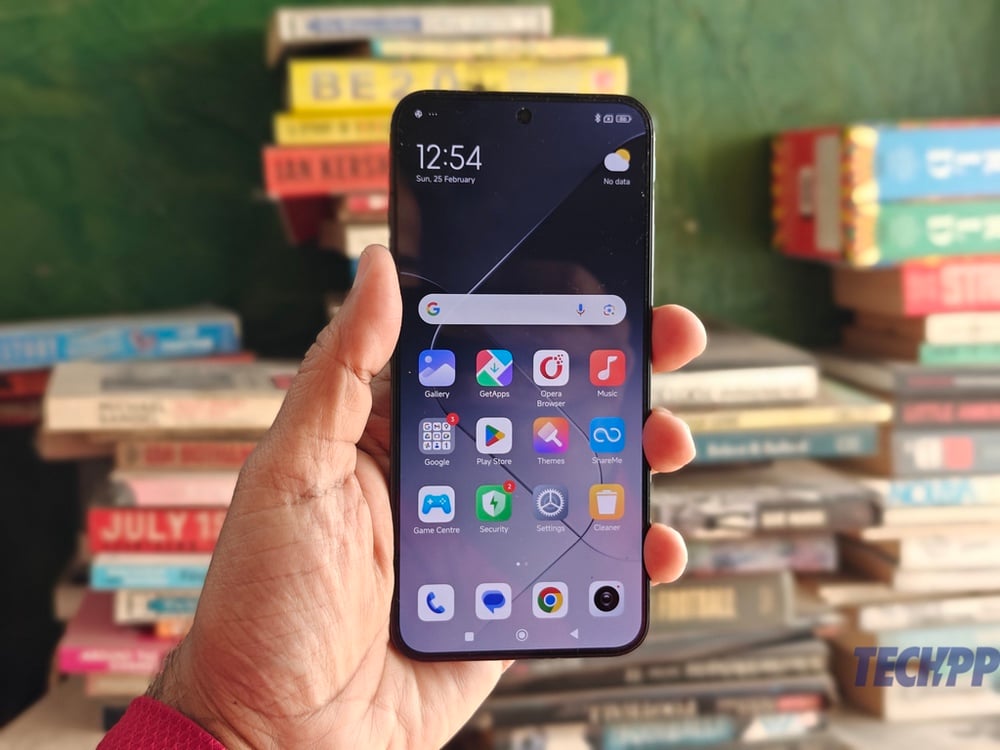
On the non-camera front, the Xiaomi 14 does pretty much everything you would expect from a top-line Android flagship. The display is not as bright as some of its competitors (most notably the OnePlus 12) but is great for watching videos and films, aided by the very good stereo speakers. The flagship processor and RAM also make Xiaomi a very good performer in terms of gaming – it ran Call of Duty and Genshin Impact without any stutters whatsoever, and frankly, we did not miss having a bigger screen, although hardcore gamers might. Multitasking, too, worked very smoothly. The phone never gets unusually warm either, although very slight heating does take place during heavy-duty gaming and long video shoots.
Xiaomi’s much talked-of HyperOS flows smoothly across the Xiaomi 14. It does come with some bloatware (Opera browser, Netflix, PhonePe) and some Xiaomi system apps, but we encountered no problems whatsoever while using the device. HyperOS has a cleaner look and feel than MIUI and also consumes fewer resources, though resources are not an issue on this device. We feel HyperOS strikes a healthy balance between stock Android and feature-heavy UIs like FunTouch OS, giving us plenty of features (especially in terms of image and video editing and sharing) without overwhelming us.

The 4610 mAh battery will easily last out a day of normal to heavy use, and thanks to support for 90W charging and a 120W charger in the box (so sorry, Mother Nature), it can get recharged fully in around 35 minutes. There is also support for 50W wireless charging, and Xiaomi claims it can recharge the phone in 46 minutes, although wireless chargers of that speed are rare and expensive in the Indian market at the time of writing. 5G connectivity worked fine with our Airtel connection, and the in-display fingerprint scanner worked smoothly, too. As we said, it’s pretty much flagship-level stuff.
Xiaomi 14 Pricing: Below the Pro, but in the Never Settling and iPhone zone
The Xiaomi 14 is available in a single 12 GB/ 512 GB RAM and storage variant for Rs 69,999.

This price is below the Rs 79,999 at which the Xiaomi 13 Pro was launched but still puts it within striking distance of the OnePlus 12, which starts at Rs 64,999 and can boast Hasselblad cameras and a bigger battery and higher resolution display, as well as the Vivo X100 which stars at Rs 63,999 and comes with Zeiss optics and some portrait photography magic of its own as well as a bigger battery and display. There are even two compact phones with plenty of camera muscle in its range – the Pixel 8, with its computational camera magic and Android smarts at Rs 75,999, and the iPhone 15, which now sports a 48-megapixel main sensor and a Dynamic Island at close to Rs 70,000.
Xiaomi 14 Review Verdict: Should you buy it? It is a solid value for money if you Leica it!

So, should you consider investing in the Ciaomi 14? Our answer to that question takes the form of another question: just how much do you value Leica photography?
For, while it is a very good performer, the Xiaomi 14 can be matched by other devices in the spec and general smartphone performance department by a number of other devices. Even its relatively compact form factor is not totally unique and is matched by the iPhone 15 and Pixel 8.
What makes the Xiaomi 14 really different from any of the flagships out there is its Leica camera connection. There is no other phone out there that can deliver the Leica-flavored photography that Xiaomi does, with typical Leica hues, a night that stays dark and has a black-and-white flair, and portraits that no other phone can match.
Cameras on other phones might deliver similar detail and better zoom, and some, like the Vivo X100, might even add their own Zeiss-mic touch to portrait modes, but if you seek the blend of striking contrasts and detail that make Leica special, then the Xiaomi 14 stands alone (at least until the Xiaomi 14 Ultra comes to town and that is way more expensive at Rs 99,999). In a camera photography world that seems obsessed with matching each other, the Xiaomi 14 takes a road less traveled and is perhaps the only phone out there that can claim to have a color signature that is totally its own.
So let’s keep this simple:
If you want a flagship phone for about Rs 70,000, there are options.
If you want a compact phone for about Rs 70,000, there are options.
If you want a phone with great cameras for about Rs 70,000, there are options
But
If you want a phone that has all of the above and ALSO brings the legendary Leica flavored photography for about Rs 70,000…
There’s no other phone for you.
Its compact stature is impressive. Its performance is brilliant. But it is the Leica soul of the Xiaomi 14 that is unmatchable.
- Compact, premium design
- Smooth operation
- Very good cameras
- Good battery life, fast charging
- Leica portraits and filters
- Leica portrait modes can be inconsistent at times (focusing issues)
- Some bloatware on HyperOS
| Design |
|
| Camera |
|
| Software |
|
| Performance |
|
| Price |
|
|
SUMMARY
At Rs 69,999, the Xiaomi 14 comes in the price range of the likes of the OnePlus 12, the Pixel 8, and the iPhone 15. Can its Leica cameras help it carve a niche for it? |
4.0
|

