

In Summary
- The latest phone from Google, the Pixel 8a, comes with the highest price tag seen on a Pixel a-series device. At Rs 52,999 (USD 499), the Google Pixel 8a is the most expensive in the ‘a’ series of Pixel phones launched by Google in India.
- Even at the higher price, the Pixel 8a is the most affordable of the Pixel 8 series, with the Pixel 8 at Rs 69,999 (USD 669) and the Pixel 8 Pro at Rs 1,04,999 (USD 1059).
- It comes with the same processor seen in the Pixel 8 and Pixel 8 Pro, the same seven years of assured Android updates, and a truckload of flagship-level Android smarts, but can the Pixel 8a make a space for itself in the premium Android zone?
Google’s Pixel ‘a’ variants have had a rather interesting journey. They started out as slightly less expensive variants of the ‘normal’ Pixels, then emerged as premium mid-segment Pixels, moved on to being flagship-killing Pixels, and with the Pixel 8a, the Pixel a-series gets into the zone which we feel suits it best – the proper premium segment.

No matter what folks try to tell you, at Rs 52,999 in India (and $499 in the US), the Pixel 8a is no longer a ‘premium mid-segment device’ (like the OnePlus Nord) or even a flagship killer (like the OnePlus 12R, the Nothing Phone 2 or even the Pixel 7a), but is pretty much in the premium phone zone.
When it was launched at a higher price than its predecessors (the Pixel 7a and Pixel 6a (both of which had been launched at Rs 43,999), we wondered if it could hold its own in this zone, Well, it can.
Table of Contents
Pixel 8a design and appearance: A small-ish wonder that’s fantastic, made of plastic
The Pixel 8a follows the same design template as the Pixel 8 and Pixel 8 Pro, and thanks to this, looks far more premium than the glossy-backed Pixel 7a did. Yes, its back is still plastic, but it has the same ‘frosted glass’ look that the Pixel 8 and 8 Pro have, with the logo seeming to be below the surface. We got the Porcelain (white) color variant with the typically Pixel metal-colored camera bar on the back.
While not as eye-catching as the Aloe Green variant, which is being seen on social media, it does exude a lot of smooth, understated class and picks up no smudges or fingerprints. Everyone we showed it to actually assumed it was glass. The Pixel 8a also comes with the rounded corners of the 8 and 8 Pro and a metal frame with sides that appear straight but curved slightly to make the phone comfortable to hold.

At 152.1 mm, it is actually slightly taller than the Pixel 8 (150.5 mm) but remains a compact phone by modern standards, if not quite as small as the iPhone 15 or the Galaxy S24. It is not insanely slim at 8.9 mm and has a reassuringly solid feel to it at 188 grams. It is pretty resilient, too – it comes with IP67 dust and water resistance, which means it can survive a dunk in the water.
However, Google has gone with the almost ten-year-old Corning Gorilla Glass 3 protection on the display, an odd choice in a device with a premium price tag. The eagle-eyed equipped with visual vernier calipers might notice the slightly thicker bezels around the display, but the Pixel 8a is all about premium design feels, with its blend of glass, metal, and folks-swear-it-looks-like-glass plastic!
Google Pixel 8a specs and software: Getting closer to the premium zone
The Pixel a-series has generally been distinctly under-specced as compared to the ‘normal’ Pixels. The Pixel 8a, however, is closer to its more expensive cousins in terms of specs. This is most noticeable in terms of the display, where the Pixel 8a comes with a 6.1-inch FHD+ OLED Actua Display with 120 Hz refresh rate, which is similar to the slightly larger, 6.2-inch one on the Pixel 8. Like the Pixel 8 (and 8 Pro), the Pixel 8a also runs on Google’s own Tensor G3 processor and also comes with RAM and storage variants of 8 GB/ 128 GB and 8 GB/ 256 GB, with UFS 3.1 storage.
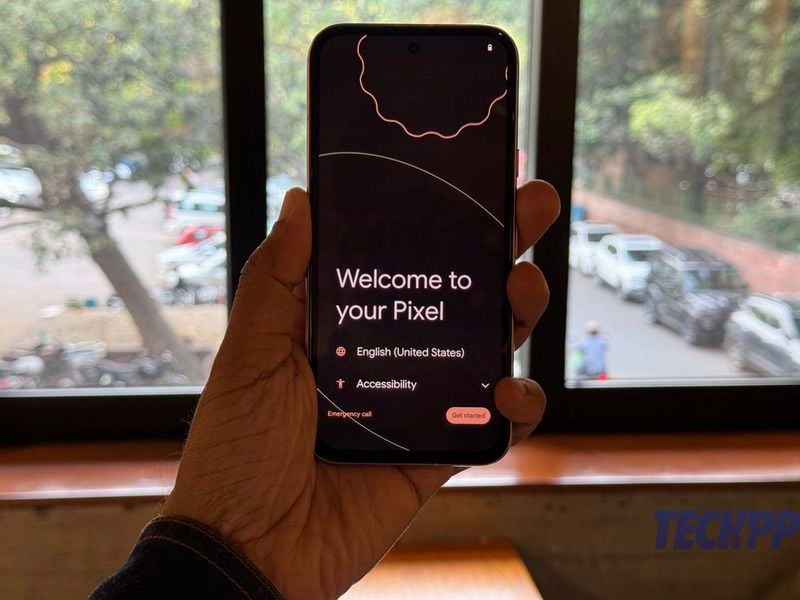
The cameras, so important on a Pixel, are, however, different from the Pixel 8 and very similar to the Pixel 7a – a 64-megapixel main sensor with OIS with a 13-megapixel ultrawide on the back, and a 13-megapixel selfie camera. The phone comes with a 4492 mAh battery (close to the 4575 mAh one on the Pixel 8) and supports wireless charging. Still, charging speeds remain at the very low Pixel 7a levels – 18W (wired) and 7.5W (wireless) – which are significantly slower than the Pixel 8 (27W wired and 18W wireless). Also on board are stereo speakers.
Most significantly, however, the Pixel 8a gets not only the latest Android 14 but also a lot of the AI tools that are on its 8 and 8 Pro siblings, including Magic Editor, Magic Eraser, Audio Magic Eraser, and AI Wallpaper, and also access to Google’s Gemini Nano AI model.
In the best Pixel tradition, this is clean, uncluttered Android with no bloatware, and like the 8 and 8 Pro, the Pixel 8a also assures users of a massive seven years of Android updates! All said and done, the Pixel 8a remains a step behind the Pixel 8 and Pixel 8 Pro in spec terms, but thanks to that display (this is the first Pixel a with a 120 Hz refresh rate display), that step is not as steep as it used to be in the past.
Pixel 8a cameras: Business as usual, brilliant as usual (with AI chipping in)

Cameras have always been one of the USPs of the Pixel series, irrespective of the suffix after the number. That does not change with the Pixel 8a, which is easily one of the best phone cameras in its (new) segment. On paper, the Pixel 8a seems to have cameras with a similar megapixel count to the Pixel 7a, but in terms of performance, there seems to be a subtle difference.
As with all Pixel cameras, there is a lot of detail in the images snapped by all the cameras, but unlike its predecessor and even the 7 series of Pixels, the Pixel 8a comes with slightly richer colors. You will not get the dazzling, eye-popping riot of colour that some other phones deliver, but images are more pleasant as compared to past Pixel variants.
Video quality from the main sensor has been significantly improved too. Selfies are very good as well, with a very subtle amount of skin smoothing having been introduced. There is no telephoto sensor here, so you get 2x lossless zoom and about 8x digital zoom, which is handy but nowhere as good as seen on the Pixel 8 and 8 Pro, with noise creeping in often. The ultrawide is a good performer but lacks autofocus, which is a little disappointing at this price point, but the main sensor’s performance more than compensates.




A big plus is low-light photography – the Pixel 8a is one of the best in its category in this regard, delivering rich colors even in relatively dark conditions and a decent amount of detail as well. Using any kind of zoom in low light is a bad idea, though, as one ends up with pasty textures and very compromised clarity. Stick to the main sensor, and you will get great shots.
Portrait images are very good, too, although they take a bit of time to be processed – with the camera seemingly taking a normal shot and then blurring out the background when you view the image in the gallery – something that we noticed in the Pixel 8 and 8 Pro as well.
While the photography app remains very minimalist in the typical Pixel tradition, there are a lot of AI image and video editing tools that let you do much more with your content. These include Magic Editor, which literally lets you move objects around in your photography and even carry out complex editing tasks easily; Magic Eraser, which lets you remove unwanted objects and people from images; Best Take, which takes the best expressions of people from a series of group snaps and combines them into one; Magic Audio Eraser that tries to remove background noises from your videos; and much more.
They do not always work perfectly – Magic Eraser does not work as well in crowded areas, and Magic Audio Eraser tends to trip up when the background noise is dense – but they definitely make a big difference to the whole image processing process. Our only complaint is that they can seem a little sluggish at times – something we noticed in the Pixel 8 and 8 Pro as well – and can sometimes depend on network connectivity.
Pixel 8a gaming and performance: An AI beauty, but not a gaming beast

The Pixel 8a is one of the best Android devices you can get for everyday use and photography. The display is not the brightest we have used (although it is discernibly brighter than the one on the Pixel 7). Still, it handles colors very well and, combined with the very good stereo speakers, delivers a very good multimedia experience. The clean interface might disappoint those used to getting stacks of preinstalled apps and utilities, but the phone itself sails through routine and even slightly heavy tasks with ease. You can open a dozen apps on the Pixel 8a and still face no lags at all. Google has also significantly improved the speed of the in-display fingerprint scanner – the one on the Pixel 8a is as good as any we have used in the segment.
The clean UI is very easy on the eye (the rhyme is unintentional), and you also get plenty of AI tools like circle to search, auto transcription, live translation, and summarize. You can replace Google Assistant with Gemini Nano to get more detailed results, chat about this and that, and even compose messages. There are lots of features to use and explore on this device, and thanks to the chip and plenty of RAM, they all work very smoothly if you have a good network connection. What’s more, this being a Pixel, more features, as well as newer versions of Android, are likely to arrive on the device in the coming days as well – this is an incredibly future-friendly phone, thanks to Google’s flagship chip running the show.

That chip, however, still struggles in comparison with recent Qualcomm Snapdragon and MediaTek Dimensity processors when it comes to high-end gaming. You can play Call of Duty and Genshin Impact on it on very high graphics settings, but be ready for some lags, as well as slightly uncomfortable spikes in temperature (the Pixel 8a is otherwise a very cool operator!).
The one area where the phone falls well short of flagship level is in terms of battery – the 4492 mAh battery struggles to get through a day if you use a lot of AI and give the phone the option to increase the refresh rate to 120 Hz (it is set to 60 Hz by default). The 18W charging speed means that it takes about 100-120 minutes (two hours) to charge over a wired connection, while the 7.5W wireless charging speed makes the feature almost irrelevant. Of course, just like its siblings, the Pixel 8a does not ship with a charger in the box!
Pixel 8a price: The most premium ‘a’ of them all

Pixels are generally available in single RAM and storage variants in India. However, the Pixel 8a comes in two storage variants at these prices:
- 128 GB: Rs 52,999
- 256 GB: Rs 59,999
The Pixel 8a has the same USD price as the Pixel 7a (USD 499), but in India, its prices are significantly higher than both the Pixel 7a and Pixel 6a, both of which were available at Rs 43,999 for 128 GB storage versions.
At these prices, the Pixel 8a gets right into the premium zone against the likes of the iQOO 12, which comes with a Qualcomm Snapdragon 8 Gen 3 processor at exactly the same price, the still-very-good Samsung Galaxy S23, which starts at Rs 49,999, and even the iPhone 14, which is available from some retailers at around Rs 55,000.
In terms of pure Android experience, we think its closest rivals would be the Nothing Phone (2), which also has clean Android with a very good update record and runs on the Qualcomm Snapdragon 8+ Gen 1 processor, which can outrun the Tensor 3 close in gaming and benchmark performances, and now comes at a much lower price tag of Rs 34,999.
Pixel 8a review verdict: Should you buy it?

So, is it worth shelling out a premium price for the Pixel 8a? The answer to that really depends on how much you value a Pixel experience in general and its AI side in particular. Unlike the Pixel 7a and the Pixel 6a, the Pixel 8a is not a distant cousin of the ‘normal’ Pixels in terms of specs and performance. Whereas its predecessors had been mainly about bringing the Tensor processor at a lower price point, the Pixel 8a also adds a better display and more flagship-level design and brings in the same seven-year update assurance that the normal Pixel 8 does, which, given the speed at which AI is developing, becomes a huge factor for those looking for a device that is relatively future-proof, at least in software terms.
We would have preferred better battery life and faster charging speeds, but still, all said and done, you pretty much get the flagship Android experience on the Pixel 8a at a much lower price than the Pixel 8 (Rs 69,999) and the Pixel 8 Pro (Rs 1,04,999). You will get better specced devices at lower prices, but then that was always the case with the Pixel range. You do not go for a Pixel for specs and benchmarks but for Android at its unfiltered best. And the Pixel 8a delivers that. It stays true to the Pixel ‘a’ tradition of being the most affordable new Pixel of them all. Its price is more premium now, but so is its performance.
Buy Google Pixel 8a (USA)
Buy Google Pixel 8a (India)
- Premium design
- Very good Android experience, with AI features
- Good cameras
- Generally smooth performance
- Seven years of updates
- IP67 dust and water resistance
- Gorilla Glass 3 on a premium phone
- Very slow charging
- Battery life could have been better
- Still not a gaming beast
| Design |
|
| Software |
|
| Performance |
|
| Cameras |
|
| Price |
|
|
SUMMARY
It comes with the same processor seen in the Pixel 8 and Pixel 8 Pro, the same seven years of assured Android updates, and a truckload of flagship-level Android smarts, but can the Pixel 8a make a space for itself in the premium Android zone? |
4.0
|

