

In Summary
- Qualcomm Snapdragon 8 Elite is the successor to the 8 Gen 3. The new “Elite” branding aligns with desktop processors..
- The Snapdragon 8 Elite features a new architecture with upgraded CPU, GPU, and NPU. It uses second-gen Oryon CPU cores, delivering 40% better GPU performance.
- Beyond the CPU and GPU, it includes the Snapdragon X80 modem, Bluetooth 6.0, dual micro NPU, more on-device AI, and UWB support.
- Smartphones with the 8 Elite will launch in a few weeks.
Qualcomm has announced its latest processor for flagship Android smartphones, Snapdragon 8 Elite. It is the successor to the 8 Gen 3 with Elite branding. The new naming convention matches the recently announced Snapdragon X Elite desktop processors. The new Snapdragon 8 Elite has a new architecture and big performance improvements compared to the predecessor. It features the latest 2nd-gen custom Oryon CPU cores and a new Hexagon NPU that offers up to 45% better CPU performance than the 8 Gen 3. Here is everything you should know about the Snapdragon 8 Elite processor and how it compares against the 8 Gen 3 and Apple’s latest A18 Pro Bionic chip.
Table of Contents
Qualcomm Has a New Naming Conversation. Again!
Qualcomm has changed the naming convention for the flagship 8 series processors, which is now easier to remember; the new naming convention matches the X Elite series processors for laptops with the Elite name term.
In the Future, the Snapdragon 8 Gen series will be named under the Elite branding, and it is important to understand the naming convention of the new processors before going forward.
Yet, I am sceptical about what Qualcomm calls the next gen of 8 Elite. Will that be 8 Elite Gen 2 or 9 Elite, or will a new naming connection exist? Let’s leave it for Qualcomm. Currently, the ‘8′ in the ‘8 Elite’ represents Generation (4,6,7,8), and the Elite is the processor’s name.
Snapdragon 8 Elite CPU: The new Orion Cores
Qualcomm has entirely re-architected the CPU for the 8 Elite. The new 8 Elite introduces Qualcomm’s new custom-built 2nd Oryon CPU for mobile processors, replacing the Kryo architecture (ARM Cortex designs from ARM) used in previous Snapdragon CPUs (8 Gen 3).
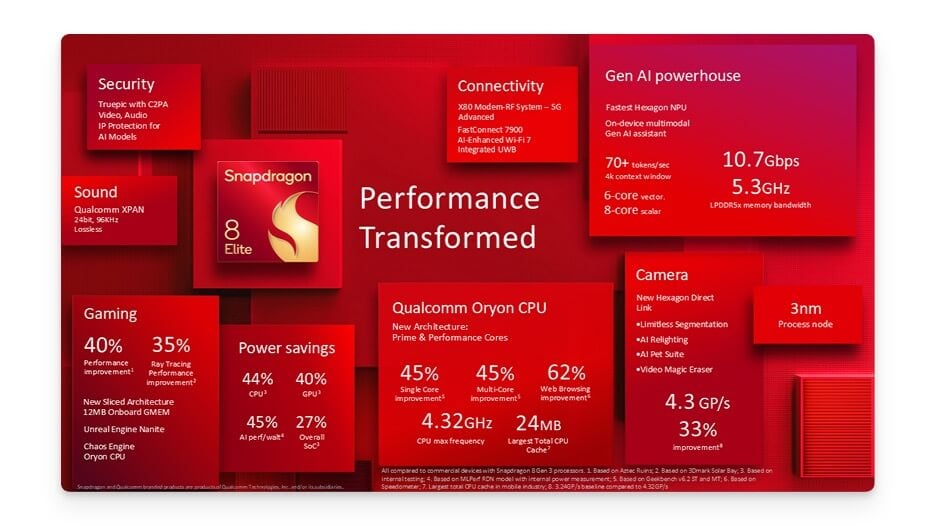
The 8 Elite is built on a 3-nanometer process. It features a new 2+6 CPU core setup versus 1+5+2 on the 8 Gen 3. It includes one prime core clocked at 4.32 GHz (compared to the Snapdragon 8 Gen 3’s 3.4 GHz), 4 performance cores at 3.53 GHz, and 4 efficiency cores.
Our phone core beats their PC chip. Lol. #SnapdragonSummit pic.twitter.com/WfmOhmdV5u
— Sascha Segan (@saschasegan) October 21, 2024
Qualcomm claims the new Snapdragon 8 Elite offers a 45% performance improvement over the previous Snapdragon 8 Gen 3 and 44% power efficiency, even mocks Intel Lunar. Qualcomm also claims it has the largest shared cache for better real-world performance.
Snapdragon 8 Elite vs 8 Gen 3 CPU comparison
Feature | Snapdragon 8 Elite (Oryon CPU) | Snapdragon 8 Gen 3 (Kryo CPU) |
|---|---|---|
CPU Architecture | Oryon CPU (custom architecture) | Kryo CPU |
Core Configuration | 2 Prime (4.32 GHz), 4 Performance (3.53 GHz) | 1 Prime (3.4 GHz), 5 Performance (3.2 GHz), 2 Efficiency (2.3 GHz) |
Maximum Clock Speed | 4.32 GHz | 3.4 GHz |
Process Technology | 3nm | 4nm |
Cache Size | Largest shared cache | Standard cache |
AI Performance Integration | 45% faster Hexagon NPU with Oryon integration | Qualcomm Hexagon NPU Gen 2 |
Snapdragon 8 Elite GPU: Sliced Design
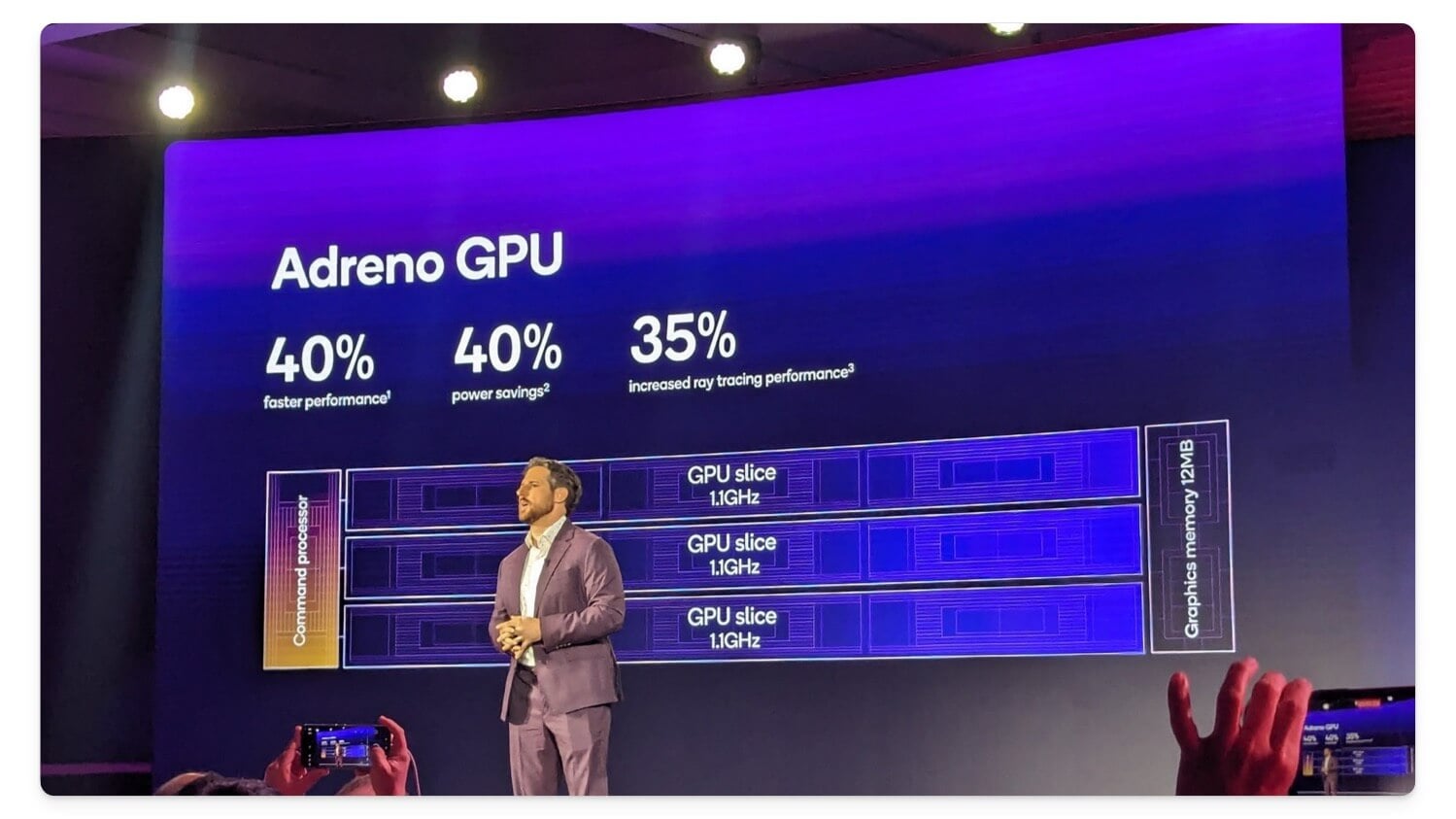
Like the CPU, the Snapdragon 8 Elite introduces a new custom Adreno GPU architecture called a sliced design. Instead of a single GPU, the new architecture divides the GPU into three slices, each with its dedicated memory, which is said to offer better performance and efficiency.
Qualcomm claims the new Adreno GPU offers up to 40% better performance than the previous generation and a power reduction of 40%. For better graphics and gaming, The 8 Elite also gets advanced hardware-accelerated ray tracing, support for the new Unreal Engine 5.0, HDR gaming support with HDR10, HDR10+, HLG, Dolby Vision, improved GSR, and now supports upscaling to 8K and more and can support up to 240 FPS on compatible displays.
Snapdragon 8 Elite vs 8 Gen 3 GPU comparison
Feature | Snapdragon 8 Elite | Snapdragon 8 Gen 3 |
|---|---|---|
Architecture | New Sliced Adreno | Standard Adreno |
Performance Boost (vs Previous Gen) | 40% | 25% |
Power Efficiency (vs Previous Gen) | 40% | 25% |
Ray Tracing | Enhanced with global illumination | Supported |
Max Frame Rate | 240 FPS (Now, Supports Frame Motion Engine 2.1) | 240 FPS |
Game Super Resolution (GSR) | 8K | 4K |
Thermal Management | Improved further | Standard |
Gaming Engine Support | Unreal Engine 5.3 | Unreal Engine 5.2 |
Snapdragon 8 Elite NPU: Hexagon NPU
Along with the CPU and the GPU, the NPU also gets a decent upgrade on the 8 Elite. The new architecture features Hexagon Direct Link between the CPU, GPU, and NPU. Qualcomm claims the new AI performance of the 8 Elite is 45% faster in AI processing than the previous generation and up to 45% more power-efficient.
Snapdragon X Elite has more AI cores leading to up to a 45% NPU boost #SnapdragonSummit pic.twitter.com/zbwWM4KSmd
— Sascha Segan (@saschasegan) October 21, 2024
Unlike the 8 Gen 3 with limits, The new Hexagon NPU on the 8 Elite now fully supports multimodal AI that supports different types of inputs, including voice, text, and images. It also enhances useful AI features such as real-time object recognition, scene detection, and AI-based image enhancements in the camera. It supports advanced functionalities like AI-powered video segmentation and AI-based noise reduction for clearer images and videos.
Snapdragon 8 Elite vs 8 Gen 3 NPU comparison
Feature | Snapdragon 8 Gen 4 (Hexagon NPU) | Snapdragon 8 Gen 3 (Hexagon NPU) |
|---|---|---|
Performance Improvement | 45% faster than Gen 3 | - |
Power Efficiency | 45% better than Gen 3 | - |
AI Model Size Support | Up to 10 billion parameters | Up to 7 billion parameters |
Precision Support | INT4, INT8, INT16, FP16 | INT8, INT16, FP16 |
Sensing Hub Micro NPUs (for always on background tasks) | 2 | 1 |
Snapdragon 8 Elite other improvements ( Display, Camera, Charging speeds)
The Snapdragon 8 Elite also brings key improvements beyond just the CPU, GPU, and NPU. It has a new AI-enhanced camera ISP, which offers more AI features and better camera enhancements. It has a new X80 5G modem, which now supports 5G mmWave and sub-6GHz with better download speeds and optimized 5G, offering better signal and coverage. It now supports Bluetooth 6.0, a new version with support for dual antennas and several enhancements in AI.

It also supports Quick Charge 5 with 100+ watts charging speeds. There is also an audio enhancement called XPAN, which supports up to 4K 60fps and Quad HD at up to 240Hz refresh rate, and an external display of up to 8K.
Additionally, there are upgrades to memory, now supporting LPDDR5x 5.3GHz up to 24GB and the same UFS 4.0 as the 8 Gen 3. It also supports triple-frequency GNSS with AI-based GNSS and better security features. Snapdragon 8 Elite devices are also expected to support ultra-wideband (UWB) wireless communication technology. Not just that, snapdragon eight allied-powered power-powered devices can get up to eight years of major OS and security upgrades.
Snapdragon 8 Elite vs 8 Gen 3 comparison
Feature | Snapdragon 8 Elite | Snapdragon 8 Gen 3 |
|---|---|---|
5G Modem | Snapdragon X80 | Snapdragon X75 |
Wi-Fi | Wi-Fi 7 (FastConnect 7900) | Wi-Fi 7 (FastConnect 7800) |
Bluetooth | Bluetooth 6.0 | Bluetooth 5.4 |
Charging Speeds | Quick Charge 5 | Quick Charge 5 |
Audio | Snapdragon Sound with XPAN | Snapdragon Sound |
Display Support | 4K at 60 Hz, QHD+ at 240 Hz | 4K at 60 Hz, QHD+ at 144 Hz |
External Display Support | 8K at 30 Hz | 8K at 30 Hz |
Memory | LPDDR5x up to 5.3 GHz, 24 GB | LPDDR5x up to 4800 MHz, 24 GB |
Storage | UFS 4.0 | UFS 4.0 |
Location Accuracy | Triple-Frequency GNSS with AI-based GNSS | Dual-Frequency GNSS |
Security | Truepic with C2PA, enhanced AI-based security | Standard biometric security |
Snapdragon 8 Elite vs. 8 Gen 3 vs. Apple A18 Benchmark Comparison
Benchmark | Snapdragon 8 Elite | Snapdragon 8 Gen 3 | Apple A18 Pro |
|---|---|---|---|
Geekbench 6 (Single-Core) | 2,845 | 2,376 | 3,358 |
Geekbench 6 (Multi-Core) | 10,628 | 7,058 | 8,974 |
AnTuTu 10 | 3,133,570 | 2,128,819 | 1,826,016 |
3DMark Wild Life Extreme | Yet to test | 5,136 | 4,574 |
Upcoming Android Flagships With Snapdragon 8 Elite
Android mobile Snapdragon 8 Elite is expected to launch within a few weeks. OnePlus has officially confirmed the launch of the OnePlus 13 with the Snapdragon 8 Elite launch event on October 31 in China. The Realme GT 7 Pro is expected to come with 8 Elite in India in November, and Asus has also announced its ROG phone 9 with Snapdragon 8 Elite.
Almost all major Android OEMs, including Samsung (rumoured to have Snapdragon 8 Elite on all Galaxy S25 series instead of Exynos). Xiaomi, Vivo, Realme, Honor, and others are expected to get Snapdragon 8 Elite processors in the coming months. Here is the list of common devices expected to come with Snapdragon 8 Elite.
- Xiaomi 15 Series (Likely to be the first device with 8 Elite)
- Oneplus 13
- Asus ROG 9
- Samsung S25
- iQOO 13
- Honor Magic 7 Series
- Realme GT 7 Pro
- and more.
Snapdragon 8 Elite: Truly Elite? Probably, Yes!
That is everything you should know about the latest Snapdragon 8. Qualcomm is going all out on its next-generation flagship processor with lots of power on board. We should see how this processor compares and performs in the real world. We don’t have to wait long this time, as upcoming devices from OnePlus, Xiaomi, and Realme with 8 Elite are set to launch next month.
As of now, with the numbers and Qualcomm’s claims, it is a huge lead for Qualcomm, betting against the longtime winner, Apple A Series. We should wait a few days and stay tuned to our site for more updates and real-world benchmarks of the Snapdragon 8 Elite in the real world. Until then, if you have any questions about the Snapdragon, comment below. I’ll try to answer them.

