

Quick Answer
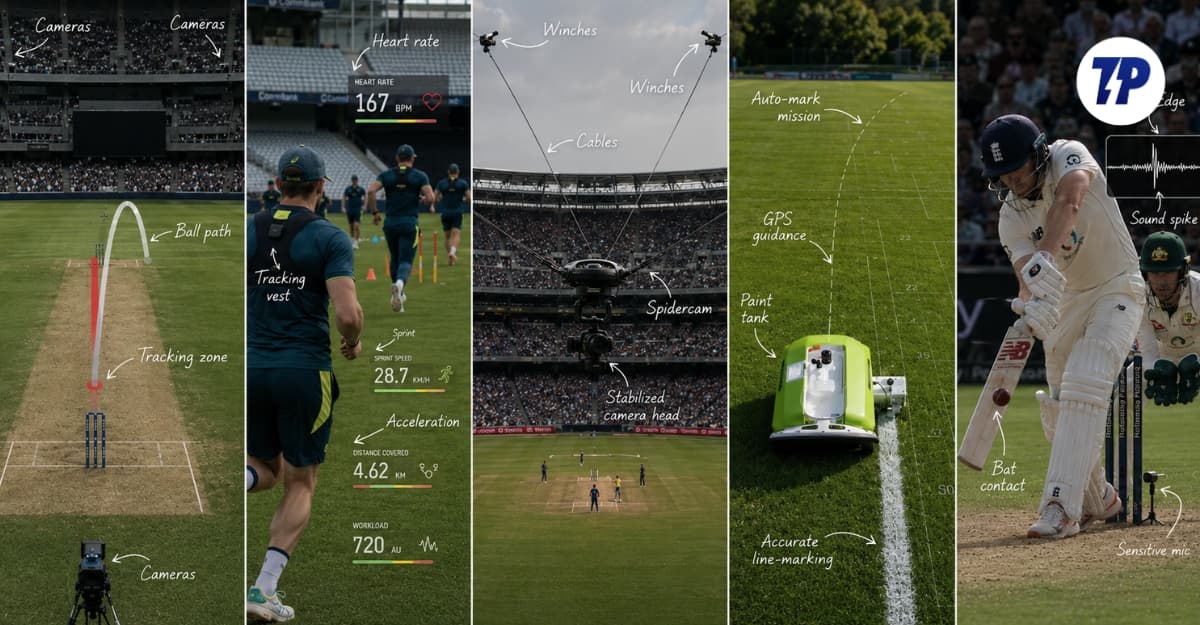
Modern sports rely on fascinating tech like ball tracking for accurate replays and decisions, player tracking wearables for fitness monitoring, Spidercam systems for cinematic shots, robotic line markers for precise field layouts, and Ultra Edge tech in cricket for detecting bat-ball contact in DRS reviews.
The amount of technology used behind every sports game is always fascinating. An audience sitting in the stands or watching digitally only sees the players on the field, but a lot of things happen behind the scenes. From broadcasting the match live with multiple cameras to instant replays and calculating player statistics in real-time, creating highly detailed tracking metrics, and much more.
I highly recommend watching the MKBHD “Behind the Sports of Golf” video. The video provides a detailed walkthrough of what happens and how much tech and planning are involved in the live telecast of golf. As always, MKBHD’s high production quality makes the video very interesting and highly recommended for anyone fascinated by what happens behind the scenes.
Watching this video gives a pretty good glimpse of what happens behind the scenes of other sports as well. Almost every modern sport uses the same level of technology; in fact, even more. If you are someone fascinated by the behind-the-scenes of tech products, this guide will cover five tech products used and how modern sports use highly advanced technology products to offer the experience that you are getting today.
Table of Contents
5 Hidden Technologies Behind Modern Sports
Ball Tracking Technology

Have you ever wondered how broadcasters instantly show a replay of a ball that shows its every path, speed, height, direction, and even the landing position? The technology behind this is called ball tracking.
Almost every sport involving balls uses this technology to determine the exact position of the ball. For instance, in cricket, ball tracking is used to find the ball position for the LBW decisions, and in tennis, it helps the umpires know where exactly the ball has landed. In football, it shows the exact ball path and offside decisions.
Ball tracking simplifies and helps to make accurate decisions. Most of the ball tracking decisions are deciding factors of the game. Imagine knowing the exact position of the ball by looking with our naked eye and even replaying it with the cameras. It’s so much harder than it looks.
The fundamental concept of ball tracking is very simple. To track the ball movement, multiple cameras and radars are placed throughout the field in different positions. These cameras and radars capture the ball’s movement and, using various software and the position of the ball from different cameras, the exact position of the ball is calculated.
This is just a high-level explanation. It requires enormous effort to implement this technology on a large scale, it involves multiple cameras, radars, and tracking systems that need to work together in real time and very fast to know the exact position of the ball.
Imagine how fast these calculations are behind the scenes, so that you can instantly see replays with exact ball tracking technology that is very accurate.
Player Tracking Technology
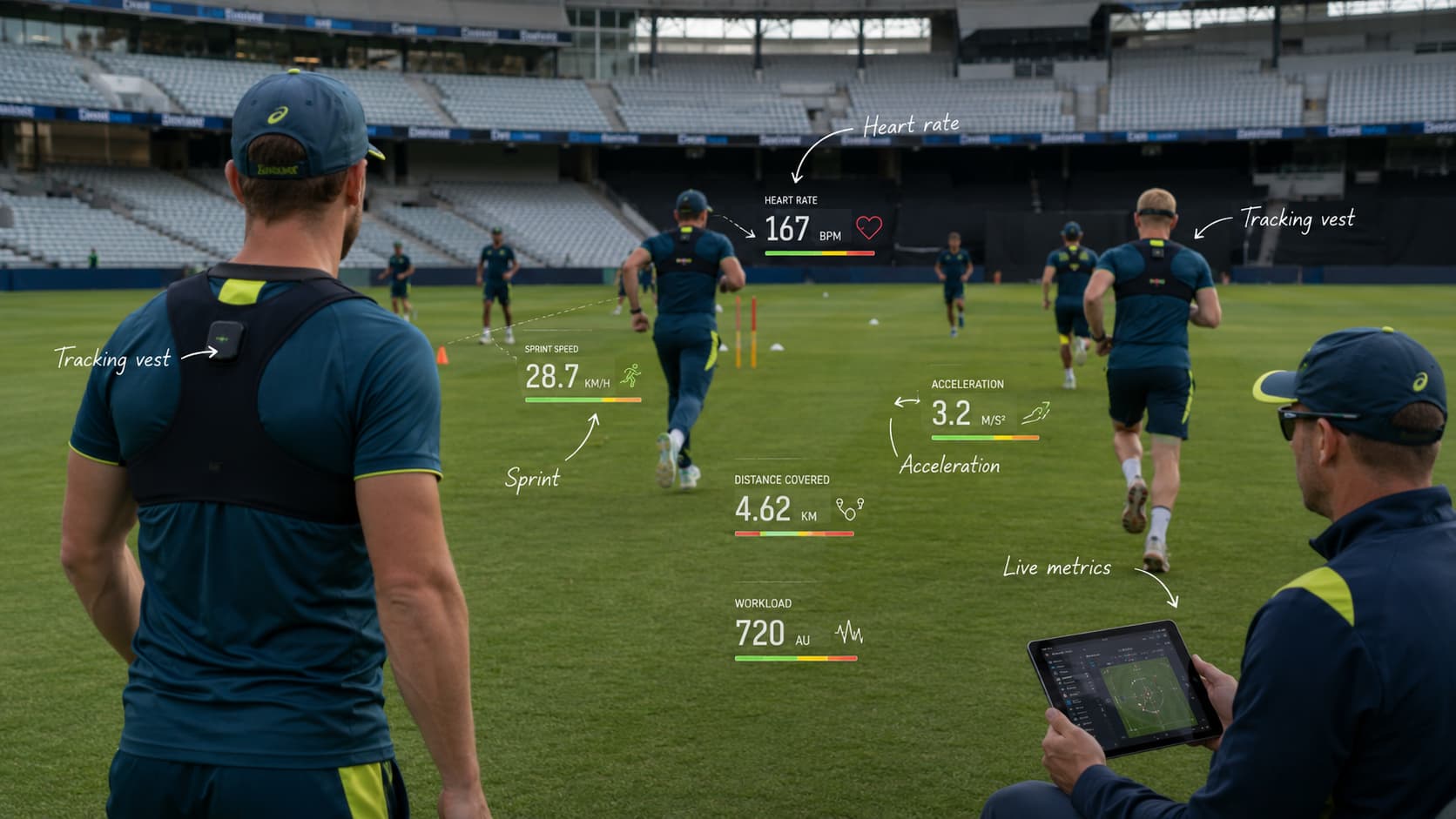
At the end of the day, every sport is a physical game that requires players to be fit and energetic, and also to avoid any unnecessary injuries. It is hard for the coaches or health monitors to look at the player and know their health status.
Many teams use advanced player health tracking tools to monitor metrics. These advanced devices track a lot of metrics, including player heart rate, sprint, acceleration, deceleration, and more. Often, these health metrics are deciding metrics for whether a player should be involved in the game or substituted for another player with better metrics.
These tracking devices come in various sizes. If you have ever been to a pre-training session in a stadium, for example, during a cricket practice session where players are usually not in their full sports attire, you can usually find these tracking devices on their bodies. These devices come in various sizes and shapes, and sometimes they are hard to even notice. And these are way more advanced than the typical personal wearables that most players often use.
Spidercam Camera Technology
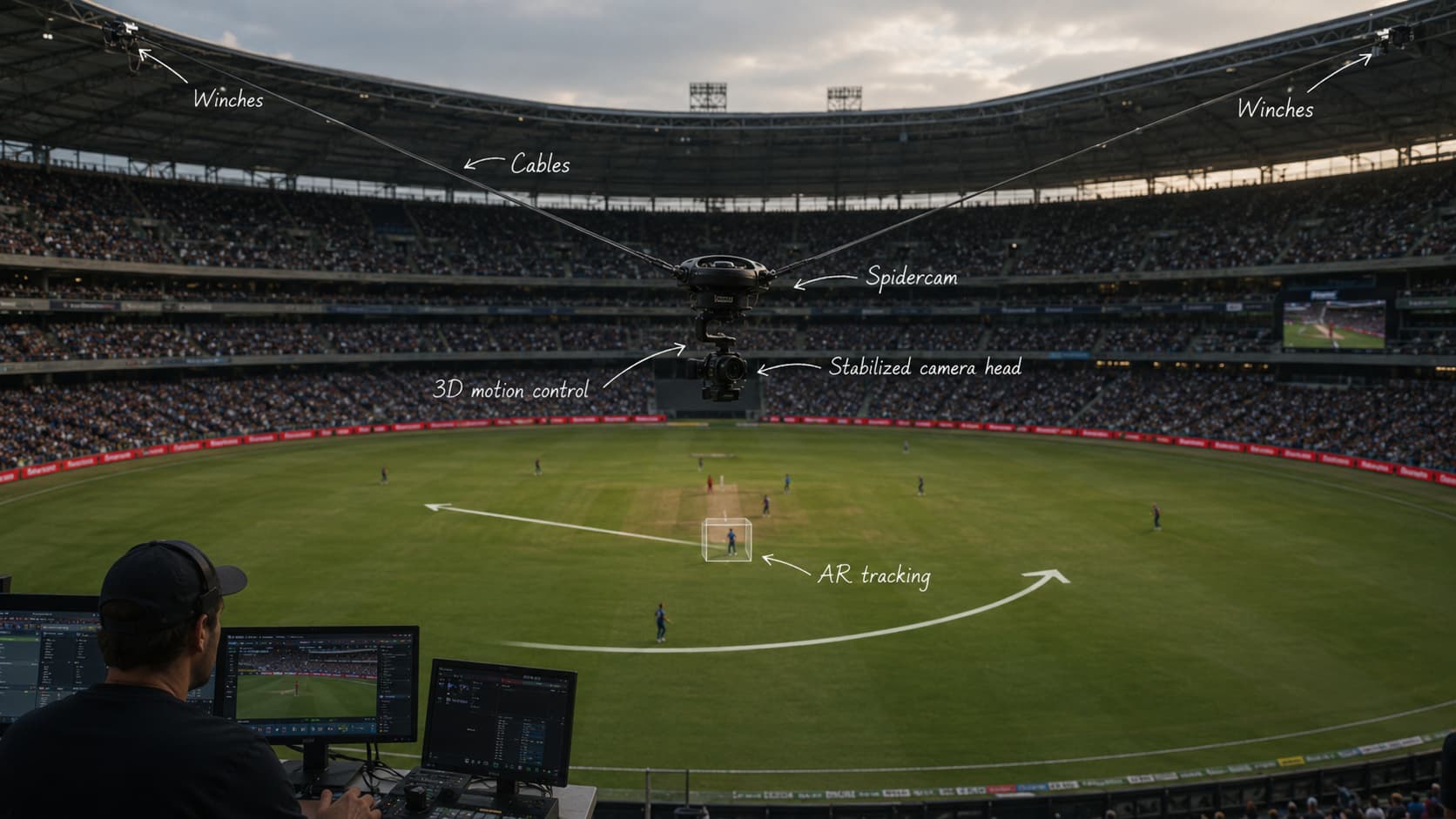
If you have been to a stadium or any major live sports event, you might have already seen a camera moving with the support of ropes. Those are the spidercams. If you have never been into stadiums, all the cinematic drone shots that you see using digital live streams probably come from the spidercams.
In sports, every moment is a celebration, and it is often hard to capture those moments with fixed cameras. On the other hand, spidercams are placed above the ground with the help of cables.
The camera moves in all directions and captures different angles. There is a lot of technology that goes behind using this camera for that smooth, cinematic output. First, for camera movement, most spidercams use winches to navigate and a 3D motion software to move the camera in different directions. These cameras are often operated by highly skilled professionals using technologically advanced software for better movements.
Many believe that we can use drones to take similar footage; however, drones often have small image sensors and are not designed for high-quality live broadcasting. Another interesting tech used in cameras is high-quality stability for a smooth image, and also AR tracking to track the movement in exact moments and follow accordingly.
Robotic Line Marking Technology
There is a lot of pre-planning that goes into every sports game. Before the game, the ground staff ensures that the ground is suitable for playing by checking whether the grass, turf, soil, wet areas, holes, loose patches, and more.
Based on the type of gameplay, they prepare the ground with proper markings that are visible to the players. In the old days, ground staff used to mark all the ground markings by manually measuring the ground in every corner and creating a plan for markings.
But thanks to technology, the process is now automated using various methods. Depending on the size of the land and the markings to make, the process often takes a lot of time. Moreover, ground staff need to ensure accuracy, making sure every line is properly aligned with the rules.
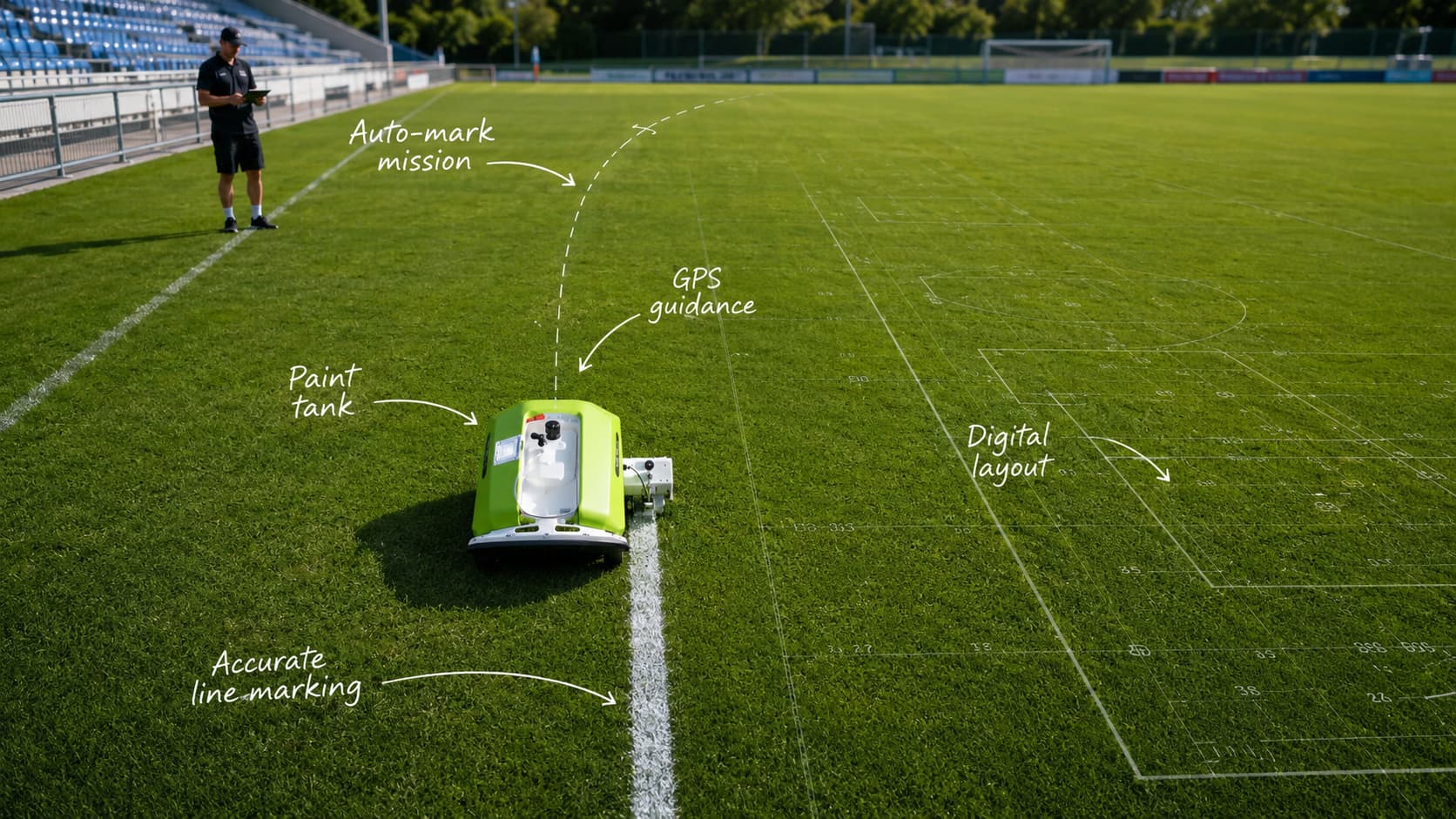
But that is simplified using a robotic line marker, where these machines automatically draw the markings depending on the pre-digital layout.
Simply, users can select the digital layout, mark it, and fill in the paint. The robots will do the rest for you, saving a significant amount of time.
Moreover, the robotic line marker makes the marks, which are very accurate based on the GPS map layout. Obviously, another benefit is that this system uses less paint compared to humans and is very accurate. Additionally, unlike most other technologies that are often used by highly broadcast events, these field markers are also available for purchase for regular users.
Ultra Edge Technology
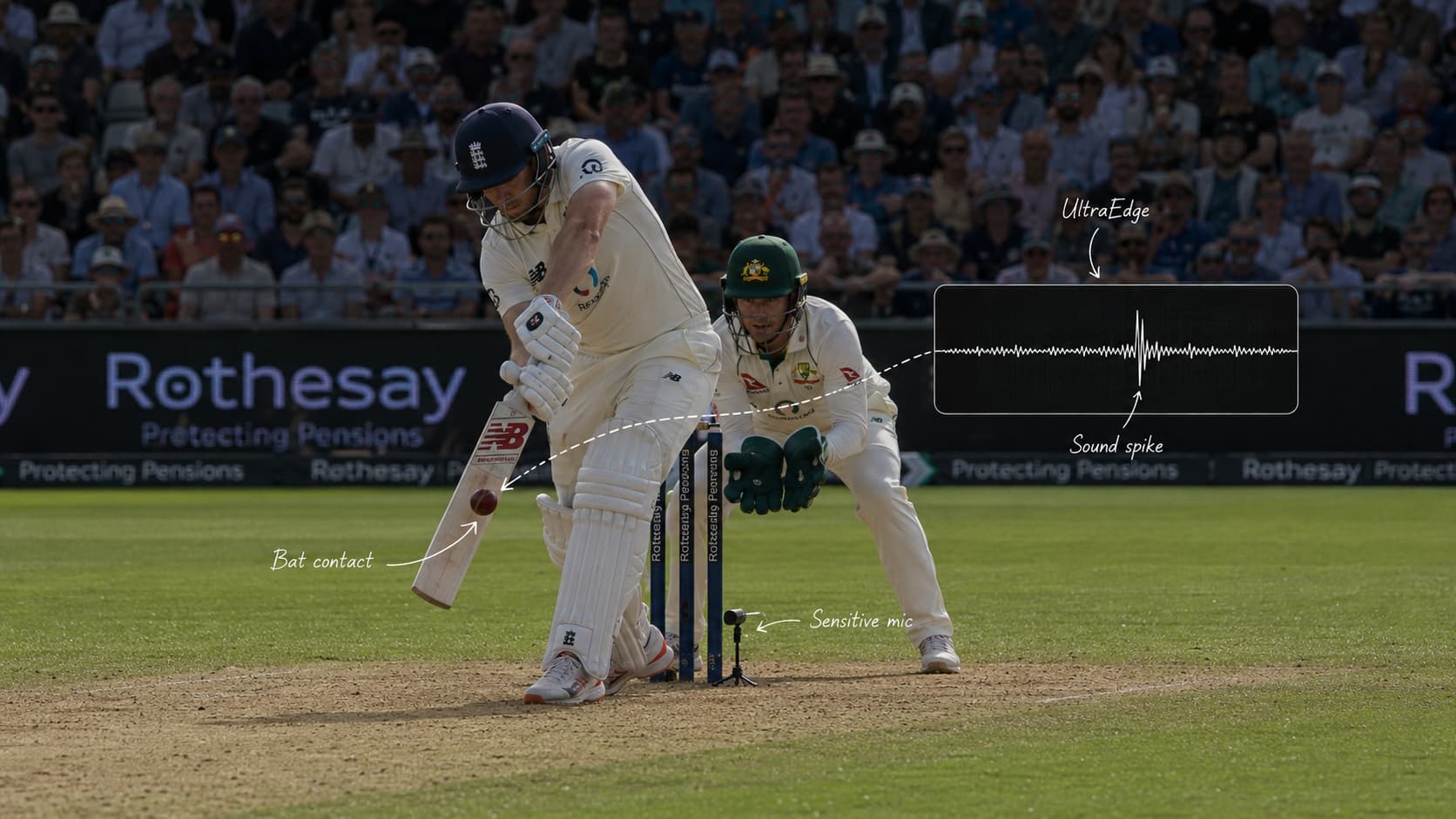
Ultra Edge is also one of the most popular and recently emerged technologies in cricket. It lets the umpires view whether the ball touched the bat or not. It is mostly used in DRS reviews, where the third umpire reviews whether the ball has touched the bat or not.
The technology behind Ultra Edge is simple. A microphone is placed behind the stumps, which captures sound when the ball touches the bat. These mics are designed to capture exactly the bat and ball sounds by removing all other unwanted noises. Advanced algorithms are used to strip out the unwanted noise and only capture the sound of the bat and ball.
During the review, the third umpire compares the sound wave and the moment of the ball and matches the position of the sound and the ball, and determines whether the ball touched the bat or not. This is also one of the most accurate ways to decide and know whether the ball touched the bat or not.
In most cases, another technology called Hot Spot is also used to determine whether the bat made contact with the ball. For this, infrared cameras are used to get the heatmap. If the ball made contact with the bat, heat is generated so that umpires can decide whether the ball actually interacted with the bat.

When the ball touches the bat, it creates a small distortion, a heat wave, which is captured by the infrared cameras. This usually appears as a white spot during reviews.
The Hidden Technology Behind Modern Sports
Those are the five different technologies that are popular and very fascinating in modern sports games. Although the ideas behind some of these technologies are simple, implementing them on a large scale is one of the toughest jobs. Nevertheless, they are used in real games that every one of us watches today.

