

In Summary
- The Snapdragon 8 Elite, with its custom Oryon cores (2+6), outperforms the Dimensity 9400 in Geekbench and AnTuTu benchmarks.
- Both chips offer similar GPU performance and enhanced NPU capabilities for on-device AI models.
- Brands like Samsung, OnePlus, and Realme will soon release Snapdragon 8 Elite-powered phones, while the Vivo X200 will debut the Dimensity 9400.
Qualcomm has been leading the mobile processor market for some years, and with the Snapdragon 8 Elite, it might remain the leader. On the other side, MediaTek has been growing in number, and more than ever, smartphone OEMs have been using this chipset to compete against Snapdragon at the flagship level.
In recent years, companies have also announced their flagship smartphones with the high-end MediaTek series processors. If you are looking for a flagship smartphone in 2024 or 2025, you will most likely see smartphones powered by the Snapdragon 8 Elite or the MediaTek Dimensity 9400, flagship processors from these two companies. In this post, I will compare these two processors, and let’s see which one is right for you.
Table of Contents
Snapdragon 8 Elite vs MediaTek Dimensity 9400: CPU
Feature | Snapdragon 8 Elite | MediaTek Dimensity 9400 |
|---|---|---|
Core Architecture | Qualcomm Oryon custom architecture (not Kryo) | ARM Design |
Core Configuration | 2 Prime core @ 4.32 GHz, 6 Performance clocked at 3.53 GHz | 1 Cortex-X925 @ 3.63 GHz, 3 Cortex-X4 cores, 4 Cortex-A720 cores |
Process Node | 3nm | 3nm |
Cache Size | Large cache | 12MB L3 cache |
Max Clock Speed | Up to 4.32 GHz | Up to 3.63 GHz |
Both of these processors have different architectures. Qualcomm has ditched the ARM architecture ARM design in its latest Snapdragon 8 Elite and used its own custom-built and Gen Oryon cores, creating a significant difference in the architecture of both processors.
On the other hand, MediaTek uses an All Big-Core ARM architecture, with high-end Arm Cortex-X925 CPU cores designed for high-end performance in the MediaTek processor. As for the cores, the 8 Elite has a new 2+6 configuration with one prime core clocked at a maximum of 4.3 GHz and six performance cores.
Meanwhile, the MediaTek Dimensity 9400 comes with a 1+3+4 architecture where the prime core is clocked at a maximum of 3.63 GHz, using the latest high-end ARM Cortex X925 architecture, along with three performance cores and four efficiency cores. Both processors are built with 3nm TSMC processes.
Both processors are new to the market, and we don’t have real-world performance data yet. Smartphones with these processors are expected to arrive in the next few weeks. Here are the leaked benchmark scores and how they compare to benchmarks.

As per the Geekbench scores shared by Geekerwan, Snapdragon 8 Elite leads in both single-core and multi-core tests, while MediaTek Dimensity 9400 is slightly behind the 8 Elite, with a single-core benchmark score of 2809 and a multi-core benchmark score of 8847 compared to Snapdragon’s single-core score of 3216 and multi-core score of 10,051.
Snapdragon 8 Elite scores the highest in multi-core performance, but its single-core performance is lower than Apple’s latest A18 Pro processor, which leads with 3509 points. As per the tests, MediaTek Dimensity 9400 scores 9003 points in multi-core and 3010 points in single-core, which is behind both Snapdragon 8 Elite and Apple A18 Pro.
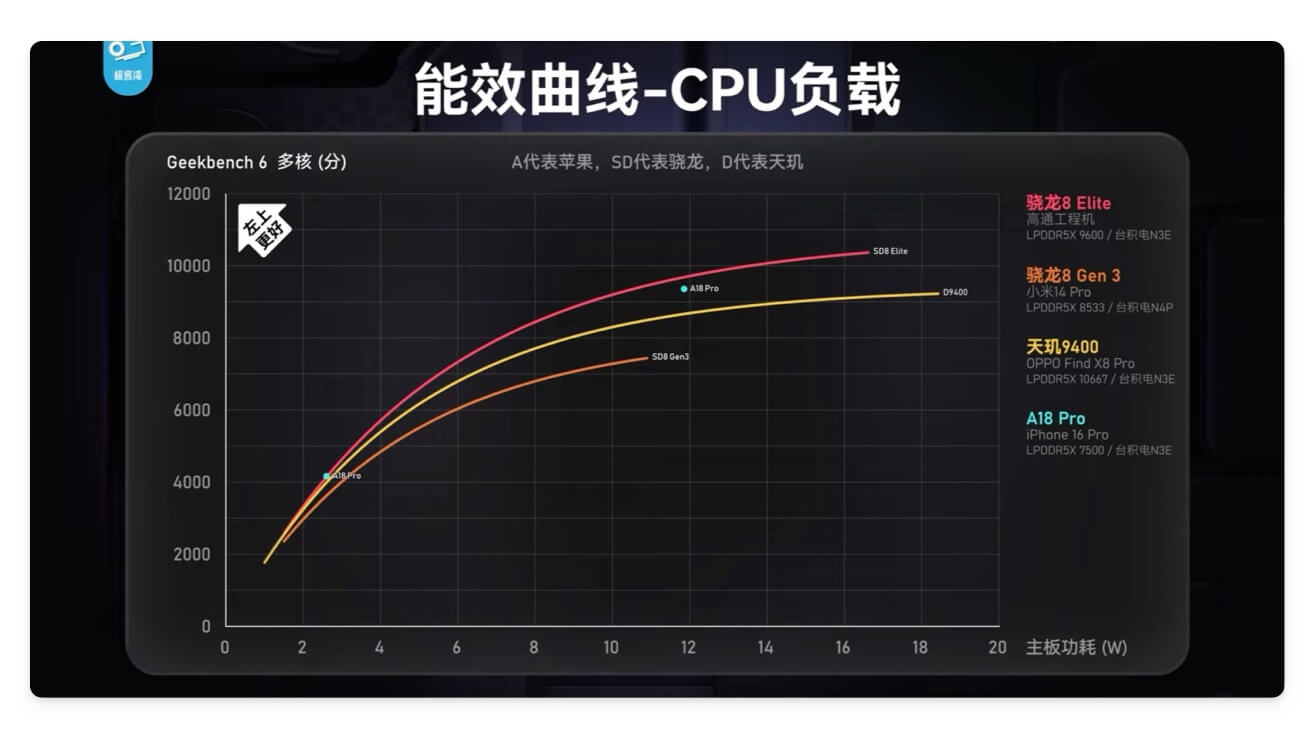
According to the power efficiency graph, the Snapdragon 8 Elite beats the Dimensity 9400 in terms of power efficiency. As per the graph, at 12W power, the Snapdragon 8 scores a Geekbench score of around 10,500 in multi-core, while the Dimensity 9400 scores about 8500 at the same power. This means that the Snapdragon 8 delivers 24% higher performance than the Dimensity 9400.
In terms of scalability, if you look at the graph of the Snapdragon 8 Elite, power consumption from 6W to 12W has increased performance by 70%. In contrast, the performance increase on the Dimensity 9400 is about 55%. This indicates that the Snapdragon 8 Elite is 15% more efficient in performance scaling than the Dimensity 9400.
In low-power mode, as per the graph at 6W, the Snapdragon 8 Elite scores 6000 points in Geekbench, while the Dimensity 9400 scores about 4800, which translates to a 25% better score for the Snapdragon 8 Elite. This is also the case in peak performance, where at 20W, the Snapdragon scores 11,000 while the Dimensity has over 9400, making the Snapdragon 8 Elite approximately 17% better.
These results show that the Snapdragon 8 Elite outperforms the Dimensity 9400 at every stage, indicating that the 8 Elite is more efficient than the MediaTek Dimensity 9400, according to the numbers shared by Geekbench.
In AnTuTu scores, both processors scored around 3 million, with Snapdragon 8 Elite beating MediaTek with a slightly better score of 3115282, whereas MediaTek scored 3007853.
However, in some tests that include single-core score per GHz, Dimensity 9400 is ahead of Snapdragon 8 Elite. Nonetheless, both have powerful CPUs and drastically improved performance. Based on the numbers, both processors seem to have the best performance. We should know how these perform in the real world soon.

Snapdragon 8 Elite vs MediaTek Dimensity 9400: GPU
Feature | Snapdragon 8 Elite | MediaTek Dimensity 9400 |
|---|---|---|
GPU Model | Adreno with sliced architecture | ARM Immortalis-G925 MC12 |
Ray Tracing | Yes, hardware-accelerated | Yes, hardware-accelerated |
Process Node | 3nm | 3nm |
Max Display Resolution | 4K @ 60Hz | 8K @ 60Hz |
Both processors use different GPU architectures. Qualcomm has been leading in terms of GPU performance, even beating Apple for the past two generations, and with the Snapdragon 8 Elite, it continues to do so. Meanwhile, MediaTek’s Dimensity scores well, translating to strong real-life performance for both. These processors are more powerful than ever, offering similar graphical performance.
Regarding GPU architecture, the Snapdragon 8 Elite uses the Adreno 830 with a slicing architecture, while the Dimensity 9400 uses the ARM Immortalis G920 5M12. Both processors support hardware-accelerated ray tracing.
In the Snapdragon 8 Elite, Qualcomm has used a new slicing architecture with the Adreno 830 GPU, which can potentially bring more power and perform better than the Dimensity 9400. While we don’t have real-world data yet, the preliminary results show that they perform well with similar performance levels.
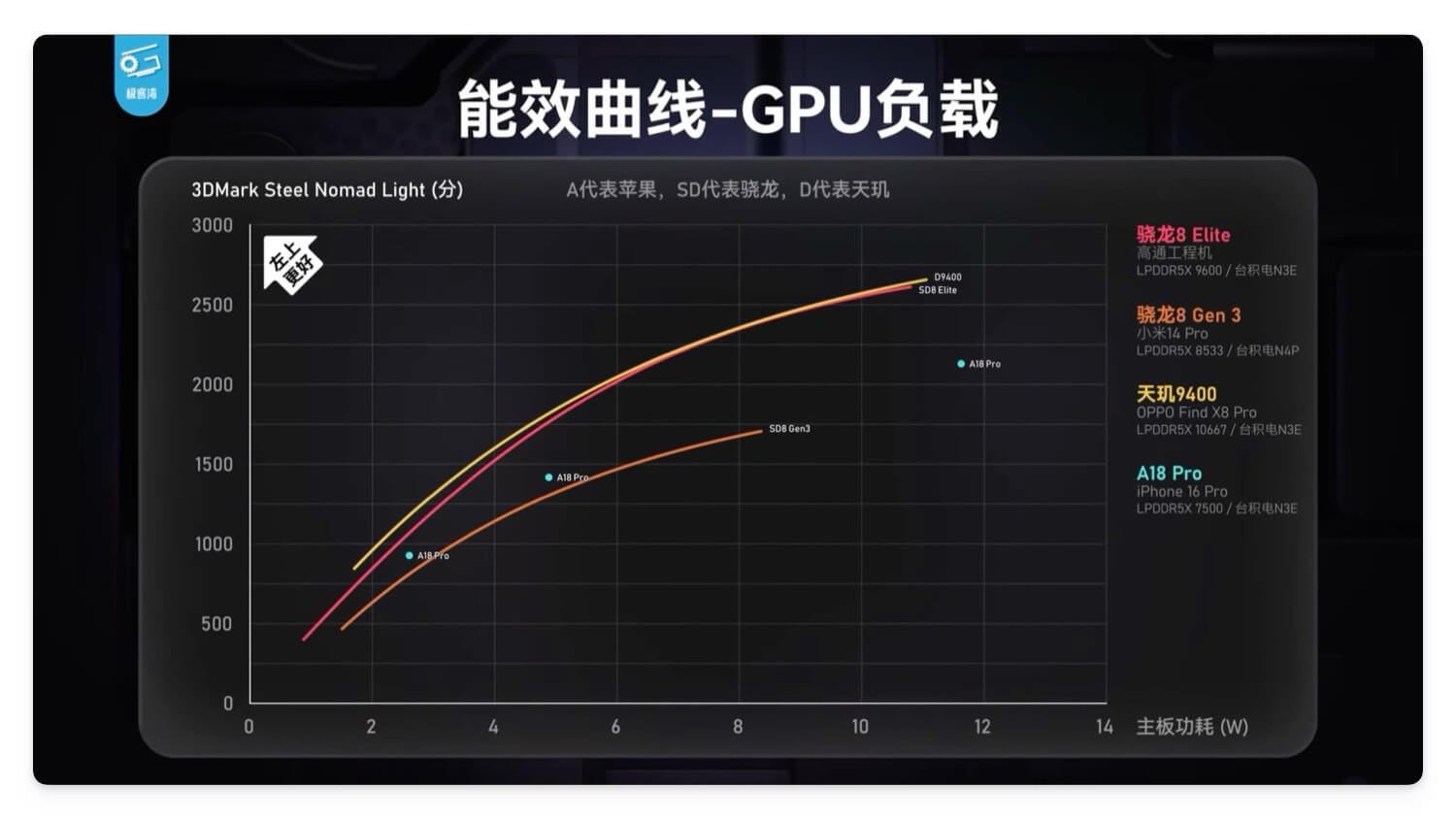
As per the graph of power-efficient charts, considering the power of 6W, the Snapdragon 8 Elite reaches a score of 2200, while the Dimensity 9400 scores around 2100, showing a close performance at this power level.
At peak performance, around 10W, the Snapdragon and Dimensity 9400 are similar, with a slight edge for the Snapdragon 8 Elite in some instances. Regarding scaling, the Snapdragon’s performance nearly doubles if we consider the power rising from 6W to 12W. In contrast, the Dimensity’s performance is slightly less, indicating that Snapdragon has a better efficiency edge.
Regarding both GPU and CPU at high performance, the Dimensity 9400 slightly beats the Snapdragon 8 Elite with better scores in some tests. However, in real-world usage, both processors are expected to perform similarly.
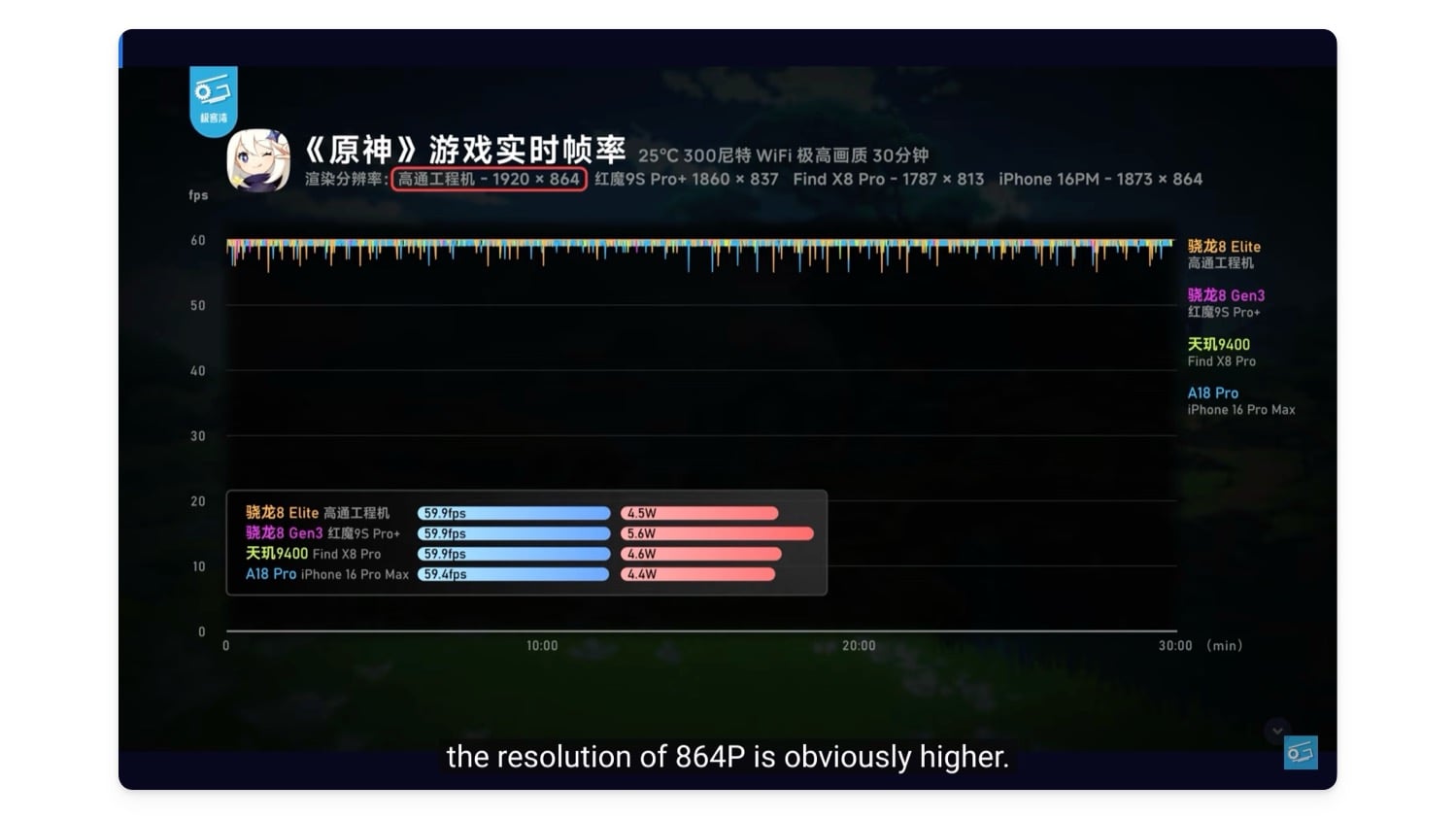
This translates to real-world performance on both the Snapdragon 8 and Dimensity 9400. Based on Genshin Impact’s gaming performance, Snapdragon is slightly better, with a 2.2% advantage over Dimensity 9400. Both processors deliver the same frame rate of 59.9 FPS, with the Snapdragon using 4.5W of power on average, while the Dimensity 9400 consumes slightly more power at 4.66W for the same frame rate. Both smartphones consistently maintain a steady frame rate of 59.9 FPS, making them powerful for gaming.

On the other hand, in another test with Hong Kong AI Star Royale, the Dimensity 9400 is slightly more power-efficient than the Snapdragon 8 Elite. Both processors achieve an average frame rate of 59.6 FPS, but the Snapdragon 8 Elite consumes an average of 6.2W, while the Dimensity 9400 uses slightly less power at 6.0W.
Snapdragon 8 Elite vs MediaTek Dimensity 9400: NPU
Feature | Snapdragon 8 Elite | MediaTek Dimensity 9400 |
|---|---|---|
Manufacturing Process | TSMC 3nm | TSMC 3nm |
Memory Support | Up to 24GB LPDDR5x @ 8533 MHz | Up to 24GB LPDDR5x @ 5333 MHz |
Storage | UFS 4.0 | UFS 4.0 |
Camera ISP | Triple 18-bit, up to 200MP | AI-powered, up to 320MP |
Video Capture | 8K HDR @ 30 fps, 4K @ 120 fps | 8K @ 60 fps, 4K @ 120 fps |
5G Modem | Snapdragon X80, up to 10 Gbps | Integrated 5G modem, up to 7 Gbps |
Connectivity | Wi-Fi 7, Bluetooth 5.4, satellite support | Wi-Fi 7, Bluetooth 5.4 |
Audio | Snapdragon Sound, aptX Lossless | AI-enhanced audio |
Display Support | QHD+ @ 144Hz, 8K @ 60Hz external | 8K @ 60Hz |
Thermal Management | Higher heat under sustained load | Better sustained performance |
Security | Secure Processing Unit (SPU) | Biometric and AI-based security |
Since the AI era surrounding us, NPU has become a main component of modern chips. The Snapdragon 8 Elite and MediaTek Dimensity 9400 have improved NPUs than their predecessors. Both processors allow devices to run on-device multimodal AI tasks with better performance and lower power consumption.
Qualcomm uses the latest Hexagon NPU, which combines CPU, GPU, and NPU to perform tasks collaboratively. It can deliver up to 45% faster AI processing than the previous 8 Gen 3. In contrast, MediaTek uses a new NPU architecture, which is said to be 80% faster than the previous generation Dimensity 9300.
Both processors can run large language models locally on devices for AI performance. Qualcomm has a dual-channel LPDDR5X memory running at 5.3 GHz, providing better bandwidth for intensive AI tasks. At the same time, the Dimensity 9400 has also been proven to be faster and more reliable in complex AI tasks, especially in video generation, real-time translation, and voice assistance.
Both processors also come with improved power efficiency. Qualcomm’s latest Hexagon NPU is set to be the most powerful and combines the components of CPU, GPU, and NPU for specific tasks, potentially offering better performance. On the other hand, the MediaTek NPU claims a 30% improvement in power efficiency over its predecessor.
Both processors support image generation and camera enhancement features. The Snapdragon has the latest AI signal processor that supports real-time features like object recognition, automatic detection, video eraser, AI-based noise reduction, and more.
The Dimensity 9400 also offers on-device features for image generation, better translation, and photography enhancements like AI-based HDR and real-time zoom. While these processors can perform AI features on-device, the devices should include these on-device AI capabilities to utilize their power better.
Snapdragon 8 Elite vs MediaTek Dimensity 9400: Display, Connectivity and More
Beyond the CPU, both processors have improved specifications for other important components like memory, storage, camera, connectivity, audio, and more. Starting with the Snapdragon 8 Elite, it supports up to 24GB LPDDR5X RAM with speeds up to 8533 MHz and UFS 4.0 storage.
For comparison, MediaTek Dimensity 9400 also supports up to 24GB LPDDR5X memory, but the maximum speed is 5333 MHz, which is lower than the 8 Elite. It also supports UFS 4.0 storage.
In terms of camera and ISP, the Snapdragon 8 Elite features a triple 18-bit Spectra ISP, which can support up to a 200-megapixel camera resolution and is capable of recording 8K HDR videos at 30 frames per second and 4K at 120 frames per second. It also comes with local on-device AI features, multi-frame noise reduction, real-time bokeh, and a video eraser in the camera functions.
On the other hand, MediaTek Dimensity 9400 also has an AI-powered image ISP, which can support up to 320-megapixel resolution and offer 8K video capture at 60 frames per second and 4K at 120 frames per second. The Dimensity 9400 has advanced HDR capabilities and AI-based enhancements for low-light photography.
As per the connectivity, Qualcomm’s Snapdragon 8 Elite has the new Snapdragon X80 modem, which can offer speeds up to 10 Gbps and supports mmWave and sub-6GHz 5G, as well as Bluetooth 6.0 and satellite communication. On the other hand, MediaTek Dimensity 9400 features a 5G modem that supports mmWave and has a maximum speed of up to 7 Gbps, with support for Wi-Fi 7 and Bluetooth 5.4, but it does not support satellite communication.
Regarding audio and multimedia capabilities, the Snapdragon 8 Elite comes with Snapdragon Sound, which offers the highest resolution audio, supports various audio codecs, and supports Qualcomm aptX lossless audio. On the other hand, Dimensity 9400 lacks some audio features, particularly lossless quality.
Regarding display support, Qualcomm’s Snapdragon 8 Elite can support up to Quad HD+ resolution at 144 Hz refresh rate and external displays up to 8K 60 Hz. The Dimensity 9400 supports 8K resolution at 60 Hz for external displays and a maximum resolution of Quad HD+ at 180 Hz.
Snapdragon 8 Elite vs Dimensity 9400: Benchmarks
Benchmark/Test | Snapdragon 8 Elite | MediaTek Dimensity 9400 |
|---|---|---|
AnTuTu v10 Overall Score | 3,025,991 | 2,997,173 |
AnTuTu CPU Score | 680,996 | 653,650 |
AnTuTu GPU Score | 1,252,847 | 1,320,821 |
AnTuTu Memory Score | 611,307 | 518,304 |
Geekbench 6 Single-Core Score | 3,234 | 2,874 |
Geekbench 6 Multi-Core Score | 10,059 | 8,969 |
3DMark GPU Score (Nomad Light) | ~2200 | ~2100 |
Gaming Performance (Genshin Impact, avg FPS) | 59.9 FPS | 59.9 FPS |
Gaming Power Consumption (Genshin Impact, avg W) | 4.5W | 4.6W |
Final Thoughts: Which Chip Should You Pick?
The tests and real-world performance numbers show that the Snapdragon 8 Elite is slightly better. If you are looking for top-tier performance, the Snapdragon 8 Elite is the best option with better CPU, GPU, and power efficiency. However, these differences are minor and don’t make a noticeable impact in real-world use. MediaTek performs very close to the 8 Elite in many areas, and both processors have strong performance.
MediaTek processors are generally available at a lower price point than the Snapdragon 8 Elite. This makes MediaTek processors more affordable while offering the same top-tier performance similar to the Snapdragon 8 Elite. If you are in the market for the best performance and gaming and use Custom ROMs, the Snapdragon 8 Elite is the best. However, if you want an affordable option with similar performance to the Snapdragon 8 Elite, the MediaTek Dimensity 9400 is the best choice.
Category | Snapdragon 8 Elite | MediaTek Dimensity 9400 |
|---|---|---|
Overall Performance | Slightly offers better performance than MediaTek | Powerful, but slightly behind 8 Elite |
CPU Performance | Better Geekbench single-core and multi-core | Good multi-core, lower single-core scores |
GPU Performance | Strong GPU performance, leads in 3DMark scores | Higher GPU scores in AnTuTu |
Power Efficiency | Better efficiency at various power levels | Slightly higher power usage in some tasks |
AI | Supports on Device AI features. | Supports on-device AI features. |
Gaming Experience | Offer best gaming performance | Offers very similar gaming performance and better in few cases. |
Price Consideration | Pricing depends on smartphone brands | Affordable than 8 Elite, also pricing depends on smartphone brands |
FAQs about Snapdragon 8 Elite vs MediaTek Dimensity 9400
Does the difference in benchmark scores between the Snapdragon 8 Elite and Dimensity 9400 significantly impact everyday smartphone usage?
Benchmarks are an easy way to differentiate the performance of these processors, but they are not the only parameters that can be considered. Factors like overheating, throttling, heat generation, and more will also play a key role in differentiating them in real-world performance. Currently, these benchmarks can give us an idea of what to expect. In this case, the Dimensity 9400 is slightly behind Snapdragon 8 Elite, which means in real-world use, you might not notice any significant difference between them.
Which processor handles heat better during intensive tasks, and does one throttle performance more than the other?<
Snapdragon 8 Elite handles heat slightly better compared to Dimensity 9400. However, we should wait for real-world tests to determine which processor generates less heat. Both processors have a history of thermal throttling under certain conditions, so we should see how they perform, as both are built by TSMC's 3nm process. Hopefully, neither will throttle significantly. We should wait for the results to know more.

