

In Summary
Snapdragon processor naming convictions have become a lot more confusing recently, especially with the Snapdragon 7 series with new sub-variants. To summarize, we have three categories in the Snapdragon 7 series: the top variant (Plus), the standard, and the S model, which is a toned-down version of the standard one. The Snapdragon 7+ Gen 3 is the most powerful, and the Snapdragon 7 Gen 3 is the most used. Simply put, 7+ Gen 3>7+Gen 2>7 Gen 3>7 Gen 1> 7s Gen 3>7s Gen 2
Snapdragon 7 Series processors naming conventions, especially with the new sub-variants, have become a lot more confusing recently. Even as a reviewer, it was quite challenging for me to differentiate between processors. With more mid-range smartphones featuring Snapdragon 7 series processors, it can be overwhelming for users to decide which one to pick and which processor offers better performance.

Understanding this problem, I have compared all the current and recently announced Snapdragon 7 Gen processors to help you choose the right one for your needs. In this guide, you will learn about the naming conventions of the Snapdragon 7 series, learn more about each variant and benchmarks, and finally, decide which one to pick.
Table of Contents
Understanding Snapdragon 7 Series Naming Conventions
Before diving into the Snapdragon 7 series, let’s first understand overall Qualcomm’s naming convention.
There are four different tiers in the Snapdragon processor lineup:
- Snapdragon 8 Gen series: Flagship and Premium Tier
- Snapdragon 7 Gen series: Mid-Range Tier
- Snapdragon 6 Gen series: Lower Mid-Range Tier
- Snapdragon 4 Gen series: Entry Level
- Plus Variant: This is an overclocked version of the standard variant with higher performance. These are more powerful than the standard variant. Sometimes, there is a difference in core configuration between the standard and Plus variant. (as seen in the 7 series). In contrast, other times, the difference is just an increase in clock speed, typically found in the 8 series.
- Standard Variant: These typically don’t have naming extensions and represent the main version of the processor.
- S Variant: This is the toned-down version of the standard variant. It might use different cores and a different GPU altogether, making it less powerful than the standard variant.
The 7 Gen Series is more confusing, especially with so many variants announced in recent times. Similar to other series, we have three different categories in Snapdragon 7 Gen. The “Plus” variant for powerful performance. The “Standard” variant is built for balanced performance. Finally, the “S” variant, the lower tier designed for efficiency and better battery life.
A big MYSTERY solved!#snapdragon pic.twitter.com/lOXZY4If2K
— Pratik Rai (@praaatiiik) July 30, 2024
Here is the naming convention breakdown of Snapdragon 7+ Gen 3. The “7” refers to the series, Gen refers to the generation, and the number 3 refers to the generation of the Snapdragon series.

With that understanding, let’s dive into each processor in detail to help you understand how they are built and what they offer.
Basics: Understanding Key Processor Factors
Before diving into the Snapdragon 7 series, here are a few things about mobile processors to understand more about their performance. If you are already familiar with the terms, you can skip to the next section.
Let’s begin with the Processor architecture. Architecture refers to how a processor is built. One important aspect to consider when choosing a processor is the number of Cores on the processor. The Core is an individual processing unit within the CPU. Generally, a processor has multiple Cores designed for different tasks. More cores typically mean better performance and multitasking capabilities, but adding more cores doesn’t always mean better performance. The core implementation depends on the overall processor’s architecture.
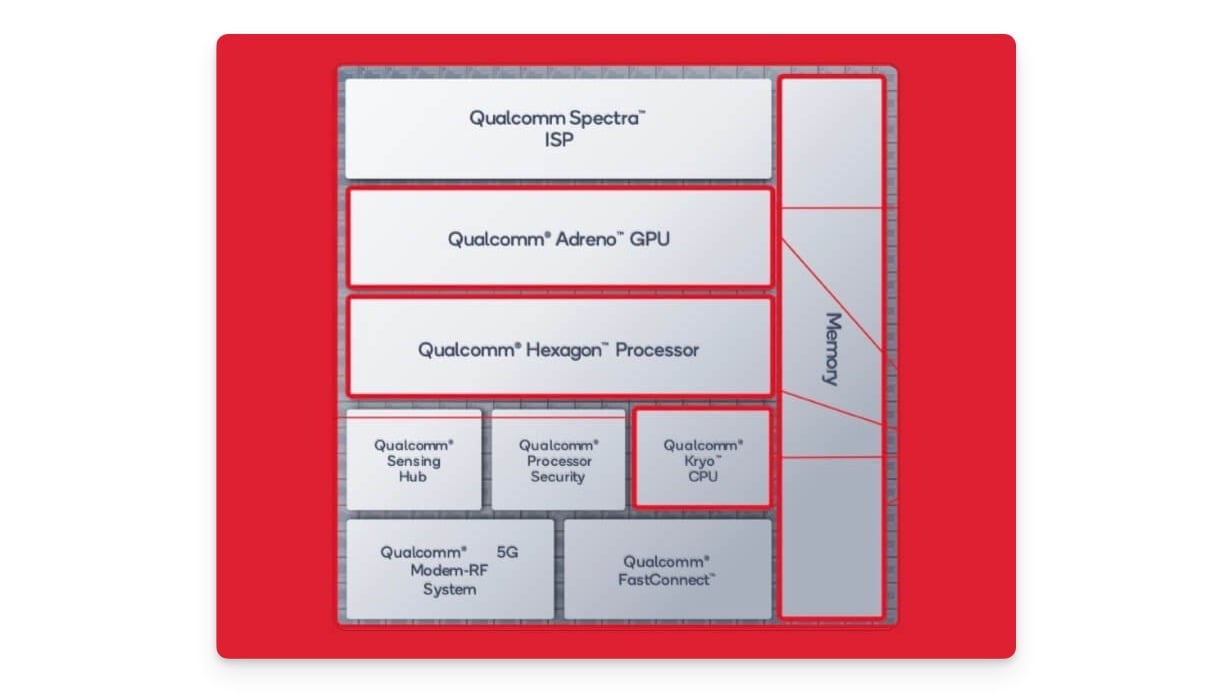
Most mobile processors, including those from Snapdragon, generally feature a minimum of four or a maximum of eight cores. Basic processors often have four cores, mid-range models; usually 7 series processors, have six to eight, and high-end flagships typically come with eight cores.
Again, These cores are often divided into different types based on performance needs. For example, in Snapdragon processors, the Kryo Prime Core is typically the highest-performing core, often using Cortex-X architecture. This core provides the most power and is usually a single core in the setup.
Next are the Kryo Gold Cores, often based on Cortex-A7X series architecture. These cores offer strong performance, focusing on everyday tasks. They perform well but are not as powerful as the Prime core. Finally, there are the Kryo Silver Cores, usually based on Cortex-A5X series architecture. These cores focus on power efficiency and handling less demanding tasks.
Another important term to understand is the clock speed of each Core. Clock speed is measured in Gigahertz (GHz), which indicates how many cycles a Core can perform per second. Higher clock speeds generally mean better performance but also higher power consumption. High-performance cores usually have higher clock speeds for demanding tasks, while the other cores have lower clock speeds for less demanding tasks to save power.
After the CPU, another important component to consider is the GPU (Graphics Processing Unit). The GPU is responsible for gaming and graphical tasks on your smartphone. Generally, a higher GPU model number indicates better graphics performance. For example, a GPU like the Adreno 750 will perform better than the Adreno 730.
Another important factor is processor manufacturing technology. It is measured in nanometers. Smaller nanometer values (ex, 6nm, 4nm) are better because they indicate more advanced and efficient technology. Most processors currently use 4-nanometer technology. Also, understanding who manufactured the processor is important. For Qualcomm, we have TSMC and Samsung. Processors built by Samsung tend to generate more heat, which is evident in almost all the devices we’ve tested, so this is something to keep in mind.
Additionally, it is also essential to consider the type of 5G modem used. Generally, higher numbers indicate better performance. Also, consider other connectivity options, such as how many displays the processor supports and whether it includes the latest technologies like 5G and Wi-Fi 6 or 7.
With all these factors in mind, you can choose the best processor. So, let’s dive into the Snapdragon 7 series and determine which is best for you.
Overview of Snapdragon 7 Gen Processors
Snapdragon 7+ Gen 3
The Snapdragon 7+ Gen 3 is the top variant in the Snapdragon 7 series and is currently the most powerful processor in the 7 Gen tier. It belongs to the “Plus” subcategory and comes with one Cortex-X2 Prime core clocked at 2.91 GHz, three Cortex-A710 performance cores clocked at 2.49 GHz, and four Cortex-A510 efficiency cores clocked at 1.9 GHz. It is built using TSMC’s 4-nanometer process. As for the GPU, it features the Adreno 750 GPU and uses the Snapdragon X65 5G modem.
I have used this processor on the Realme GT 6T, and the performance is close to the flagship level and very similar to the Snapdragon 8s Gen 3 present on the Poco F6. It uses Cortex-X2 and A710 cores, similar to flagship processors like the Snapdragon 8 Gen 1. Smartphones using the Snapdragon 7+ Gen 1 are generally priced at around 28,000. If you’re looking for top-tier performance with near-flagship capabilities, this is the one to choose.
Snapdragon 7+ Gen 2
Next, recently announced Snapdragon 7+ Gen 2. It features one Cortex-X2 Prime core clocked at 2.9 GHz, three Cortex-A710 performance cores at 2.49 GHz, and four Cortex-A510 efficiency cores clocked at 1.8 GHz. The clock speeds are slightly lower than those of the Snapdragon 7+ Gen 3. It is also built using TSMC’s 4-nanometer process. For the GPU, it comes with the Adreno 725 and uses the Snapdragon X62 5G modem.
Snapdragon 7+ Gen 2 is another powerful processor with less powerful than the 7+ Gen 3. However, it is still very capable of handling day-to-day tasks smoothly. Currently, the Poco F5 uses this processor. Its architecture resembles the 7+ Gen 3, featuring the same Cortex-X2 and A710 cores in flagship processors. It also comes with the Adreno 725 GPU, which offers better performance than any sub-category 7 Gen processor.
Snapdragon 7 Gen 3
Snapdragon 7 Gen 3 is the standard and used in many smartphones. It has one Cortex-A75 Prime core clocked at 2.63 GHz, three Cortex-A755 performance cores at 2.4 GHz, and four Cortex-A510 efficiency cores clocked at 1.8 GHz. It is built using TSMC’s 4-nanometer process and comes with the Adreno 720 GPU, using the Snapdragon X63 modem.
It uses Cortex-A715 and Cortex-A510 cores, making it ideal for everyday tasks, moderate gaming, and overall reliable performance. The GPU performance is also decent. In my experience, it can play games medium in graphics well. I have used 7 Gen 3 on the Vivo 30 and Vivo V40 smartphone.
Snapdragon 7s Gen 3
Qualcomm has recently announced the successor to the 7s Gen 2, the 7s Gen 3. The new 7s Gen comes with a new upgraded CPU architecture; unlike the 4×4 configuration in the 7s Gen 2, the 7s Gen 3 now uses one Prime core, three powerful cores, and four efficient cores. It comes with 1x Cortex-A720 clocked at 2.4 GHz, 3x Cortex-A720 clocked at 2.4 GHz, and 4x Cortex-A520 clocked at 1.8 GHz. It uses Adreno GPU and Snapdragon 5G modem and supports up to UFS 2.1 storage.
As it is a new processor, I don’t yet have real-life testing experience. However, since it is a successor, it is expected to be better than the 7s Gen 2, which is currently available on many smartphones.
Snapdragon 7s Gen 2 processor
Snapdragon 7s Gen 2 features one Cortex-A720 Prime core clocked at 2.5 GHz, three Cortex-A720 performance cores at 2.4 GHz, and four Cortex-A510 efficiency cores clocked at 1.8 GHz. It is also built using TSMC’s 4-nanometer process. If you are budget-conscious but still want decent performance, the Snapdragon 7s Gen 2 is the best choice.
However, remember it’s slightly less powerful than the 7 Gen 3. It features Cortex-A78 cores clocked at 2.4 GHz and three Cortex-A55 clocked at 1.95 GHz. There are plenty of smartphones in the market that use Snapdragon 7s Gen 2. The list includes Realme 13 Pro Plus and Realme 13 Pro. and also the Realme 12 Pro Plus. Qualcomm also recently announced the successor to the 7s Gen 2, 7s Gen 3.
Snapdragon 7 Gen Processors: Full Comparison
Feature / Processor | Snapdragon 7+ Gen 3 | Snapdragon 7+ Gen 2 | Snapdragon 7 Gen 3 | Snapdragon 7 Gen 1 | Snapdragon 7s Gen 3 | Snapdragon 7s Gen 2 |
|---|---|---|---|---|---|---|
Architecture | 1x Cortex-X4, 4x Cortex-A720, 3x Cortex-A520 | 1x Cortex-X2, 3x Cortex-A710, 4x Cortex-A510 | 1x Cortex-A715, 3x Cortex-A715, 4x Cortex-A510 | 1x Cortex-A710, 3x Cortex-A710, 4x Cortex-A510 | 1x Cortex-A720, 3x Cortex-A720, 4x Cortex-A520 | 4x Cortex-A78, 4x Cortex-A55 |
Process Technology | TSMC 4nm | TSMC 4nm | TSMC 4nm | Samsung 4nm | TSMC 4nm | TSMC 4nm |
Prime Core Clock Speed | 2.91 GHz | 2.91 GHz | 2.63 GHz | 2.4 GHz | 2.5 GHz | 2.4 GHz |
Performance Cores | 4x 2.6 GHz | 3x 2.49 GHz | 3x 2.4 GHz | 3x 2.36 GHz | 3x 2.4 GHz | 4x 2.4 GHz |
Efficiency Cores | 3x 1.9 GHz | 4x 1.8 GHz | 4x 1.8 GHz | 4x 1.8 GHz | 4x 1.8 GHz | 4x 1.95 GHz |
GPU | Adreno 740 | Adreno 725 | Adreno 720 | Adreno 662 | Adreno GPU | Adreno GPU |
5G Modem | Snapdragon X65 | Snapdragon X62 | Snapdragon X63 | Snapdragon X62 | Snapdragon 5G Modem-RF System | Snapdragon X62 |
Memory Support | LPDDR5X at 4200 MHz | LPDDR5 at 3200 MHz | LPDDR5 at 3200 MHz | LPDDR5 at 3200 MHz | LPDDR5 at 3200 MHz | LPDDR5 at 3200 MHz |
Storage Support | UFS 4.0 | UFS 3.1 | UFS 3.1 | UFS 3.1 | UFS 3.1 | UFS 3.1 |
AI Capabilities | Hexagon NPU with INT4 support | Hexagon Processor with INT8+INT16 | Hexagon NPU with INT4, INT8, INT16 | Hexagon Processor with INT8+INT16 | Hexagon NPU with INT4, INT8, INT16 | Hexagon NPU with INT8+INT16 |
Quick Charge | Quick Charge 5 | Quick Charge 5 | Quick Charge 5 | Quick Charge 4+ | Quick Charge 4+ | Quick Charge 4+ |
Snapdragon 7 Series Benchmark Comparisons
Benchmarks are the most standard way to test a smartphone processor’s performance. We have included benchmarks for almost all processors except for the Snapdragon 7s Gen 3, which was announced recently.
Processor Model | Rank | AnTuTu 10 Score | GeekBench 6 (Single-Core) | GeekBench 6 (Multi-Core) |
|---|---|---|---|---|
Snapdragon 7+ Gen 3 (4nm) | #1 | 1,411,268 | 1,913 | 5,098 |
Snapdragon 7+ Gen 2 (4nm) | #2 | 1,132,367 | 1,426 | 4,249 |
Snapdragon 7 Gen 3 (4nm) | #3 | 832,426 | 1,139 | 3,375 |
Snapdragon 7 Gen 1 (4nm) | #4 | 676,837 | 964 | 2,761 |
Snapdragon 7s Gen 3 (4nm) | - | - | - | - |
Snapdragon 7s Gen 2 (4nm) | #5 | 598370 | 920 | 2769 |
Choosing the Right Processor for Your Needs
To summarize, if you need the best performance and future-proofing, Choose Snapdragon 7+ Gen 3. If you want high performance at a lower cost, Choose Snapdragon 7+ Gen 2. If you need balanced performance for everyday use, choose Snapdragon 7 Gen 3 or 7 Gen 1. Finally, if you are on a budget but want decent performance, choose Snapdragon 7s Gen 2 or choose the latest 7s Gen 3.
Conclusion
With the new naming scheme, Snapdragon processors naming conventions are more confusing than ever. Even as a reviewer, I find it hard to remember the variants and know the difference. I hope this comprehensive guide helps you decide which processor is right for you based on your needs. I will update this article whenever there is a new variant in 7 Gen and compare it with all existing processors. Comment below If you have any suggestions or feedback.

