

Quick Answer
Facebook is still the leading social media platform, with more than 3.06 billion users globally. However, the engagement rate is slowly falling, and Gen Z is moving away from Facebook to other apps. Some teens still use Facebook for event planning, networking, selling/buying items, and staying connected with extended family. However, Facebook usage is expected to decline even further if Meta fails to attract them and make the platform more engaging.
I deleted my Facebook account four years ago (in 2020). The reason: I no longer found it helpful. As a kid, I only used Facebook to post weird and funny pictures and got excited if someone liked my post and commented on it.
Besides staying updated with my circle of friends, I didn’t find Facebook helpful. Plus, the Facebook feed is filled with ads, irrelevant posts, and unrelated content, which made me switch to other platforms and delete Facebook forever.

I haven’t gotten back to the platform since I deleted it. (Surprisingly, this doesn’t happen on every platform). Until recently, I created a new Facebook account to check the current state of the platform. I am not alone; according to statistics, all Gen Z have ditched Facebook accounts, and as per the data, only 32 percent of teenagers use Facebook now compared to 71 percent back in 2014.
But despite all these numbers, Facebook has remained the most used social media app, with over 3.06 billion users in 2024, according to various sources.
This raises the question about the future of Facebook: will it get popular again, what do the trends say, and more? In this guide, I will cover everything and answer your biggest questions.
Facebook History: When it All Started
Facebook was launched in 2004 by Mark Zuckerberg, initially available only to students at Harvard. Still, later, it was expanded to other colleges and quickly gained 1 million users in less than a year.
Later, in 2006, Facebook became accessible to everyone aged 13 or above, who could sign up for Facebook easily. com and use it. It also introduced several features, including photo-sharing options and the like button to like the posts.
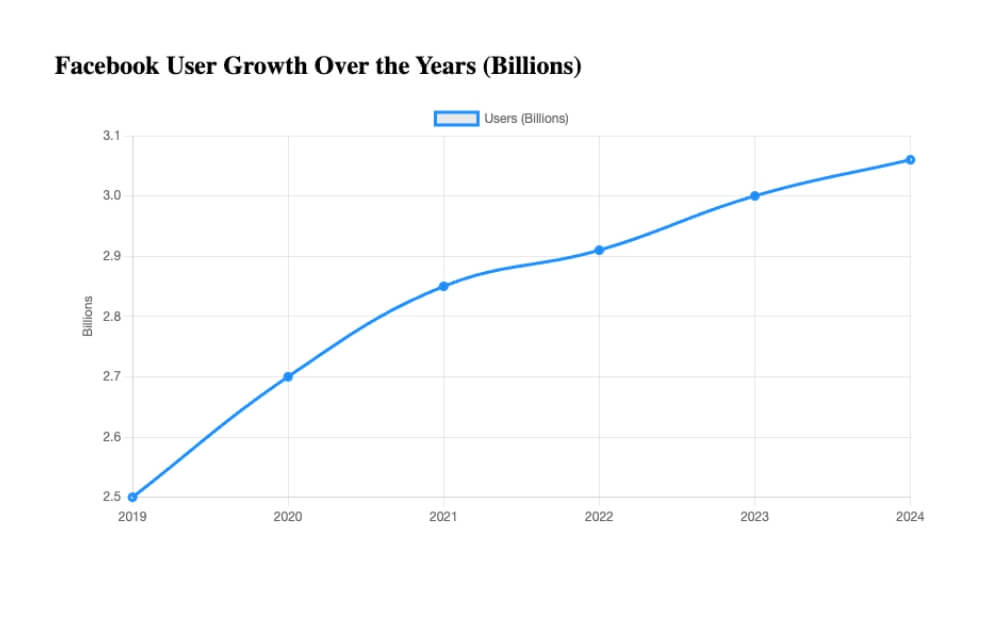 Since then, Facebook has continued to grow its users with several investments and expanded it to businesses by introducing ads, pages, and messaging options to communicate with others.
However, in 2012, two major events happened: Facebook went public with the largest IPO at the time, valued at 104 billion dollars, and later acquired Instagram for $1 billion. Facebook continued to dominate social media, and later, in 2014, it acquired WhatsApp, a popular messaging app worldwide, and bought Oculus VR.
Facebook continued to dominate until the Cambridge Analytica scandal in 2018, where Facebook misused the personal details of thousands of users. Later, Mark Zuckerberg testified before Congress, and after that, Facebook changed its policies for meaningful interaction. This was the beginning of Facebook’s decline and the loss of trust in Facebook. It had a huge impact on Facebook’s reputation.
Facebook’s platform, Instagram, grew in usage, and the Chinese short video platform TikTok became very popular. Most younger generations started using these apps and spending more time on Instagram and TikTok, which reduced the time spent on Facebook.
While Facebook started adding plenty of features to regain its trust, Gen Z continued to use TikTok and Instagram more than Facebook.
However, in 2020, due to the Covid breakout, there was a rise in engagement on Facebook and other platforms. Facebook-owned Instagram introduced Reels (short video content, a copy to TikTok) to compete against TikTok. It became quickly popular, and India’s banning of TikTok greatly helped Reels grow. Since then, Instagram has exploded in use, while Facebook has continued to suffer in engagement.
Later, in 2021, for the first time, Facebook announced a decline in its users. Facebook reported its first decline in daily users by 1 million in Q4 2021. To rebuild trust again and focus on the Metaverse, Facebook rebranded itself as Meta Platforms in 2021, announcing its shift toward AR and VR adoption.
However, the Metaverse is still in its early stages, and people are ready for the future. Addressing the decline in users, Facebook has continued to introduce new features but has still failed to regain the trust of the younger generation and increase engagement. Here is the full history of Facebook’s major events since its launch.

Two Biggest Reasons Why Facebook Is Falling
From the history of events, while the Cambridge Analytica scandal has made Facebook lose its trust, there are two biggest reasons why Facebook is struggling: because of Gen Z or teens using Facebook less compared to other platforms and fierce competition from TikTok and Facebook’s own Instagram.
As per data shared by Pew Research, in 2014-2015, 71% of US teens (13-17 years old) used Facebook, and by 2022, only 32% of US teens reported using Facebook, and also among those teens, fewer than 20% use it daily, and only 2% say they use Facebook frequently. For comparison, YouTube, TikTok, Snapchat, and Instagram all have over 50% adoption among US teens.

In another survey conducted by ExpressVPN, most people use Facebook to stay in touch with family and friends. According to the survey results, more than 50% of users aged between 18 and 24 and 45% aged 25 to 34 prefer other social media platforms like TikTok and Instagram. The survey also mentions that 39% of users aged between 18 to 24 and 29% of users aged 25 to 34 feel Facebook no longer serves a purpose in their lives, and 19% of users aged 25-34 said privacy issues are a reason for not using it.
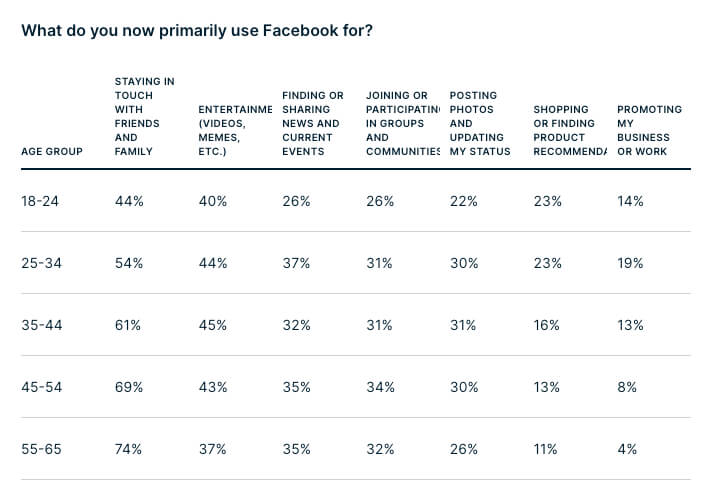
The biggest reason is that Gen Z widely perceives Facebook as a platform for their parents. Many teens have reported that Facebook’s feed feels less engaging and boring with political debates and fierce competition and more engaging content from other platforms such as TikTok with its booming short video content, Instagram with its Reels, and YouTube with its own Shorts, and Snapchat with its Stories. On the other hand, Facebook is failing to attract the younger generation.
 Also, data shows that many teens want to share their updates privately rather than share them with the public. Since Facebook encourages users to post personal updates, whereas Gen Z prefers more private interactions, they use Snapchat disappearing messages and more private ways to share information with their community.
Moreover, a few teens also reported not posting on Facebook because their connected family members might also see their posts. All in all, this makes Facebook less appealing to Gen Z users.
Despite the decline in Facebook, some teens still use Facebook to buy second-hand shopping using Facebook Marketplace. Facebook also reported that second-hand marketplaces have been hugely popular among teens, and they are seeing increased user engagement. Also, Facebook Groups are going great with users, and Facebook Messenger is still widely used in some regions to communicate with others and family members. However, there are still signs of worry despite these numbers; since many teens aren’t using it for posting and reading content, teen engagement is still likely to be reduced in the future.
Meta (previously Facebook) has addressed this and stated steps to make Facebook more engaging for teens. The company has introduced and added cross-platform posting, utilizing the user base of WhatsApp and Instagram to cross-share content directly to Facebook. Also, Facebook has added Reels, a popular short video platform, to the app, which also makes Facebook a more video-centric platform, including support for long-format videos.
The company has also announced AI-driven algorithms to keep posts and Reels more relevant, similar to TikTok, to keep users more engaged. It is also adding and improving Facebook Marketplace to keep users buying and selling from the local communities, resulting in more engagement on the platform. However, despite Facebook’s efforts, teen Facebook usage continues to decline, and also only ~28% of US teens use Facebook, compared to 95% using YouTube and 67% using TikTok.

Also, daily engagement among teens is extremely low, which is still a concern. However, experts predict that Facebook interaction will further decrease, and Facebook usage might continue to decline unless it finds a way to attract investors. Also, the fierce competition from others with engaging content is affecting Facebook’s market share.
How Can Facebook Make a Comeback?
Before getting into the details, let’s first understand the product life cycle, which can help us understand why Facebook is now in decline and how it can bounce back. Product cycle is the common term used to determine the state in which the product is in. There are four main stages of the product cycle for any production.
The introduction stage, where the new product is introduced to the market, has fewer users and has big growth potential. Next is the growth adoption, where mass users will start using the product, and here, the product gets rapid user increase and high engagement. Next is the maturity stage; here, the growth becomes lower, the market can become saturated, and it will have a stable user base. Next is the decline stage, where it fails to stay relevant, and the users leave for other platforms because it no longer engages the users and adds value to them.
Facebook is transitioning from the maturity stage to the decline stage for certain demographics. However, it is not completely dead yet. Sooner or later, Facebook can become a decline if it fails to engage the users. Still, we have over 3 billion active users with strong revenue from ads, businesses, and marketplaces showing positive trends. However, if the platform doesn’t stay relevant and competitive, Facebook might lose it further.
The first thing is to stay competitive and create engaging content. While Facebook has tried different ways, such as directly including Reels and cross-platform AI content, it still failed to create a recent content experience by introducing a new competitive video format. Facebook has a long history of copying features instead of building products from scratch, and also, since Meta, the parent company of Facebook, already owns Instagram, Meta might continue focusing on video formats and making an AI-driven feed more similar to TikTok.
Since Gen Z is losing interest, Facebook can bring features specially designed for Gen Z, such as groups, better secure messaging, and cross-platform messaging, which are already in the works. Most importantly, unlike YouTube, Instagram, or even TikTok, where creators are at the centre stage of creating content, Facebook should focus more on the creators, which can help produce engaging content. But still, this will be a challenge for the company to do.
The inputs might seem common, but remember, Facebook also has other products, and they changed their goal from being a social platform to being a Metaverse company, dumping billions of dollars into AR and VR development. Meta still has other products, but Facebook dominates the charts with the most users and higher revenue than any other app.
 Also, the recently launched Threads gained users quickly but is seeing less engagement due to competitors like X (formerly Twitter) declining in user engagement despite getting 100 million users early. It’s hard for the company to make a new platform work again. To win users, Facebook must be unique rather than just another product where users already spend their time. Copying products also works, but grabbing the market share and staying competitive is important.
Can Facebook Rise Again, or Is It Too Late?
If Meta continues to push Facebook with Reels, short videos, engaging content, and a marketplace, it might attract users in the future. The older generation will continue using Facebook. However, Facebook user growth has slowed globally; Gen Z is leaving Facebook for TikTok, Snapchat, and Instagram. Engagement is declining in key markets. Facebook can bounce back if the platform makes it more attractive than others, wins back trust, and introduces more features to make the app relevant, or the platform will continue to develop slowly.

