

In Summary
- Apple announced that Tim Cook would be stepping down from the post of CEO on 1 September, 2026. He will move up to Executive Chairman, and John Ternus (current Senior Vice-President, Hardware Engineering) will take over as CEO.
- This brings to an end almost a decade and a half of CEOship under which Apple scaled new heights of success, becoming the world’s first trillion-dollar company along the way.
- Although he was always (and not always favorably) compared to his predecessor, the charismatic Steve Jobs, Tim Cook leaves behind a legacy that is every bit as formidable. He was the man who made Apple a truly global tech power.
“This would never have happened under Steve.”
”Steve would never have done this.”
”He might make money, but he is not Steve Jobs.”
Imagine spending more than a decade of your existence being compared with your predecessor, and not always favorably at that. Even your doing well was considered at times to be a betrayal of the values of your predecessor, who incidentally was a person you loved so dearly that you offered to donate your kidney for him. Imagine building up the first trillion-dollar company in the world only to be told, “You will never be like Steve.” And heck, yeah, imagine telling the world you are stepping down from your post later in the year, only for your own President to claim that you kissed his posterior and asked him for favors.
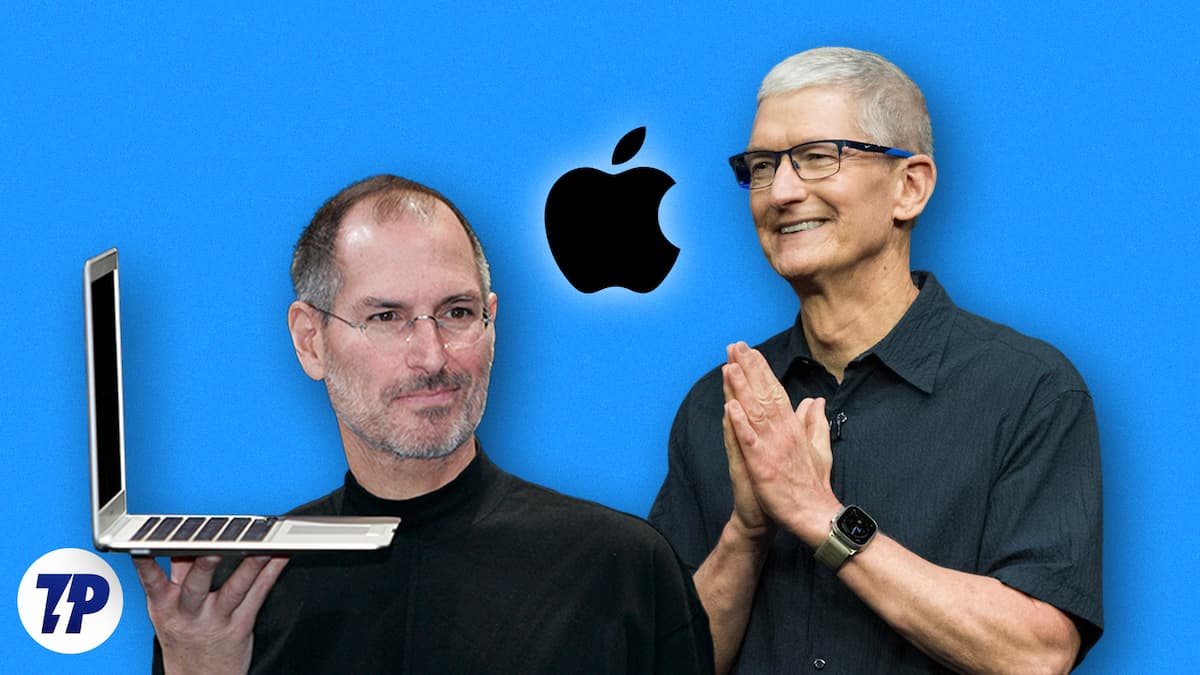
Welcome to the world of Timothy Donald Cook, CEO of Apple. Until 1 September 2026, that is.
Not “Steve”, but with his own aura
The news that Cook would no longer be Apple CEO by September was greeted with surprise by many in the tech world. For, ever since Steve Jobs left the world in late 2011, Cook has been at the helm of the world’s best-known and at times most valuable tech company. The thought that the slightly paternal, academic-looking, slim man will no longer be coming on stage to kick off Apple events is a strange one.
No, he was not Steve Jobs (heck, who is!), but over the years, Tim Cook had built what today’s social media crazy generation would call “aura.” There was no hush of expectation when he walked on to the stage or when he arrived to inaugurate a store, but in its place was something equally important: respectful affection. Steve Jobs added show business and flair to Apple; Tim Cook just (just!) added exponentially more business to Apple.
The “anti-Steve Jobs!”
In many ways, Cook was actually seen as the “anti-Steve Jobs.” His biggest critics (and there are many) felt that he had moved Apple away from Jobs’ “core values.” They point to how Apple’s product design has now become more predictable and repetitive, and how the brand is no longer seen as being as “insanely innovative” as it once was, and has stopped “inventing segments” after the AirPods and Apple Watch, which were launched about a decade ago.
The critics also point to Apple’s large product portfolio, which now comprises a variety of MacBooks, iMacs, iPads, iPhones, Apple Watches, AirPods, and accessories of different configurations, hues, and most importantly, prices. We are reminded that one of the first things Jobs did when he saved Apple from imminent extinction in 1996 was brutally slash its portfolio. Surely, Cook has violated a key commandment of the Sacred Book of Jobs by expanding Apple’s portfolio to such an extent that there are four types of iPhones, four types of iPads, four types of AirPods, and God knows what else?

Put those two points together, and you have the greatest “Anti-Jobs” accusation leveled at Cook – that he has taken the “art” out of Apple and simply made it a business. A company that apparently chases market share and profits much more than it tries to put a “ding in the universe.” Every time a senior Apple Executive left their post, it was assumed that they were driven out by Cook’s commitment to commerce – the legendary Jony Ive is believed to have left, disenchanted by his CEO’s lack of interest in Apple’s products. Every time something has gone wrong, be it a bug in the OS or a presentation that seemed a little drawn out, Cook has had to confront the albatross of his predecessor – “This would not have happened under Steve.”
The OG Priest of Premiumization
All this criticism tends not just to ignore but even belittle Cook’s greatest achievement. For no matter what his critics say, the record shows that he made Apple one of the world’s top brands, and indeed, the first company ever to be valued at a trillion Dollars. He made Apple not just reach new markets but succeed in them, and all without compromising on the brand’s reputation for high quality at a premium price. Under Cook, Apple did not conquer the world by launching low-priced products targeted at the masses, but by making a whole new set of consumers realize that “value for money” could also mean “high price, high quality.” He did not make tech affordable for the masses, but convinced the masses to pay more for better tech. In tech, he was the OG Priest of Premiumization.
India is a prime example of this. When Jobs passed away in 2011, India did not really occupy an important place in the Appleverse. Products were released well after their international launch, and many never even made it to Indian shores (the first iPhone, for example). Fast forward to the current day and age, and India is not only one of Apple’s most important markets, but an iPhone (the iPhone 16) was the highest-selling smartphone in the country. And all this with prices that increased every year. Skillful inventory management played a huge role in this, as during Cook’s tenure, older models of different Apple products were available at lower prices than new ones, in stores for longer periods of time. It was a masterclass of operations management.
Jobs put Apple on the map; Cook spread it right across the globe
Which is perhaps why Jobs picked Cook as his successor. He knew that while Cook was not a “real product person,” he was a wizard when it came to logistics, operations, and supply chain management. Expertise was needed in Apple’s next stage of expansion. To say that Cook delivered on it is an understatement. What is truly mind-boggling, however, is not just the volumes and market share that Apple has grabbed under Tim Cook but the fact that it has done so without losing its premium sheen. Kidney jokes are still made about the brand, and in countries like India, almost every Apple product launch is accompanied by complaints about its price. But these are inevitably followed by queues outside stores. Under Cook, Apple has gone from being seen as “overpriced” to being “expensive, but worth it.”
Tim Cook is stepping down as Apple's CEO, and John Ternus is taking over his position from September 1, 2026#Apple #TimCook #AppleCEO #JohnTernus pic.twitter.com/5k60uL4RtQ
— TechPP (@techpp) April 21, 2026
Of course, it would be naive to say that everything Cook has touched has turned to gold. The brand has had its share of failures, most notably Vision Pro, the iPhone mini, and the iPhone Plus, and some are saying the high-profile iPhone Air has been a bit of a dud as well. There has also been a fair amount of criticism about his relationship with the US Government post 2025, but to be fair, the President’s “farewell note” to him seems to show just what he – and many other ‘tech bros’ (as well as most of the world) – are dealing with. Cook has borne it all with stoic calm and common sense. We do not hear of outbursts of temper or emotion from him, or hear him telling users that they do not know how to hold a device, or poking cynical criticism at the competition. If triumph and disaster were to meet Tim Cook, he would treat those impostors the same.
The critics are right: Tim Cook is not Steve Jobs. And he has never tried to be. He has never claimed to be a product wizard or an artist or tried to stun a crowd with his on-stage brilliance. To use a Hollywood comparison, he is the Clint Eastwood to Jobs’ Marlon Brando – he is not unpredictably spectacular, but his sheer consistency is his magic. When Jobs came on stage, you never quite knew what was coming. And stood up to applaud. When Cook came on stage, you often had a fair idea of what was coming. And still stood up to applaud. There were two separate sections in the book that is Apple. Both important, but in different ways. Neither was perfect, but both were compelling. Again, in different ways.
Apple rocked under Steve.
Under Tim, it Cooked!
Pun intended.

