

Every year, the Mobile World Congress (or MWC)—one of the biggest tech conferences of the year—gives us a sneak peek into what to expect in the consumer technology space for the year. This year’s conference just wrapped up, and it wasn’t any different, as we got to see some really exciting products, some of which could shape the future of mobile and computing.

Here are six such interesting announcements from MWC 2024.
Table of Contents
Deutsche Telekom’s App-Free Concept Phone
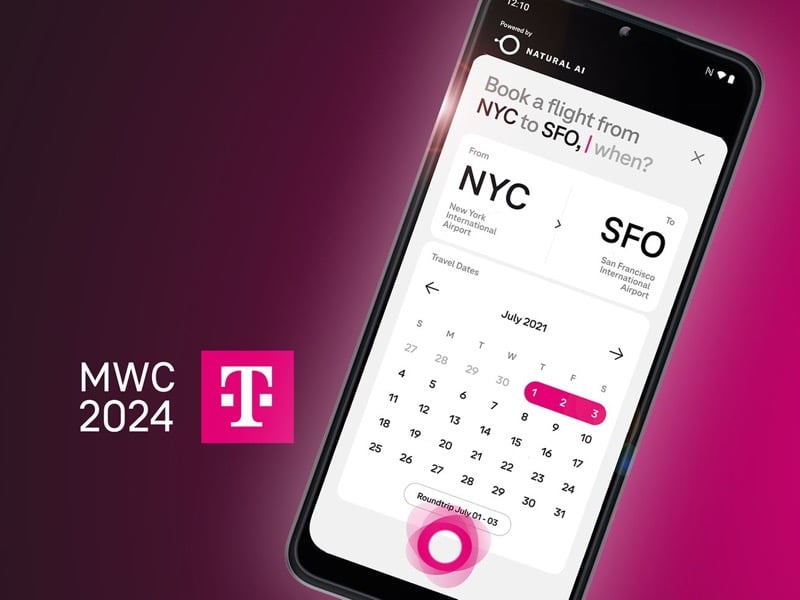
AI is at the forefront of most product announcements and conferences these days. And it shouldn’t come as a surprise that it took center stage at this year’s MWC, too.
However, what’s different about this AI announcement is that it isn’t some software you can access on your phone or computer. Instead, it’s AI-enabled hardware—a smartphone, to be specific.
Deutsche Telekom, one of the biggest telecommunications providers in Europe, has showcased an app-free AI smartphone at MWC 2024. It’s a collaborative effort with Qualcomm and Brain.ai. For those unaware, Brain.ai is the same company behind the iOS app Imagica, which promises to bridge the gap between software and intelligence to provide users a way to get things done without having to perform them inside apps manually.
Deutsche Telekom’s idea behind the AI-enabled device is to offer users a generative interface. One that’s free from apps and handles user’s needs solely using AI. Basically, it wants users to use their voice to tell the assistant what they wish to do, and the assistant will carry out the task for them.
The company demonstrated the concept by integrating the interface into its existing T Phone. Some of the use cases it suggested as part of the demo include booking flights, planning trips, creating a shopping list, and editing photos.
Lenovo’s ThinkBook Concept Laptop With a Transparent Display

Another device that managed to grab the attention of a large number of attendees at this year’s MWC comes from the house of Lenovo. This isn’t the first time Lenovo has demoed something like this, though, as we saw a sci-fi concept product, a rollable laptop, from it at MWC 2023.
However, this year’s is a step ahead. The company has created something that looks a little too futuristic from the 2024 standard: a laptop with a transparent screen.
Called the ThinkBook Transparent Display Laptop Concept, the device features a 17.3-inch micro-LED transparent display. It’s all glass, and there are no borders around the edges, which means you can see what’s present right behind the laptop.
In real life, it’s hard to think of scenarios where you’d want such functionality from a laptop. However, Lenovo says that the AI integration on the laptop opens up new avenues of work collaboration, where people—digital artists in particular—can take advantage of the overlap with the real world to create content that blends the virtual and real world.
Of course, being a transparent display could pose some challenges with regard to visibility and legibility. But Lenovo says this isn’t a problem on its concept laptop, thanks to the use of micro-LED technology, which provides high color saturation with good contrast and brightness levels.
Aside from a transparent display, what’s also unique about the new ThinkBook concept laptop is its keyboard. Instead of fitting in a physical keyboard, Lenovo has added a flat touchscreen panel on the laptop. In addition to serving as a keyboard, this screen also lets you sketch things using a stylus.
Motorola’s Bendable Concept Phone
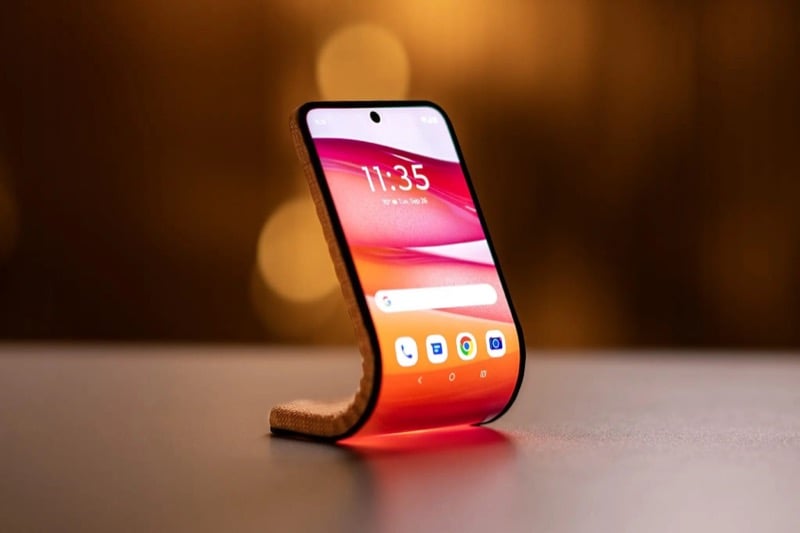
If you thought a transparent display on a laptop was too futuristic, wait till we tell you about Motorola’s new bendable mobile phone that it demoed at MWC 2024. While the concept phone doesn’t have an official moniker, Motorola is calling it a rollable concept phone.
If you follow tech closely, you’ll immediately realize that this isn’t the first time we’ve seen a rollable phone. Lenovo showcased something similar, albeit less mature, back in 2016. However, the latest iteration appears to have improved significantly, and it’s apparent with the more practical use cases it now promises.
The phone features a bendable screen with a back made out of woven fabric. You can either slap the phone on your wrist like a bracelet or place it on a table, and the operating system seemingly adapts to the device’s orientation. When worn on the wrist, the magnetic strip at the back of the phone helps keep it in place and prevents it from falling off. You need a strap accessory to use it on your wrist.
Additionally, the phone can also take different shapes depending on your requirements. For instance, you could bend it like a rainbow—with the display facing outward—when you want to play a two-person game. Or you could fold just the bottom part to make a stand for the phone while you watch some content on its screen.
Oppo Air Glass 3 Prototype
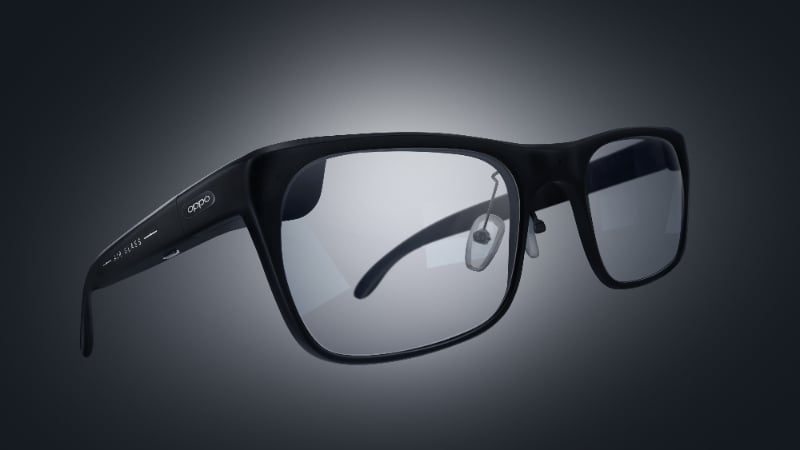
Smart glasses are smarter versions of regular glasses that promise to help you with various day-to-day tasks. While they aren’t something new, Oppo is still prototyping its assisted reality glasses, the Oppo Air Glass, to make it better. And, from the looks of it, it seems the company has made some progress.
Called Oppo Air Glass 3, the latest smart glasses from Oppo, showcased at MWC 2024, can now access Oppo’s AndesGPT model through a smartphone. As such, these glasses can now understand different data types like text, images, video, and audio, which allows them to process even complex scenarios.
You can access AndesGPT on the glasses via the AI voice assistant. Simply press the temple of the Air Glass 3 to activate the AI voice assistant and tell it to perform whatever you want to accomplish. Alternatively, the Air Glass 3 also support touch interaction, which you can use to carry out operations like music playback, voice calls, image browsing, and more manually.
Talking about hardware, the Air Glass 3 surprisingly look like a pair of regular glasses than previous iterations. However, they’re slightly heavier now, coming in at 50 grams. Oppo says the new glasses feature a new resin waveguide (with a refractive index of 1.70) to eliminate the rainbow effect, a display uniformity of more than 50%, and a peak eye brightness of 1000 nits. Together, these changes are said to provide a wearing experience that’s close to a regular pair of glasses.
Nubia Music Phone
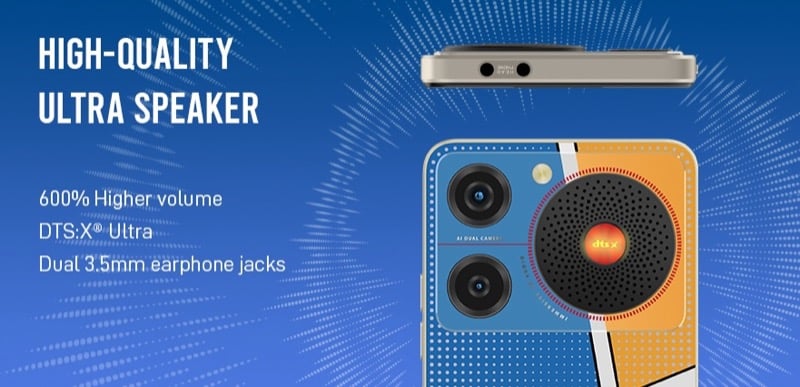
While the brands we’ve talked about thus far were focused on showing their technological prowess, the one we’re going to talk about just wanted to stand out for being cool—well, for some, at least— in the market.
Presenting ZTE’s Nubia Music, a party speaker masquerading as a phone. Aptly called Nubia Music, the phone has a standout back panel design and can reach volumes up to 600% louder than average speakers, according to the company.
But that isn’t all. The Nubia Music also comes with two headphone jacks, so you and your friend or partner can listen to music together without any compromise. Priced at $149, Nubia Music will be available for purchase in Europe and the US from March.
Samsung Galaxy Ring
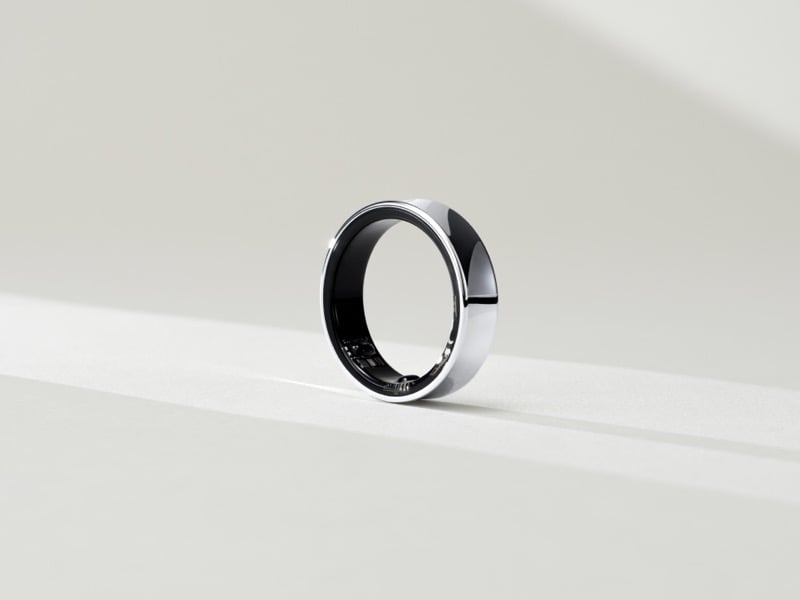
Lastly, we have another actual product that could hit the market soon. It’s a smart ring called the Galaxy Ring, which Samsung just teased at MWC 2024 without giving out much detail.
The Galaxy Ring is said to come with a glossy finish and will be available in three colors: ceramic black, gold, and platinum silver. When available, you’ll be able to get it in nine different sizes.
As of the time of writing, the Galaxy Ring is expected to come with a bunch of health-tracking features, including heart-rate tracking and sleep tracking. There are also rumors on the internet suggesting that the ring will offer control for Samsung SmartThings and support wireless payments via Samsung Pay.
MWC 2024: Not All Concepts and Protypes Are Bad
Concepts seldom materialize into consumer products. Nevertheless, it’s always intriguing to check them out, as a lot of the concepts often give us an idea of how far tech has progressed and hint at the possibilities going forward.

