

In Summary
- The Nothing Ear are the latest flagship TWS to be released by Nothing, following the Ear (1) and the Ear (2). They follow a new naming system, with the number being dropped from their names.
- The Nothing Ear claims to come with better sound (courtesy ceramic drivers) and ANC as compared to their predecessors and also come with support for ChatGPT but they are also more expensive.
- At $149/Rs 11,999, the Nothing Ear offer some innovative features and a design that is very different from anything in the market out there. But they face some very tough competition from other premium TWS in the same price zone.
It might be best known for its smartphones, but Nothing actually has more earphones in its portfolio. The brand’s first product was a TWS, the rather quaintly-named Nothing Ear (1), and with its latest TWS, Nothing has tweaked the nomenclature of that series, dividing it into the premium Nothing Ear and the slightly more mainstream Nothing Ear (a). The Nothing Ear sticks to the same design principles as its predecessors but comes with a slightly higher price tag, getting it even deeper into premium waters. Does it do enough to hold its own there?

Table of Contents
Nothing Ear Design: Sticking to those see-through looks
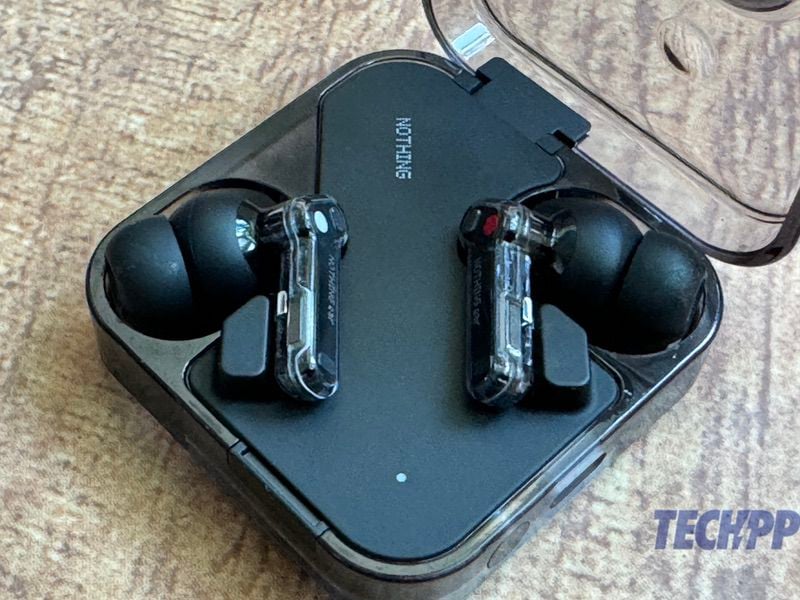
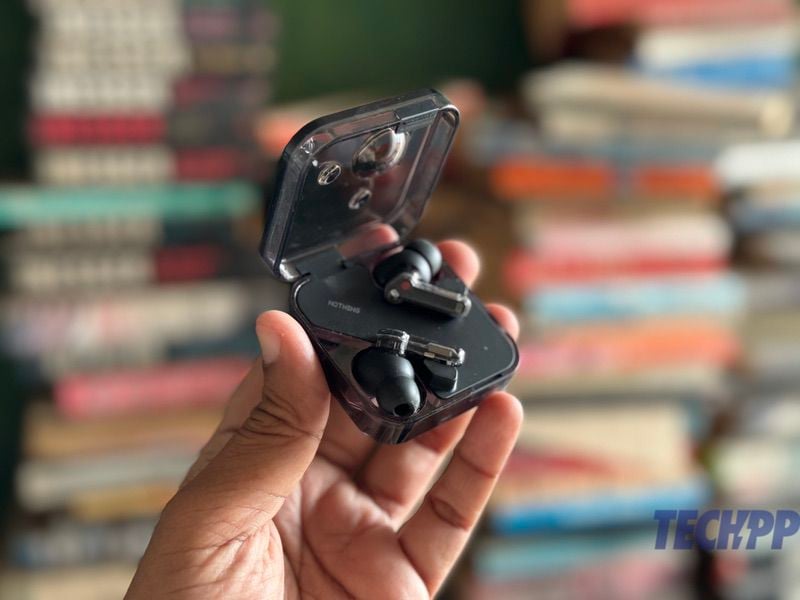
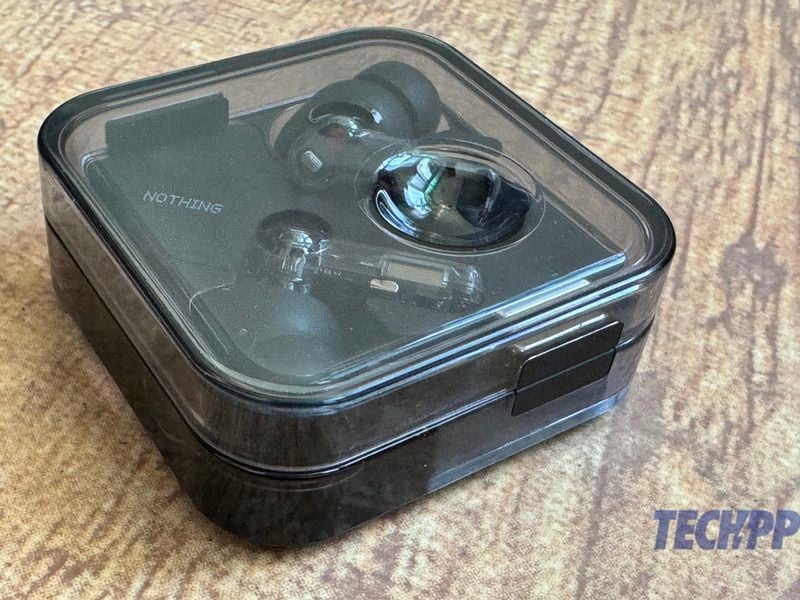
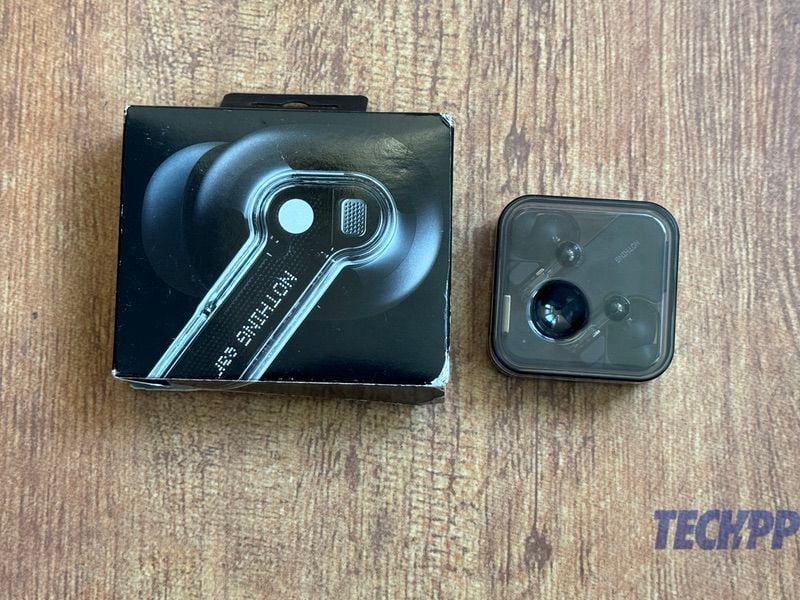
In terms of design, the Nothing Ear are very similar to the Ear (1) and Ear (2). You still get a square-ish case with a slightly circular depression on the lid, giving it very fidget spinner vibes. The case has a transparent lid, through which you can see the two buds lying horizontally inside! On one side of the case is the USB Type-C port for charging, with a connectivity button next to it – it was very difficult to spot on the black variant we got.
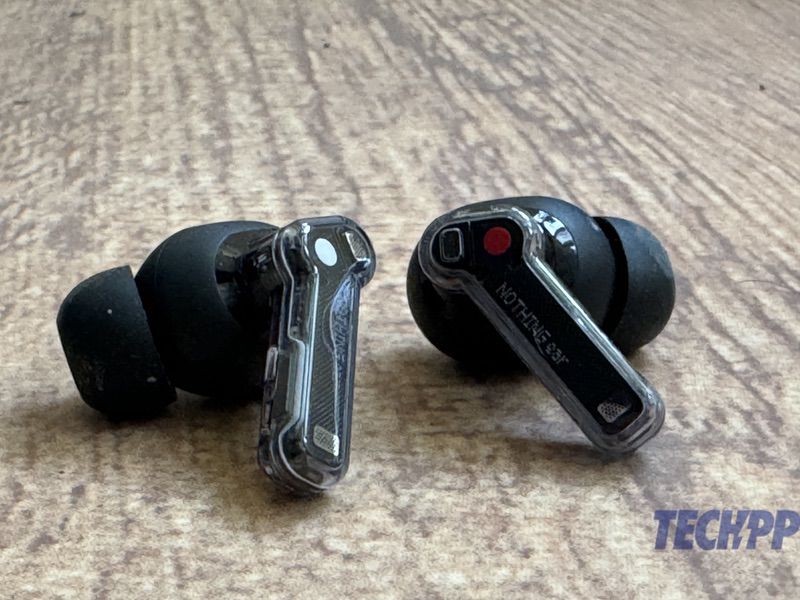
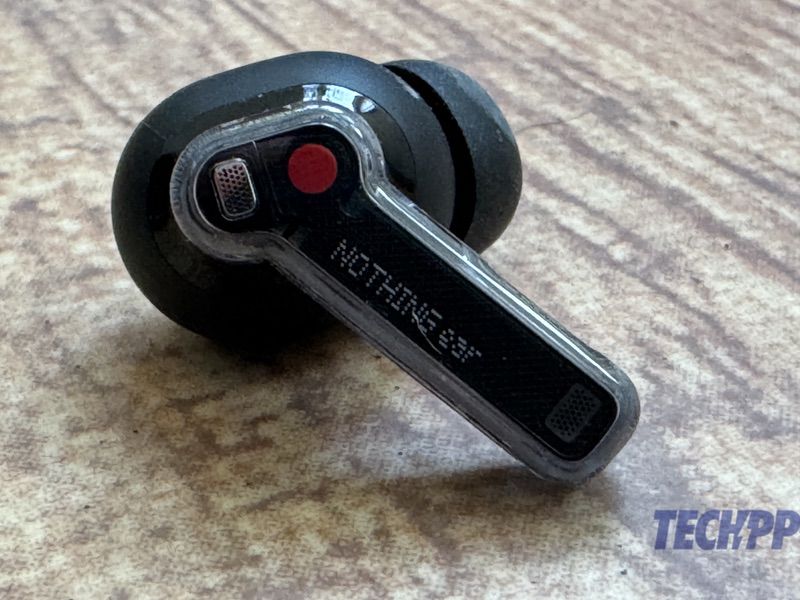
The earphones follow the broad Nothing template of having stems with bulbous earbuds at the top. The inside part of the stems are transparent-ish, a key Nothing design vibe, and there is an LED inside to show the battery level. The buds have red and white dots on the top of their stems to show they are meant for the right (red) and left (white) ears. These dots are also present on the slots in which they ‘lie’ down in the case as well.
The buds are light at 4.62 grams, and the case is 51.9 grams light and at 22 mm, slim enough to slip into a coat or trouser pocket. The buds have IP55 dust and splash protection, and in a nice touch, the case has an IP54 rating, too, making them both suitable for the gym and maybe the odd spot of light rain. The lid snaps shut magnetically, and the buds attach to their connection points in the case magnetically, too. The case has a generally solid feel to it, but the lid wobbles a little, which is a bit surprising in a TWS with this price tag. You also get two additional sets of eartips in the box and a USB Type-C cable for charging.
The Nothing Ear retain the distinct look of their predecessors, but their plastic and very scratch-prone build (of case and buds both) does not make them look very premium. They will still turn heads, though, thanks to their very distinct design.
Nothing Ear comfort and ease of use: Remaining as easy to use as ever
The Nothing Ear buds are quite comfortable to wear, although, like all TWS, they will drop out from time to time. The TWS come with an ear fit test that allows you to find the fit that best suits you, and from what we could see, it was reliable enough. Using the TWS is relatively easy, too. Thanks to the presence of stems, there is no need to press the buds themselves, letting them stay in one’s ears, unlike those TWS, which need the buds to be tapped or pressed, disturbing the fit in the ears.
Connecting the buds to a phone is as simple as hitting the connectivity button and then connecting to the device over the Nothing X app, which is available for both Android and iOS. One can connect the TWS to two devices simultaneously. Nothing deserves a round of applause for sticking to a broadly consistent control system. By default, a single pick of the stem lets you play, pause audio, answer, or hang up a call.
A double pinch takes you to the next track or declines an incoming call, and a triple pinch takes you to the previous track while pinching and holding activates noise control. You can customize all the controls to an extent except for the single pinch and can even allot a function to double pinch and hold, choosing from options like increasing or decreasing volume or invoking a virtual assistant. It is a reasonably steady and easy-to-use control system, depending on distinct presses (pinches) of the stems rather than taps.
Nothing Ear audio quality: Bringing on the bass
On paper, the Nothing Ear seem to have smaller drivers as compared to the Nothing Ear (2) – 11 mm as compared to 11.6 mm. Nothing, however, claims that it has gone for custom ceramic drivers this time, which deliver much better audio quality. They certainly sound deeper than the Nothing Ear (2) with a very strong bass accent and are very different from the more balanced path that the original Nothing Ear (1) had followed. However, the bass never overwhelms the other frequencies.

If you want even more bass, you can turn on the Bass Enhance algorithm through the Nothing X app, which enhances lower frequencies even more. You also get an equalizer in the app, which lets you not only enhance bass, treble, and voice but also gives you the option to customize your own settings. And if you want something more elaborate, then the Advanced version of the equalizer lets you literally fiddle with different frequency levels to come out with your own settings. Audiophiles might not like the bass forward signature of the TWS but they will love the equaliser options, which incidentally can be used to tone down the inherent bassiness of these buds.
If you like bass, though, then there is very little to complain about here. The Nothing Ear deliver bass without cluttering up other frequencies, although instrument separation is not as good as one would have liked at this price point (again, you can tweak equalizer settings to improve this, but most consumers people really cannot keep going to the equalizer). There is support for hi-res audio, and the audio quality is very good for those who love watching action films and playing games (a low latency mode actually works, and in a cool touch, gets triggered automatically when you switch on Game Mode on a connected Nothing phone).

In the best Nothing tradition, the audio quality of the TWS have actually improved in terms of quality (volumes are impressively loud as it is). However, we would still rate them a level below other premium players. We would have preferred a more balanced sound by default – the bass is impressive, but unless you are a basshead, too much of it can be a little tiresome. You can even create your own sound profile using a test in the Nothing X app, after which the app works out a personal profile for you and then adjusts the sound accordingly. Results were mixed, though, with some of us being impressed and others not. It definitely is an interesting concept. We also felt that audio sounded much better when we had paired the TWS with our Nothing Phone (2) as compared to other phones, especially in terms of detail.
Nothing Ear ANC, call quality and battery life: Ticking the boxes
The Nothing Ear come with adaptive noise cancellation (ANC), which adjusts noise cancellation levels depending on the noise outside. You can also choose to switch between three levels of noise cancellation – low, mid, and high. There is also a transparency mode, which allows external sound to come in. We found ANC on the TWS to be very good on the ‘high’ level, but the other levels were largely token, and adaptive noise control was also not as effective as we have seen on other TWS from Jabra and Sony.
ANC quality overall has improved with inevitable firmware updates, but we must confess that we expected a bit more in this regard at this price point. If ANC matters a lot to you, just stick to the ‘high’ level – it is good enough to get you some peace in noisy cafes and metro rides and close to what you get from the competition. It is in the adaptive route that the buds lose their way a little.
Call quality on the buds is decent but not exceptional and, again, a clear level below that of the competition – in fact, call quality on the Nothing Ear had seemed inferior to even the Nothing Ear (2) before a software fixed matters. The buds are best used for calls in a relatively quiet environment; even switching between devices can be slightly erratic. Bluetooth connectivity is excellent, especially with Nothing phones – our buds stayed connected to our Phone (2) even ten feet away with a wall in between!
The battery life of the Nothing Ear is decent if you do not use ANC – you will get eight hours of usage. Use ANC heavily, however, and that time gets clipped to a reasonable but not exceptional 5 hours or so. The case is believed to provide 4-5 recharges, so if you are not using ANC, you will get about 40 hours, and close to 22 hours if you use ANC. Those ANC numbers are a bit of a disappointment at this price point. The Nothing Ear also come with support for wireless charging and can even be charged off the back of the Nothing Phone (2). A super neat touch is fast charging, which lets you get about ten hours of usage (without ANC) with ten minutes of charging.
Nothing Ear: The ChatGPT angle
One of the most hyped features of the Nothing Ear has been its integration with ChatGPT, allowing you to replace the default Google Assistant (or Gemini, if you have taken that option) with ChatGPT. This can be done through the Nothing X app, which generally works smoothly, giving elaborate and very conversational replies to queries. While this feature will interest AI fans, we found ourselves returning to Google Assistant simply because it enabled us to do more routine tasks. We would currently consider ChatGPT integration to be more cool than functional. It is great to have it at one’s disposal, nevertheless. We will be discussing ChatGPT on the Nothing earphones in detail in a forthcoming story soon.
Nothing Ear pricing: Getting more premium
The Nothing Ear are priced at $149/Rs 11,999, which makes them more expensive than the Nothing Ear (2), which were launched at Rs 9,999. It also places them even more prominently in the premium zone and within touching distance of the very good Sony WF-1000XM4, which are sometimes available at Rs 12,999, and very good and equally smart Pixel Buds Pro and the Samsung Galaxy Buds 2 Pro, which are available in the vicinity of Rs 11,000 or even lower at times. And, of course, those willing to spend just a little more will be tempted by the base AirPods, which might not have ANC but are at another level in terms of consistency and sheer ease of use.
Nothing Ear review verdict: A no-brainer for Nothing Phone users
We will make it simple – if you have a Nothing phone, or more particularly, a Nothing Phone (2), then the Nothing Ear are a no-brainer. This is because there is so much that the phone seems to unlock on the TWS, from better audio quality to better connectivity to ChatGPT support and, of course, those cool touches like switching automatically to a low latency mode and even charging wirelessly off the back of the phone. It is the perfect accessory. Move it to another phone, however, and steps of mortality creep in.
Although the buds deliver great sound for mainstream users and have good ANC, they are still off the premium pace, especially when compared to the likes of the Galaxy Buds 2 Pro and the Sony WF-1000XM4. Their real value, however, comes to the fore if you use them with a Nothing phone, preferably the Phone (2). Of course, that could change with a few updates. This is a Nothing product, after all.
- Design remains unique
- Good audio quality (though bass-centric)
- ChatGPT integration
- Multiple level ANC
- Good battery life
- Regular updates
- More expensive than before
- Adaptive ANC not very effective
- Call quality is not the greatest
- ChatGPT works only with Nothing Phone
- Case and buds prone to scratches
| Design & appearance |
|
| Audio quality |
|
| ANC and calling |
|
| Additional features |
|
| Price |
|
|
SUMMARY
At $149/Rs 11,999, the Nothing Ear offer some innovative features and a design that is very different from anything in the market out there. But they face some very tough competition from other premium TWS in the same price zone. |
4.0
|

