

In Summary
- The Apple M4 outperforms Snapdragon X Elite (X1E-84-100) in single-core performance and is way ahead in terms of GPU.
- However, the Snapdragon X Elite (X1E-84-100), due to its 12-core setup, has better multicore scores. Apple M4 also has a better power efficiency than the Snapdragon X Elite (X1E-84-100), with its 3-nanometer process and lower power consumption with a 4-efficiency core setup.
- Snapdragon X Elite (X1E-84-100) leads in terms of NPU and AI performance, with its Hexagon NPU having higher AI performance at 45 TOPS compared to Apple M4’s 38 TOPS Neural Engine.
If you have been paying attention to laptop processor launches these days. There is a race among all processor manufacturers to take the crown of being the best, fastest, or most efficient processor in the market that consumers like you and me can get to buy.
It began when Apple transitioned from Intel to their in-house silicon with their M1 series, which was announced in 2020. It was a phenomenal success; the Apple M1 has beaten out the competition in terms of performance and efficiency, especially in battery life. It has changed the laptop market forever, with big numbers on board, claiming the title of the most efficient processor.
This shift has changed the path for other companies. Since Apple’s transition, Intel has been working to catch up with Apple regarding performance and power efficiency. It is not fair to directly compare a processor used on Windows with a processor used on a Mac. Still, as a consumer, I think the line between them has thinned significantly with the recent processor variants if you want to buy a laptop with better battery life.
This battle for performance numbers has heated up even more with the announcement of Snapdragon X Elite, another ARM-based processor (Elite and Plus series) for laptops designed by Qualcomm. While Qualcomm and Intel compete against each other, Apple has consistently maintained its position as the market leader.
However, the Snapdragon X Elite processor from Qualcomm and the latest Lunar Lake processor from Intel are now matching up to Apple’s M series processors, narrowing the gap. Interesting to see how the Apple M4 processor will fare against these two. While Snapdragon processors are not as popular among consumers, they offer good battery life and performance numbers.
There are plenty of options if you are looking for a laptop with the best battery life. However, suppose you are considering a laptop powered by Snapdragon X Elite (X1E-84-100), a top variant in the X Elite series or the latest Apple M4 series. In that case, this post will compare both flagship processors from these companies and help you decide which one to get based on your preferences.
Apple M4 vs Snapdragon X Elite: Architecture and Manufacturing Process
Category | Apple M4 | Snapdragon X Elite |
|---|---|---|
Manufacturing Process | TSMC 3nm | TSMC 4nm |
Core Configuration | 10 cores: 4 Performance (P-cores) + 6 Efficiency (E-cores) | 12 cores: 8 Performance cores + 4 Efficiency cores |
Architecture | ARMv9.2-A, with customizations for macOS and iOS | ARMv9, featuring Qualcomm's custom Oryon cores |
Memory Architecture (Unified Memory Architecture) | Up to 24GB LPDDR5X | Up to 64GB LPDDR5x |
Thermal Design Power (TDP) | 20W | Flexible TDP range (23W to 80W) |
Max Core Frequency | Up to 4.4 GHz for performance cores | Up to 4.3 GHz for the high-performance. |
Memory Bandwidth | 120 GB/s | 135 GB/s |
Architecture and manufacturing processes play a very important role in determining the performance and efficiency of the processor. Both Snapdragon and Apple processors are based on ARM architecture, but their setup has significant differences. Although much of the processor architecture is similar, both these processors are customized differently for their requirements.
To start, Apple M4 is one generation ahead in the manufacturing process. Both Apple M4 and Snapdragon X Elite use TSMC for chip manufacturing; the Apple M4 is based on a 3 nm process, while the Snapdragon uses a 4 nm process.
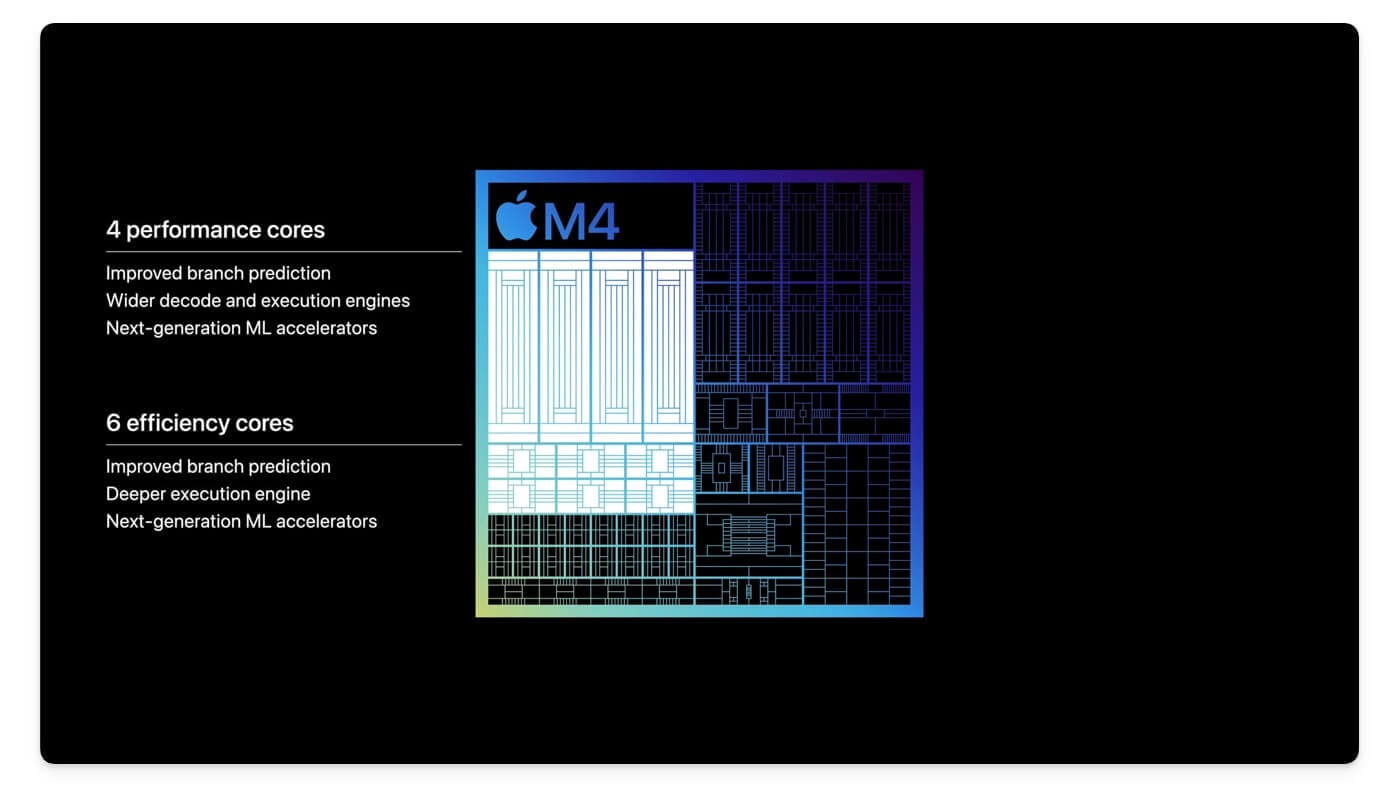
In terms of core configuration, the Apple M4 uses a hybrid design with four performance cores, known as P-cores, and 6 efficiency cores, using the latest Armv9.2-E architecture, customized for macOS. This setup includes enhanced AI-accelerated instructions and uses a Unified Memory Architecture (UMA), allowing the CPU and GPU to share the same memory for improved performance and data transfer efficiency.
On the other hand, the Snapdragon X Elite features a 12-core setup with 8 performance and 4 efficiency cores using custom Oryon cores, which are based on the Armv9 architecture for advanced instruction sets. Like the Apple M4, the Snapdragon X Elite uses a unified memory approach, resulting in slightly higher latency when sharing data between the CPU and GPU. Snapdragon architecture supports up to 64 GB of LPDDR5X memory, with a memory bandwidth of 135 GB/s, which is higher than the M4, which supports up to 16GB and a memory bandwidth speed of 120 GB/s.
With these powerful core setups, there is also a difference in thermal efficiency between the processors. Due to the 3 nm process, Apple has an edge with a lower Thermal Design Power (TDP) rate, estimated at around 20 W. On the other hand, using a 4 nm process, the Snapdragon X Elite consumes slightly more power, with a TDP ranging from 23 W to 81 W, which may generate more heat than Apple’s chip.
Performance (Single-Core vs. Multi-Core)
According to the Geekbench 6 scores, the Apple M4 excels in power efficiency and has better single-core performance. However, the Apple M4 is slightly behind the Snapdragon X Elite’s high-end variants in multi-core performance due to the X-Elite’s better multi-core setup.
Geekbench 6 scores for the Snapdragon X Elite and Apple M4 processors
Processor | Single-Core Score | Multi-Core Score |
|---|---|---|
Snapdragon X Elite | 2,714 | 14,078 |
Apple M4 | 3,103 | 12,065 |
These differences mean the Apple M4 might perform better in single-threaded tasks such as regular web browsing, media playback, app launching speeds, and everyday use. In contrast, the Snapdragon X Elite may excel in multi-threaded scenarios and perform better in video rendering and graphical-intensive tasks.
However, it’s worth noting that the Snapdragon might consume more power due to its 4 nm process and higher TDP output. Currently, we don’t have comparisons between real-world performance speeds and app launch speeds for any apps. We will update the post once I get hands-on with the M4-powered Mac.
Regarding the Snapdragon X Elite, I have used the Asus Vivobook S15 OLED with the Snapdragon X Elite, and the app loading speeds are very fast. I didn’t notice any issues. Also, it is not fair to compare Windows with Macs, but if you’re looking for app loading speed, we should wait until we can compare the Mac Apple M4 and the Snapdragon X Elite for a better assessment.
Graphics and Gaming Performance
Feature | Apple M4 | Snapdragon X Elite |
|---|---|---|
GPU Architecture | 10-core integrated GPU, | Adreno X1 GPU integrated |
Ray Tracing | Hardware-accelerated ray tracing | Hardware-accelerated ray tracing |
Memory Architecture | Unified Memory Architecture (UMA) for CPU and GPU | Unified Memory Architecture (UMA) for CPU and GPU |
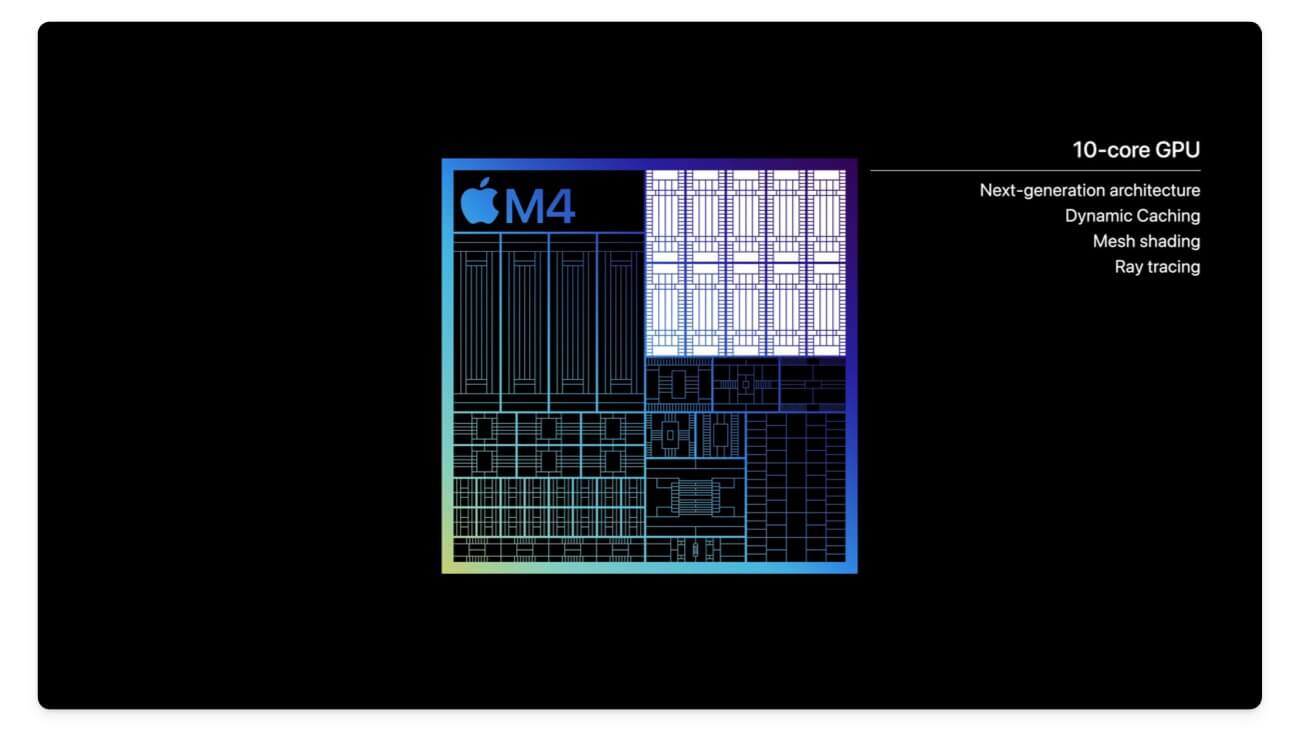
The GPUs on Snapdragon X Elite and Apple M4 are not as powerful as the dedicated GPUs in other Intel x86 or AMD-powered devices. However, if you compare these two, Apple takes the lead. In terms of GPU architecture, Apple M4 uses a 10-core GPU architecture and supports advanced features like hardware-level ray tracing and dynamic caching.
On the other hand, Snapdragon X Elite uses the Adreno X1 GPU with 6 Cores, which also supports ray tracing and higher graphic performance with a higher memory capacity, supporting up to 64 GB. This higher memory capacity can help achieve better graphical performance in certain tasks compared to Apple M4, which is limited to a maximum of 16 GB.
Using your laptop for graphic-intensive tasks gives you better flexibility on Snapdragon X Elite. However, looking at the overall picture, both Snapdragon X Elite and Apple M4 are not great options for high-end gaming, as they have integrated GPUs that are not as powerful as dedicated GPUs found in Intel laptops. Consider the devices with dedicated GPUs for better gaming performance and more power for graphic-intensive tasks.

Compared to the Snapdragon X Elite, the Apple M4 takes the lead with stronger GPU capabilities. If you’re seeking the best performance for gaming (Macs have limited support for Games) and graphic-intensive tasks like video editing, getting a laptop with a dedicated GPU would be the best option.
There aren’t comprehensive performance GPU benchmarks available for Apple M4 since it has not been widely released. However, based on 3DMark Wild Life GPU benchmarks, Apple M4 scores higher. Apple M4 scores around 8,673. In comparison, Qualcomm’s Snapdragon X Elite falls behind with scores of 6,000.
We don’t have exact numbers for the Apple M4 for the Vulkan benchmark yet, but the Snapdragon X Elite scores around 23,649. Regarding graphics performance measured in TFLOPS, Qualcomm’s Snapdragon X Elite achieves approximately 4.60 TFLOPS, while Apple M4 is expected to score higher.
Until we have more concrete data, refer to the table below for a comparison based on available benchmark results and CPU/GPU architecture. Once I get more data for Apple M4, I will update this table with the actual benchmark scores. Based on current architecture and results, Apple appears to have better GPU performance than Snapdragon X Elite.
Benchmark Test | Apple M4 | Snapdragon X Elite |
|---|---|---|
3DMark Wild Life Unlimited | 8,673 | 6,286 |
Vulkan Benchmark Score | N/A | 23,649 (approximate Vulkan score) |
Graphics Performance (TFLOPS) | N/A | 4.6 TFLOPS |
Snapdragon X Elite (X1E-84-100) vs Apple M4 NPU
Feature | Apple M4 | Snapdragon X Elite |
|---|---|---|
NPU Architecture | 16-core Neural Engine, integrated with Unified Memory | Hexagon NPU, supports scalar, vector, and tensor operations |
AI Performance (TOPS) | 38 TOPS | 45 TOPS |
Precision Support | INT8, FP16 | INT4, INT8, FP16 |
Since NPUs (Neural Processing Units) have become crucial for local AI tasks on modern devices, the Apple M4 and Snapdragon X Elite have significantly improved NPU.
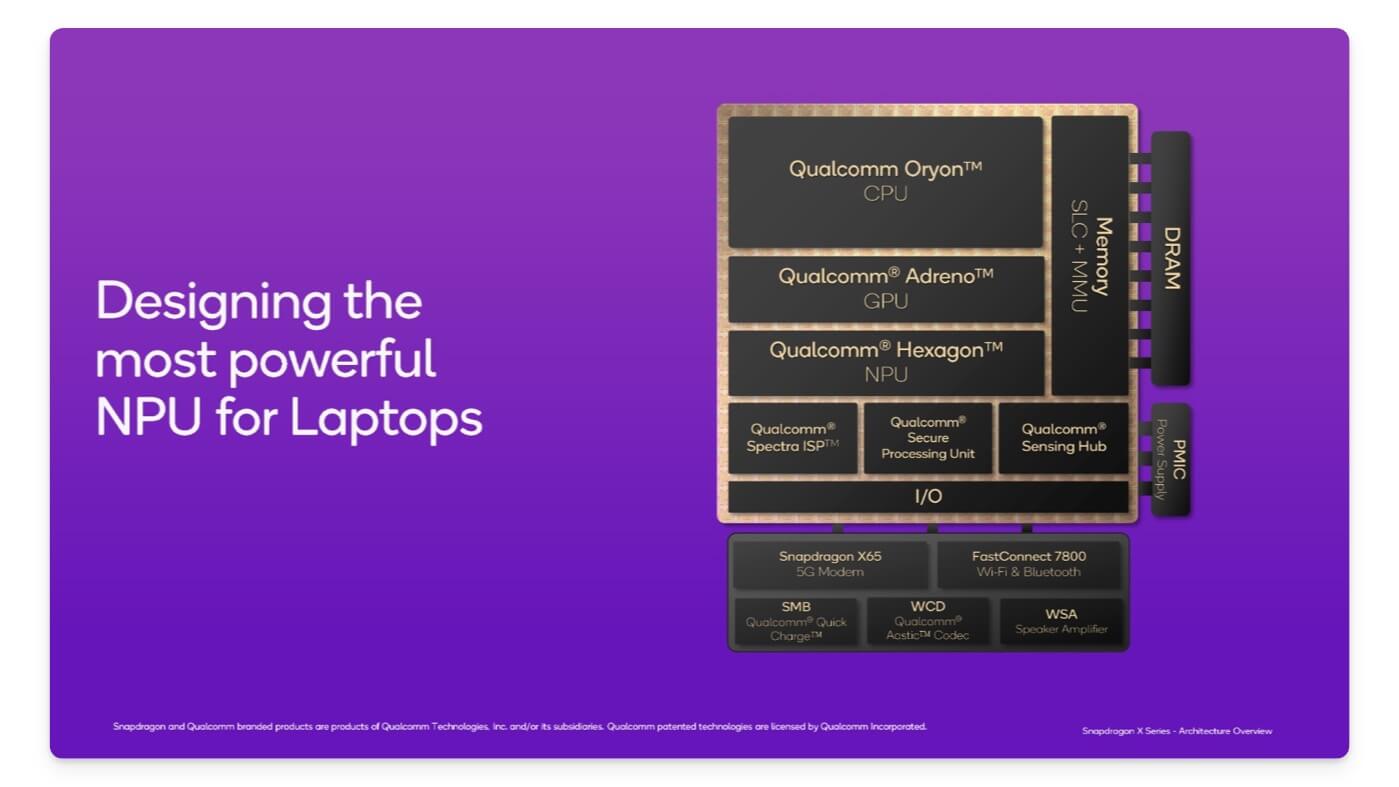
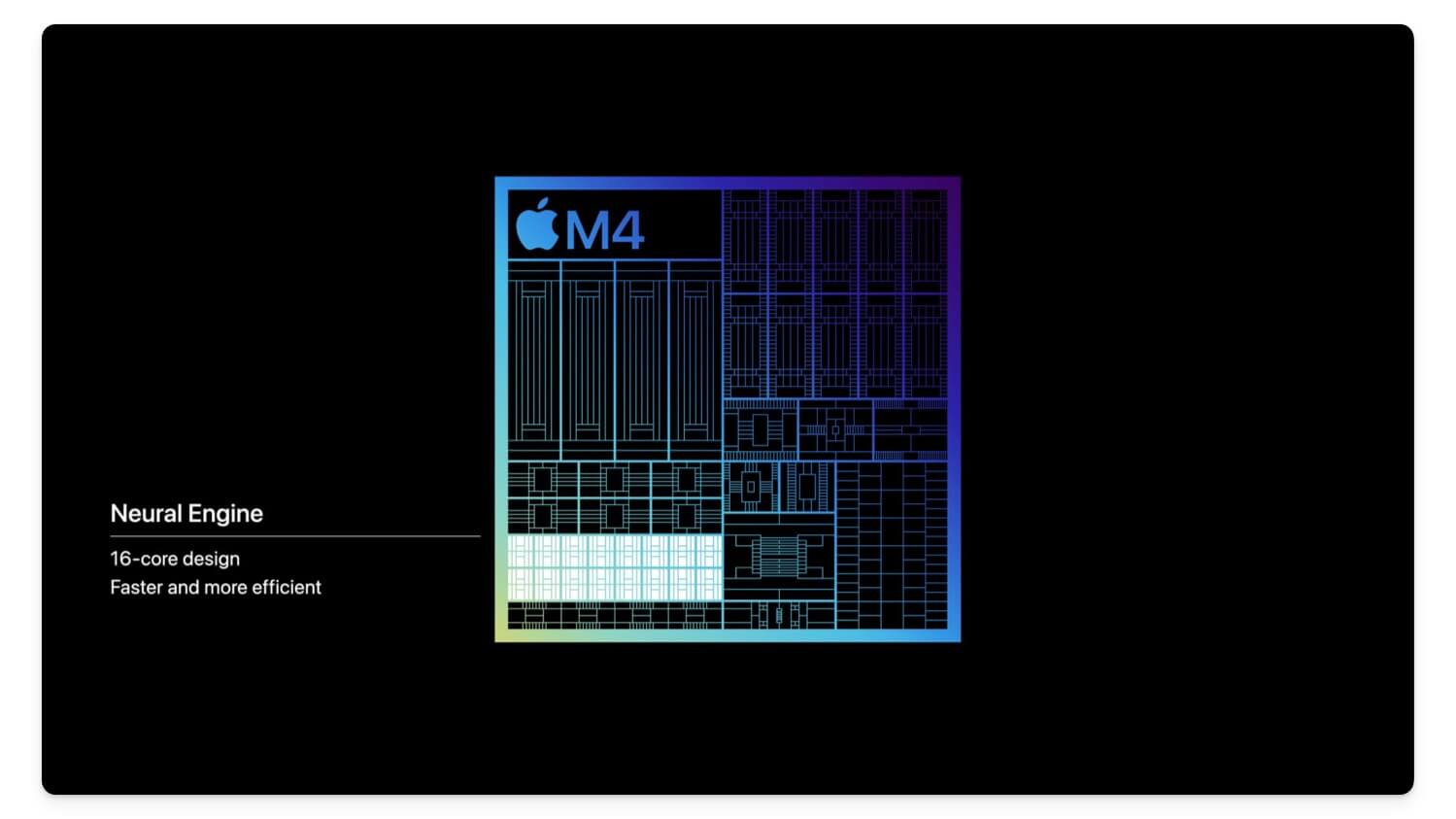
The Apple M4 features a 16-core Neural Engine NPU integrated directly into the silicon and can deliver up to 38 TOPS (trillion operations per second) for AI processing power. Its performance per watt is slightly better than that of the Snapdragon. On the other hand, the Snapdragon X Elite comes with the Hexagon NPU, supporting local AI tasks and mixed-precision processing, including INT4, INT8, and FP16. Meanwhile, Apple M4 supports INT8 and FP16.
Both processors offer on-device AI features and real-time AI capabilities. Still, the Snapdragon X Elite has the edge regarding raw AI performance, with support for up to 45 TOPS, which can handle more demanding AI workloads better compared to Apple’s M4. However, the Apple M4 excels in efficiency and real-time tasks.
Based on my experience with the Snapdragon X Elite on the Asus Vivobook S15 OLED, its on-device AI features performed well and are helpful. While there isn’t any real-world AI benchmark data yet for the Apple M4, Apple’s implementation of the Neural Engine and AI processing is expected to be powerful and efficient.
Benchmark Test | Apple M4 | Snapdragon X Elite |
|---|---|---|
AI Performance (TOPS) | 38 TOPS | 45 TOPS |
Geekbench ML Score (Inference) | 9700 (Device: iPad Pro with M4) | 13000 |
Mixed Precision Support | Supports INT8 and FP16 | Supports INT4, INT8, FP16 |
Real-Time AI Tasks (Photo Processing) | 57 images/sec (Device: iPad Pro with M4) | 64 images/sec (approx.) |
HDR Image Processing | 506.2 Mpixels/sec (Device: iPad Pro with M4) | 480 Mpixels/sec |
Ray Tracing AI-Assisted | 17.7 Mpixels/sec (Device: iPad Pro with M4) | 15.2 Mpixels/sec |
Although no direct comparisons of NPU benchmarks for both processors are available, based on the leaked data and reported specifications, it is clear that both the Apple M4 and Snapdragon X Elite can handle advanced AI tasks effectively.
Conclusion: Which One Should You Pick?
Of course, M4 is the only option if you want a Mac. Suppose you are looking for a Windows laptop with the best battery option processor. In that case, you can go for a Snapdragon X Elite (X1E-84-100) and also consider Intel Lunar Lake’s processors, which offer more flexibility and better performance than the Snapdragon X Elite you want for a Windows laptop. The main advantage of Intel Lunar Lake is that it supports more applications than the Snapdragon X Elite processor. View my detailed comparison guide.
However, when comparing Snapdragon X Elite (X1E-84-100) and Apple M4, both the processors perform great in real-world performance, but Apple has a higher edge in CPU/GPU tasks.
In terms of single-core CPU performance, Apple has the higher hand, and in multi-core, the Snapdragon X Elite (X1E-84-100) beats the Apple M4. In terms of GPU, Apple is way ahead of Snapdragon X Elite (X1E-84-100). Finally, in terms of NPU, both processors have improved NPUs, whereas Apple’s approach might differ based on its Apple Intelligence. Windows’ approach is already working, and I had a great time using AI features on the Asus Vivobook S15 OLED laptop.
Finally, the Apple M4 is more powerful. It offers greater battery life and better security, whereas the Snapdragon X Elite (X1E-84-100) is best for multi-core performance, such as video and data processing, memory-intensive applications, and better connectivity. However, the Snapdragon X Elite (X1E-84-100) has limited app support for apps as of now, which is a big con and makes you think twice before opting for the Snapdragon XL.
Speaking of other important specifications of the Snapdragon XL and Apple M4, both offer modern connectivity, with Apple M4 supporting up to Wi-Fi 6.0 and Bluetooth 5.3. In contrast, the Snapdragon X Elite (X1E-84-100) supports Wi-Fi 7.0, Bluetooth 5.4, and 5G mode. As per video playback, the Apple M4 can play 4K 60, while Snapdragon X Elite (X1E-84-100) can play 8K 60 and 4K 120. It also has a security touch ID.
Finally, We have a clear winner: the Apple M4; however, the Snapdragon X Elite (X1E-84-100) is very close. We cannot directly pick as both processors are designed for different platforms. Snapdragon X Elite processor is also very good and, in fact, better in multi-core performance, but looking at all aspects and when comparing both, the winner is Apple M4, which holds the crown as the most advanced and powerful choice. If you are looking for the best performance and battery, Go for the Mac powered by the M4. If you are considering Windows, You can choose Snapdragon X Elite or the latest Intel Lunar Lake.

