

In Summary
- The Nothing Headphone (1) are the brand’s first pair of over-the-ear headphones, and have been made in collaboration with KEF.
- They have a very different design, and come with premium headphone features including ANC, great battery, and a very extensive tuning system (via the app), and also packs in some very innovative features, such as a roller and paddle-driven interface.
- At $269/Rs 21,999, the Headphone (1) face some very serious competition from headphones from Sony, JBL, and Sennheiser.
The Nothing Headphone (1) have easily been the most talked about headphones of the year, thanks to their stand-out design and their association with the legendary KEF audio brand. That said, at $269/Rs 21,999, they face some serious competition from premium headphones from well-established brands like Sony, Bose, and JBL. They do bring a lot to the table, especially in terms of smart features, but is that going to be enough to convince people to invest in them?
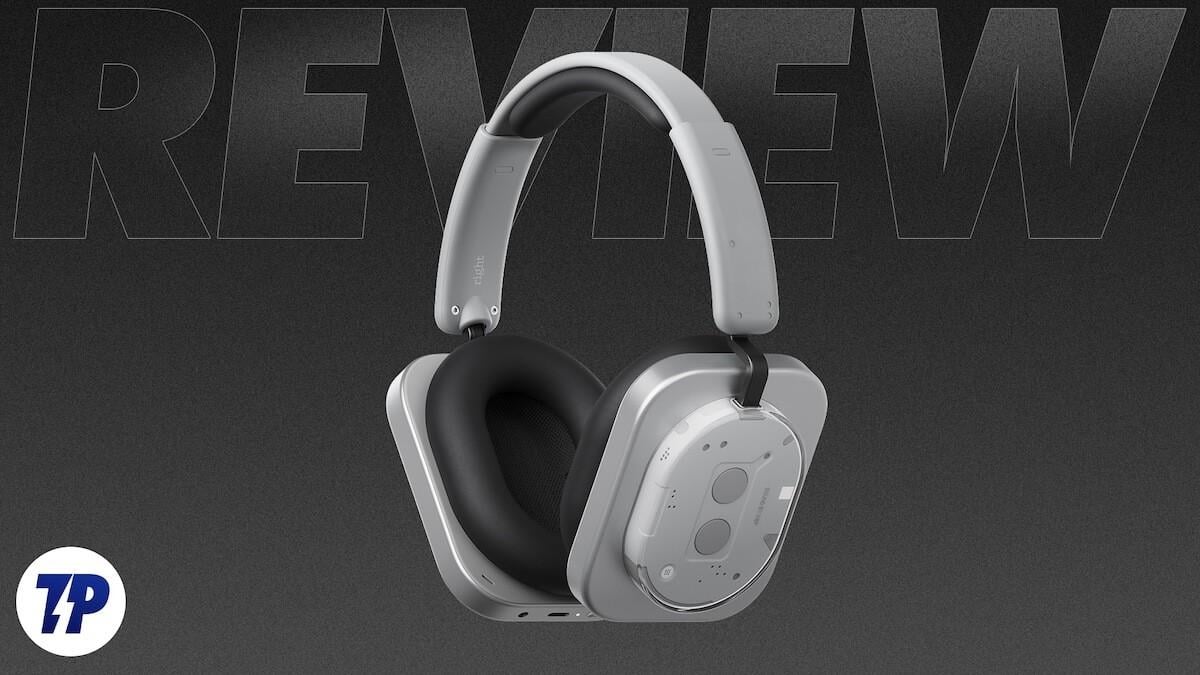
Table of Contents
Nothing Headphone (1) Design and appearance: Stand out? Definitely. Outstanding? Well…
The Nothing Headphone (1) has the most talked-about design since the AirPods Max. And just like those premium headphones, these ones, too, will stand out from the routine headphone crowd. Whether they look good or not is a matter of taste, but they certainly will turn heads because of their very unusual design.
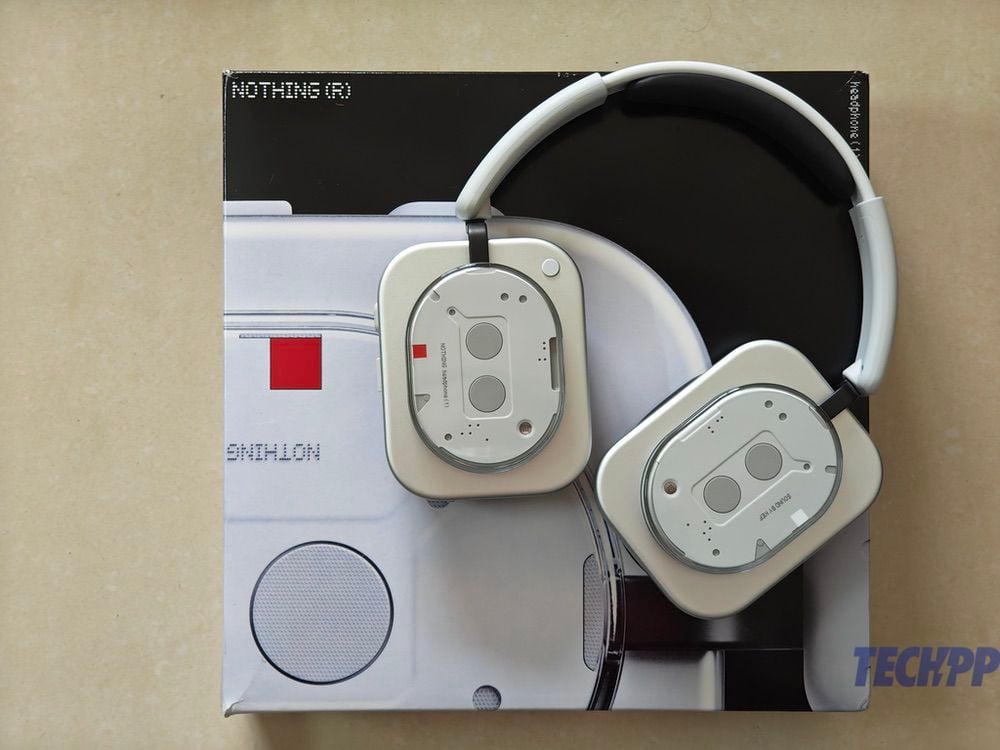
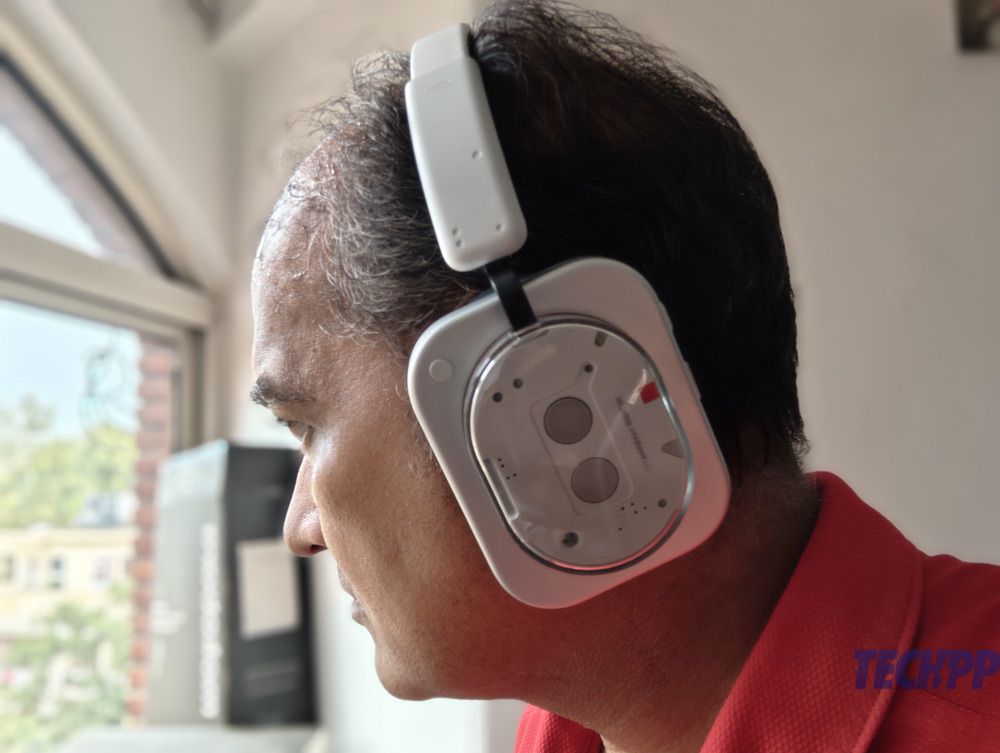
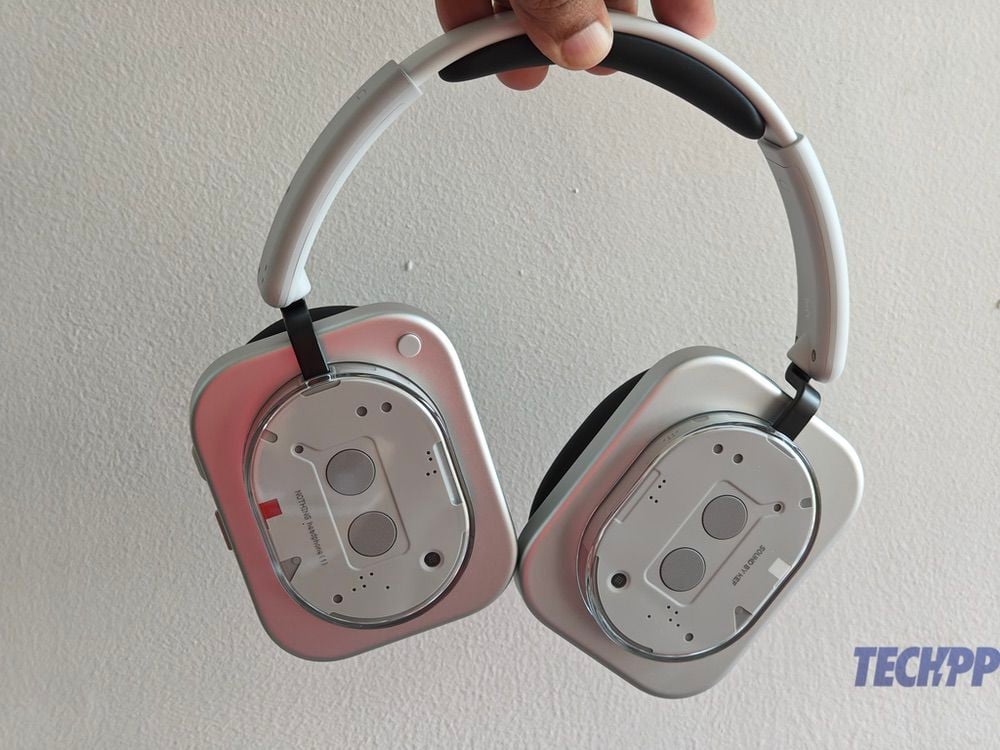
The first thing that will hit you about the Nothing Headphone (1) is just how large they are. This is because of their unique shape. While most headphones follow the concept of circular (actually oval) cups connected by a headband, the Headphone (1) has circular cups placed on square metallic slabs. The back of these oval cups have a cassette tape-inspired design, while the inner parts contain thick cushions. As a result, although the cushions themselves are round-ish like conventional headphones, the Headphone (1) have a squarish shape, and look larger than usual.
The two earcups are connected to a headband through a thin, metallic hinge, which rotates 90 degrees. As a result, the headphones cannot fold inwards and can only rotate in one direction. This makes them a little bulky, but fortunately, Nothing has included a very good case in the package, which keeps them safe. The headband itself is made of plastic and comes with a very thin line of padding on top – features that detract from the overall premium feel of the headphones. Nothing has claimed that the design is minimalistic, but we think it is a little crowded, given how bare most headphones tend to be.
At almost 330 grams, the Nothing Headphone (1) are definitely on the heavy side. And while they are very comfortable to wear, their weight means that one does get a little exhausted while wearing them for long periods (something that is also the case with the AirPods Max, which are even heavier). The square plates also make the Headphone (1) a little difficult to wear around one’s neck for long when not using them, as they tend to poke into one’s neck or collarbone. The controls are on the right square plate, with a roller button and paddle on the side, a tiny button on the outer part of the plate, an almost hidden flat button near the right earcup, while the base has an on/off slider, USB Type-C port, and a 3.5 mm audio jack, all near each other. The distance between the buttons is a little odd, as they would have been easier to use if kept near each other.
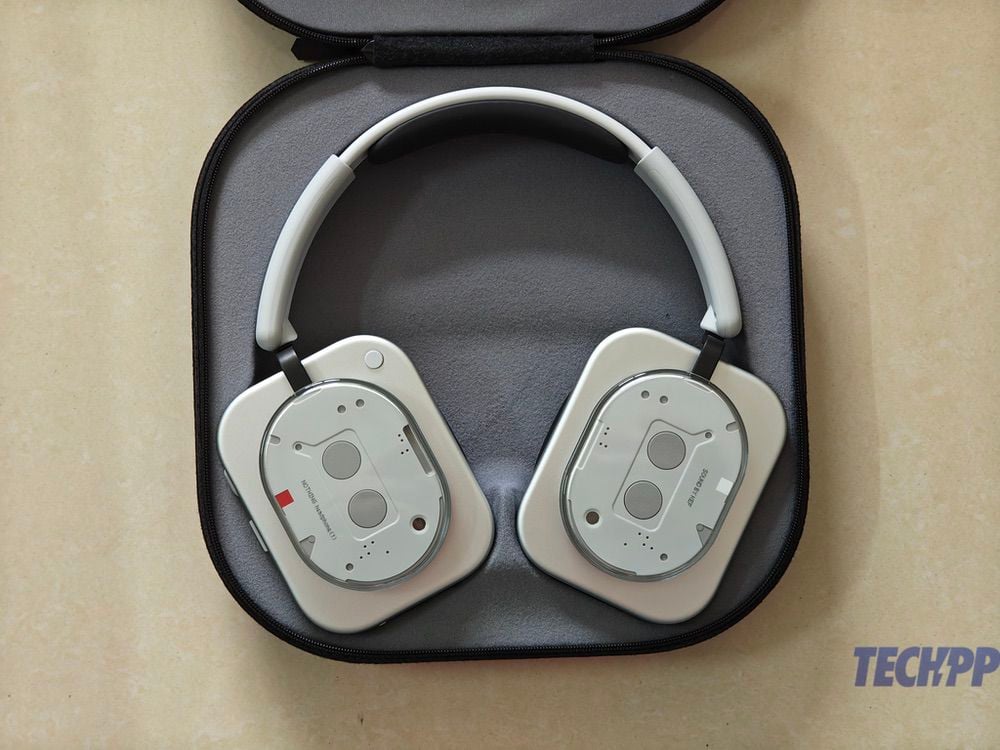
The Headphone (1) is available in black as well as white. We would recommend going for the white one, as it shows off the design on the cups much better and will turn more heads. Those wanting to attract less attention can go for the black variant. In a neat touch, Nothing has kept the earpads and headband cushions black for both color variants, ensuring that they do not appear dirty after every use. They also come with an IP52 rating, which means they can survive splashes of water and should see through a stroll in the rain, although their size makes them slightly inconvenient for extended gym sessions.
They are not perfect. We would have liked more metal and padding on the headband, a more solid hinge, and generally greater wearing and carrying comfort, but the Nothing Headphone (1) are unlike any headphones out there, and are a great way to get noticed, if that is what you seek. They certainly stand out, but whether they are outstanding is a matter of personal preference – we personally like how different they look, but they can get a little bulky and hefty!
Nothing Headphone (1) Specs: Ticking those flagship boxes
In terms of hardware and features, the Headphone (1) pack in pretty much everything you would expect from a premium pair of headphones. They come with 40mm dynamic drivers, tuned by one of the most famous names in audio, KEF, and support a very wide frequency band of 20 Hz – 40 kHz, and can handle AAC, SBC, and LDAC audio formats. They come with a total of six microphones (four for calls) and have adaptive active noise cancellation (ANC) and environmental noise cancellation (ENC). They have Bluetooth 5.3 connectivity and can connect to two devices at the same time, with support for Google Fast Pair and Microsoft Swift Pair. Also onboard are on-head detection and a special low-lag mode. The headphones work with all operating systems and can be tweaked using the Nothing X app, which works with both iOS and Android. Keeping them running is a large 1040 mAh battery, which charges over USB Type-C.
Nothing Headphone (1) Controls: Buttons beat touch, but there’s a learning curve
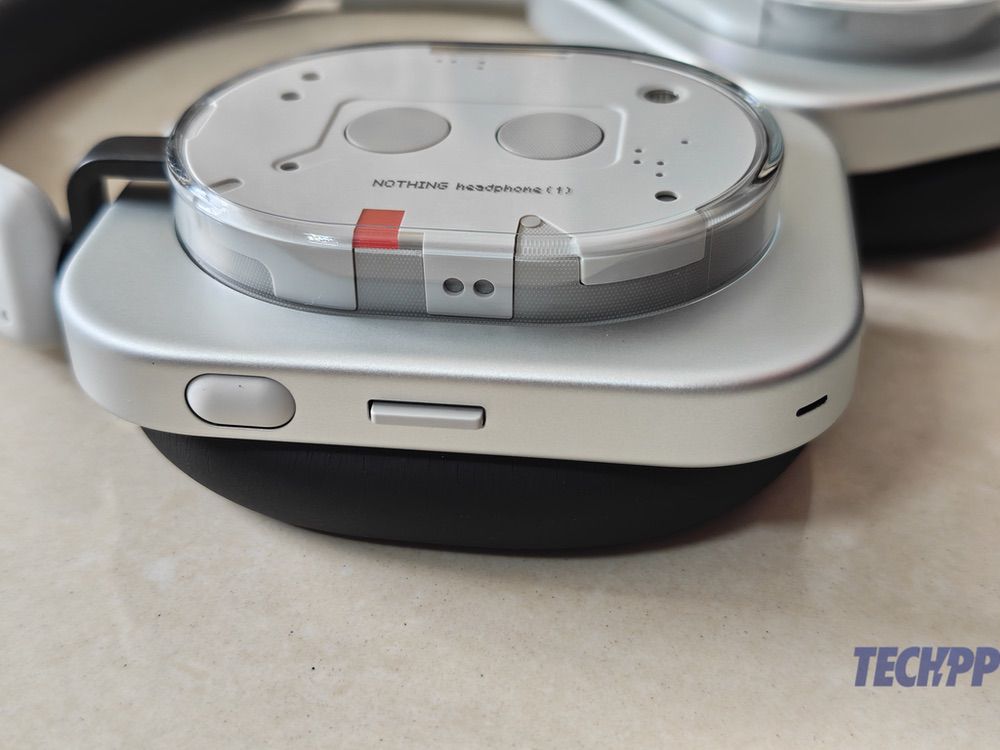
The Nothing Headphone (1) come with a totally button-driven interface, with some typical Nothing touches to it. The on-off slider on the base switches the headphones on and off and is a feature that we wish more headphones had, instead of button presses. To pair a device, long-press the button that is near the right earcup (it is almost flush with the surface, so it can be easy to miss). This will lead to a tiny LED light near the USB Type-C port to start blinking. This means the Headphone (1) are in pairing mode – one just needs to select them from the Bluetooth device list in the Settings on your phone.
But that is where the conventional button usage ends on the Headphone (1). The two buttons on the right side are a roller and a paddle, designed so that they can be easily distinguished from each other. The roller mainly controls the volume – moving your finger across it to the left decreases the volume, while moving it to the right increases it. Similarly, moving the paddle to the left takes one to the previous track, while moving it to the right takes one to the next track. It is a brilliant execution, especially as increases and decreases in volume are accompanied by tiny tactile clicks. Pressing the roller can also pause or resume playing audio, and long pressing allows one to switch between transparency mode and ANC. Similarly, pushing the paddle to the right enabled us to accept a call, while pushing it to the left allowed us to reject it. The one button on the outer part of the right earcup summons Gemini.
We needed a bit of time to get familiar with this interface, but we definitely preferred it to the touch, swipe, and tap UI that accompanies many premium headphones and TWS these days. What’s more, these controls can be customised using the Nothing X app. The different textures and shapes of the buttons are a good touch and make them easy to identify by just a touch, and once you get the hang of them, using the Headphone (1) is as easy-peasy as it gets. We just wish they had all been placed close to each other – having four buttons at three different locations on an earcup is frankly inconvenient.
Nothing Headphone (1) Audio quality: Go for that equalizer for the best results
How good the Headphone (1) sounds depends on the time you are willing to invest in tuning them. Given their association with KEF, we had extremely high expectations for the audio quality of the Nothing Headphone (1). However, the audio we got right out of the box seemed a little too dark, with weak mids and not very prominent treble – in fact, a bit like a slightly muddy version of the Sony ULT Wear. Those who love thick bass that is not too rumbly might like them, but we found them a little underwhelming. They tend to sound a little better on Nothing’s own phones (we used them with the Phone (3) and the Phone (3a) Pro), but they are still not quite premium quality, right out of the box.
Fortunately, the companion Nothing X app saves the day. The Headphone (1) is wonderfully sensitive to equalizer settings. One can choose from a “simple” option that lets you choose from four presets: Balanced, More Bass, More Treble, and Voice, and also lets one do some basic bass, treble, and mids tweaks. One can also opt for more advanced tuning and get access to a parametric equalizer that allows you to adjust different levels in detail, and even change the Q Factor – very much an audiophile zone (although spatial audio has to be turned off to use this). We would have liked some simple presets for beginners (of the “jazz,” “pop”, “rock” variety), as newcomers will not get the hang of this easily. Get the equalizers right though – we turned down the bass a bit, and moved up treble and mids – and the Headphone (1) suddenly sounds like a very good proposition. We have been using the headphones for a month, and we are still figuring out what works well, which can be rewarding and irritating in equal measure. Once you get things right, the detail is impressive, and the treble is present without being piercing. Mids are their weak point, though, especially if you have been spoiled by the likes of Sennheiser.
Spatial audio and dynamic head tracking, which are rare at this price point, work reasonably well, although not as well as on the (more than twice as expensive) AirPods Max. While spatial audio does make one feel surrounded by sound, the soundstage of these headphones remains a relatively narrow one, as is often the case with Bluetooth ANC headphones. Get them to sound right and the Headphone (1) work just fine in all scenarios – music, podcasts, gaming, watching films…the works. In fact, given the sensitivity of the headphones towards the equaliser, we would recommend having different settings for each!
The sum total of our experience is this: these can sound wonderful if you are willing to spend time tuning them. Mind you, these come from Nothing, so we are sure there are updates in the works to improve matters. In many ways, these remind us of the Nothing Phone (1) – a little eccentric out of the box, but full of potential for those willing to give them time.
Nothing Headphone (1) ANC, Calls, and Battery life: Bossing the smart zone

Their audio might need some work, but in other regards, the Nothing Headphone (1) tick the premium boxes quite thoroughly. Their call quality is top-notch and among the best we have seen in any Bluetooth headphones (second perhaps only to the AirPods Max), and people we were speaking to never realised that we were actually using headphones for the purpose. Unfortunately, this is where their weight gets to be a bit of an issue, as wearing them all the time can be a bit of a strain.
In terms of ANC, the Headphone (1) come with three levels of noise cancellation (low, mid, high) that one can adjust from the app. One can also opt for “Adaptive,” in which case the level of ANC is worked out automatically depending on the noise in your surroundings. The ANC is decent enough to lessen the sound of traffic or some of the chatter in a noisy cafe, but it is not in the class of what one gets from Bose’s QuietComfort or Sony’s WH-1000 XM series. The effect one generally gets is of a slightly loose door being shut on a noisy room – the noise gets reduced, but still comes through. Transparency mode is quite good, letting you hear a fair amount of the world around you, though there is no attempt to highlight voices over other sounds. There is also a sound of someone exhaling when we switch from ANC to transparency mode, which can be a little distracting. Multipoint connectivity works smoothly too, with the buds switching seamlessly from one device to another, depending on the source of sound.
Another area where the Headphone (1) shine is battery. The brand promises 30-35 hours of battery life on a single charge with ANC on, and the headphones deliver that. We consistently got through close to a week of usage on a single charge with ANC on, and this almost got doubled when we switched ANC off (Nothing claims 80 hours of battery life without ANC, which is quite a number). While the headphones take about two hours to charge fully, a five-minute charge got us a couple of hours of usage with ANC. If you can put up with their weight, these are super for those who use their headphones for calls and music throughout the day.
Nothing Headphone (1) Pricing: Premium, and taking on Sony, Sennheiser, and Bose

The Nothing Headphone (1) come with a price tag of $269/Rs 21,999. That puts it in the premium zone, against some very tough competition. Its biggest challengers are the JBL Tour One M2, which come with better ANC and slightly better sound out of the box and are priced at $249/Rs 19,999. Also dangerously close are headphones that have slightly higher price tags but are often available at lower ones, thanks to special offers. These include the Sennheiser Momentum 4, which come with perhaps the best audio quality on any premium ANC headphone; the Sony WH-1000XM5, which are not in the same audio league but are the boss of ANC; and the Bose QuietComfort, with the trademark soft and yet rich Bose sound and amazing ANC.
Nothing Headphone (1) Review Verdict: Get them for being different
We will keep it brutally simple: the Nothing Headphone (1) is a great set of headphones for those who want to stand out in the crowd. Their design will not appeal to everyone, but will definitely turn heads. Take the design out of the equation, however, and the Headphone (1) start facing serious competition. There are headphones that sound better out of the box (and many ANC headphones users do not like tuning their headphones), offer better ANC, and are more comfortable while having a more reassuringly solid build.
That said, the Headphone (1) do have a lot going for them. Their call quality is excellent, battery life is superb, and they come with an outstanding companion app. Even the ANC, while not exceptional, is good enough for most users. Spend some time pairing them with the right equaliser and they start sounding very good too. And that design, while eccentric, does have a reasonably good control system in it. Handle them a little carefully, and you are assured of quite a premium experience. These are easily the most noticeably different headphones in the market.
Buy Nothing Headphone (1) – USA
Buy Nothing Headphone (1) – India
- Very different, head turning design
- Superb at calls
- Terrific companion app
- Very good audio, once adjusted
- Spatial audio with head tracking
- Good battery life
- Sturdy accompanying case
- Some might not like the audio out of the box (too bassy, poor mids)
- Design is polarising, and some parts are not premium
- Heavy and not very comfortable
- Button locations are odd
| Design & Appearance |
|
| Audio Quality |
|
| ANC |
|
| Battery Life & Calls |
|
| Price |
|
|
SUMMARY
The Nothing Headphone (1) stand out with their bold design, solid call quality, and great battery life, but face stiff competition on sound, comfort, and ANC. Best for those who want different. |
4.1
|

