

In Summary
- WWDC 2026 was notable for Apple’s focus on AI. The Cupertino brand has had limited success on the AI front so far, and is perceived to be lagging behind the competition.
- Contrary to popular perception, Apple has not always been a pioneer in the field of technology. Its real strength has been its ability to make existing technology user-friendly and implement it effectively.
- Although AI has been around for a while now, the AI experience remains scattered across different devices and platforms. What it really needs is a classic Apple touch to go really mainstream. Judging by WWDC 2026, that might happen very soon.
The last few years have seen the tech world develop an almost unhealthy obsession with AI. AI this, AI that, AI there, AI then – rare indeed is the gadget or app which has not yet had an encounter with AI. When a kind of technology gets this popular, it builds pressure on brands to introduce it in their products, whether they are ready for it or not. And that leads to the vicious cycle of hype.
As with many trends and innovations, there is one brand that has seemed immune to the cycle of hype, preferring to take its own sweet time to warm up to new features and technology. Yup, we are talking about Apple, the Cupertino tech behemoth.
Notwithstanding the perception many have of its being a master inventor, Apple, throughout its history, has, in fact, not very often come out with something completely new. Iconic features and products that many credit to it actually existed in other products before Apple used them on its own. Touchscreens on phones, fingerprint scanners, face unlock, app stores, portrait mode in cameras…all existed before Apple created its own version of them, many of which went on to become cult products. It is not invention where the brand excels, but implementation.
Now, some might consider this to be a shortcoming, but we think it is actually a core strength, and that both tech and humanity have benefited from it.
Apple does not invent. It implements
From the very beginning (the Steve Jobs era), Apple has put a lot of focus on how a device, feature, or technology blends into the user’s life. A lot of emphasis has been placed on how to deliver devices or features that can be added to or used seamlessly in the user’s life, without feeling overwhelming. User interface – the part of the device that the user actually comes in contact with – has often been given top priority, and implementation of technology has received more attention, instead of just adapting what already exists. Apple is not immune to peer pressure and often gets on a trend bus, but it does so on the back of some heavy-duty homework. And quite often, the way in which it handles a feature or a technology makes it an industry standard. Apple does not often invent, but it almost always innovates and implements.
With AI, Apple’s approach has been very different. It first brought in AI – Apple Intelligence as the brand called it – in 2024, at a time when AI was already making waves and Apple’s competitors were pushing it. Although it was already late to the AI party, for once, Apple seemed to have made its AI move in a rush. In the days that passed after its release, it became clearly evident that whatever AI Apple offered was not nearly enough to match what the likes of Google, Meta, OpenAI, Microsoft, and Samsung had to offer. Even more surprisingly, there was nothing very innovative or different in Apple’s take on AI – its presentation seemed very similar to that of others, which was a massive let-down.
Apple needs AI, but AI needs Apple too
At WWDC 2026, it seemed that Apple had finally decided to up its AI game. WWDC this time around was easily the most AI-focused event we have seen from Apple. Siri AI, Apple Intelligence 2.0, more powerful Vision Intelligence, AI add-ons in Photos, Safari, and many more AI features were announced and introduced. Many of these existed in some form or another, but what was notably different was Apple’s approach to them. There was greater talk of privacy and of making AI part of the operating system, resulting in AI on Apple devices being a safe, seamless system-wide experience instead of just being limited to a few areas.
Apple’s finally coming to the AI party is important because although it has been around for more than two years now and is found in most mid and high segment phones, tablets, and notebooks, AI still comes with a significant learning curve. For all the hype around it, AI is right now more comfortable on our gadgets than in our lives. Judging from what we saw in WWDC 2026, Apple has the power to solve this major issue. While introducing (or reintroducing) AI features, Apple’s focus seemed to be on how to make AI as easy to use as possible, and how to make it the next FaceID or Portrait mode of the tech world. And that is exactly what not just Apple, but also AI, needs.
Will Apple make AI “disappear” (well, kinda sorta)
AI today is quite scattered. One platform is better for building presentations, another has a better chatbot, one is better for studying, while a different one is great at generating images or videos. Users have to get into trial and error mode to find the one that not only suits them best but also can fit into their device ecosystem. Most end up switching between different AI systems throughout the day – Gemini on their phones, CoPilot on PCs, a bit of ChatGPT on both, and so on. All of which hardly seems seamless. Pun unintended.
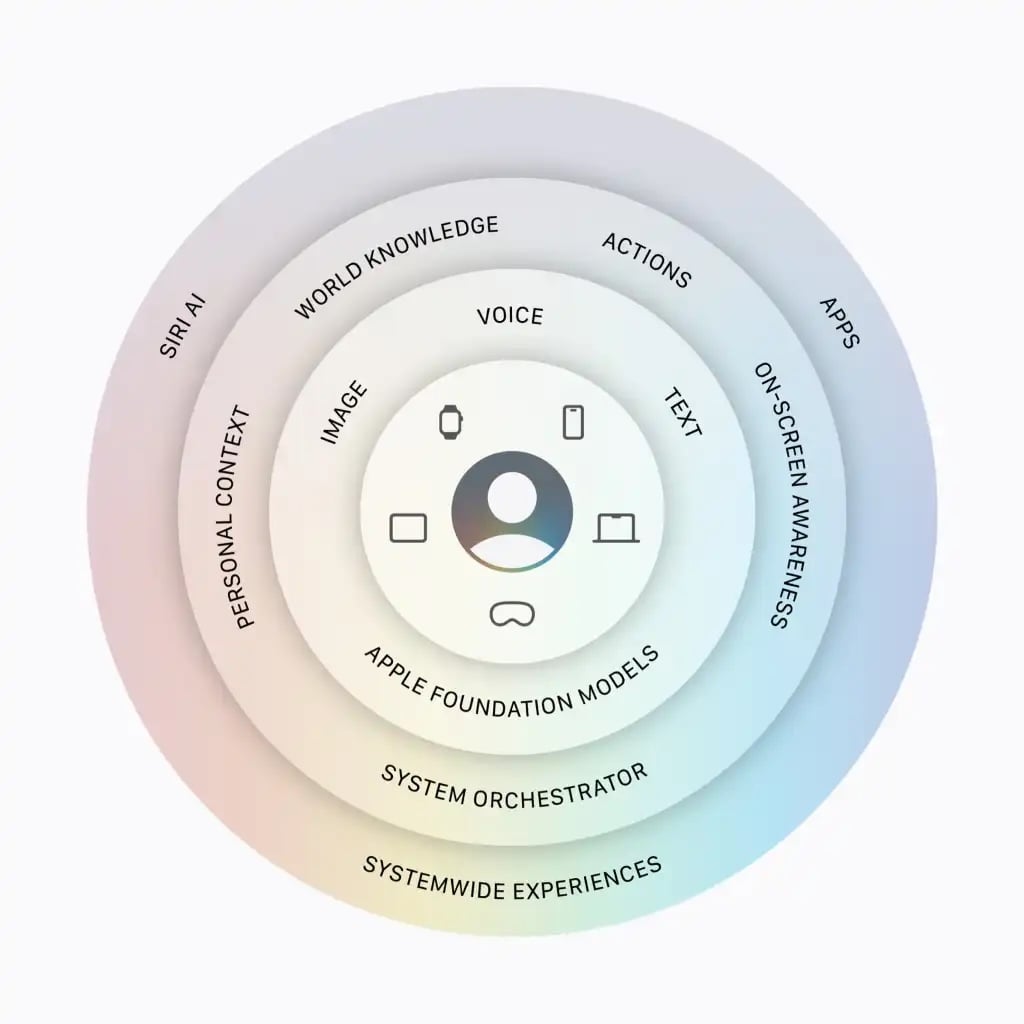
This is where Apple has an edge. Thanks to its famed ecosystem approach, the Apple software experience is broadly consistent across its devices. Devices like the iPhone, iPad, MacBook, Apple Watch, and AirPods are designed not just to work with their users but also with each other. Connectivity and information flows right through the whole ecosystem, which is religiously and regularly updated across generations. WWDC 2026 revealed that AI in the Apple world will not just be mainly for computers with watered-down versions made for other devices, but is likely to be very similar across them all – something that very notably did not happen with the first iteration of Apple Intelligence. If second time is the charm in Apple’s AI world – and WWDC 2026 did show a more unified approach – then Apple might do for AI what it did for computers, phones, and tablets: provide a new standard, which is easy to use and is so aspirational that others will rush to cop…er…be “inspired” by it.
So perhaps it is good after all that Apple has taken its sweet time to warm up to AI. It might not have got off to the best of starts (hey, the first iPhone had its headaches too), but WWDC 2026 basically confirmed that Apple is trying to tackle AI in the way it knows best– by making it feel as natural and mainstream as possible, so much so that we do not even realize we are using it. Apple has made its appearance at the AI party; now its challenge is to make AI disappear by making it so integral to the product experience that one does not notice it. Can Apple do it? Well, WWDC 2026 showed us that it has the right ideas. All that it needs to do is implement them.
And Apple’s strength is implementation.

