

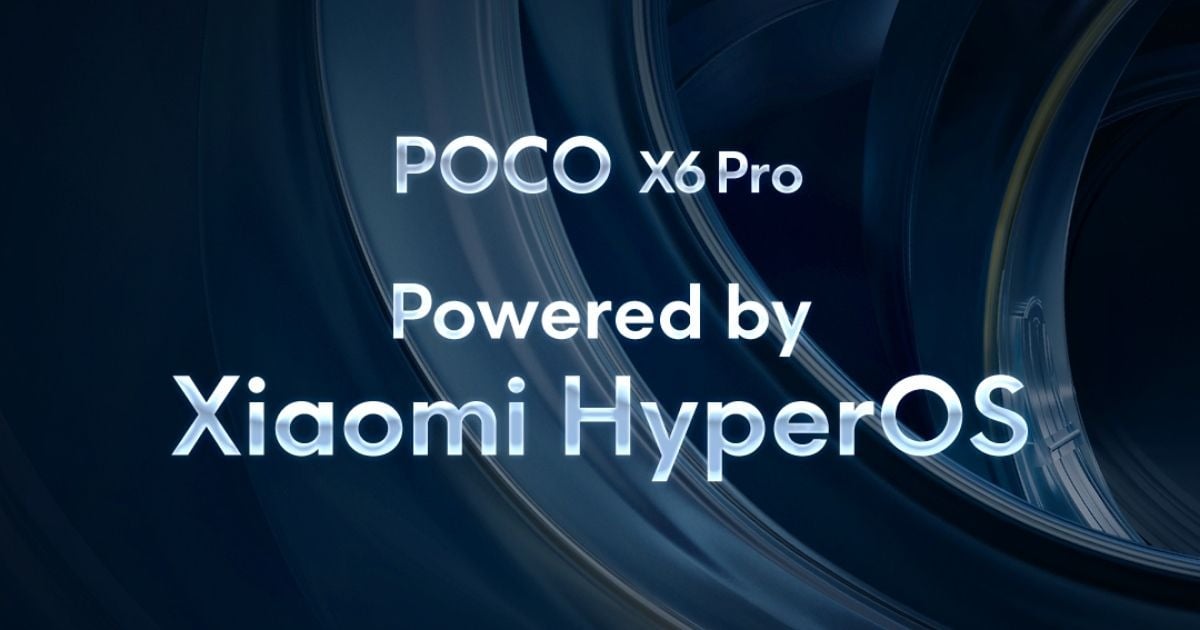
It was a single slide, but it got Himanshu Tandon more attention than the rest put together. The Country Head of Poco India was briefing the media on the Poco X6 series and had started with the Poco X6 Pro. For a while, the briefing had progressed on predictable lines. And then that slide popped up. We do not remember what the exact words on the slide were, but their meaning was clear to everyone in the room – the Poco X6 Pro would be the first phone in the Indian market to come with Xiaomi’s much-talked-about HyperOS out of the box.
Getting HyperOS first – a Note-able win?
On the surface, that might seem just like another spec brick in the phone wall. But it was much more than that. Poco was getting a much-talked-about OS from its parent brand much before any other Xiaomi or Redmi (Xiaomi’s most popular brand in India) phone did. More significantly, Redmi itself had launched its flagship Redmi Note 13 series in the Indian market just a few days prior to this briefing. The Redmi Note 13 series is part of one of the highest-selling phone series in India (more than 75 million phones sold), and well, it did not come with HyperOS out of the box and is scheduled to get it later. Poco had been able to release a phone with a new flagship OS before its higher-profile sibling.
Of course, the reason for this might be more technological than strategic – the Poco X6 Pro is a newer device that has just been launched globally, while the Redmi Note 13 series was launched in China in late 2023. However, even taking that into consideration, that slide reflected a trend that is emerging in the Indian smartphone market – Poco is emerging from the shadow of Redmi and Xiaomi in India.
Starting out, disappearing, coming back…and now growing!
To understand why this is important, one needs to understand Poco’s role in the Xiaomi brand story in India. The brand made its debut in India in 2017 and was seen as a rival to OnePlus. In spite of an impressive start, Poco went into a hibernation of sorts, and when it returned, it was in an avatar that seemed more targeted at Xiaomi’s mid-segment rival, Realme. Whereas the first Poco had flagship-killing genes, the new one seemed more like a Redmi device with often very similar specs under a differently designed hood and with more spiky comms. And as it kept a distinctly lower profile as compared to Redmi and Xiaomi devices in India, it was perceived in many quarters as being inferior in terms of quality – a few tech issues with some of its devices (the famous “motherboard” issue) did not help.
That, however, has been changing over the past year. 2023 saw Poco consistently post impressive sales figures. So much so that in Q3 2023, as per IDC, it was among the top ten smartphone brands in the country, taking seventh place with a 5.7 percent share, actually selling more than Apple (5.5 percent) and within striking distance of OnePlus (6.2 percent). Its growth rate of 50.8 percent was also the highest in the top ten. Interestingly, Xiaomi’s own share at this time was 11.7 percent.
Moving on from being bros
There are many reasons for this sudden surge. The brand’s X and F series have done consistently well and generally have been very distinct from their Redmi siblings in terms of design and specs, although the M series is still seen as the “Redmi number series with a different name and design.” There has also been a notable change in the communications strategy – the brand reached out to users with motherboard issues on its phones and offered to fix them. Poco launches have become more elaborate and detailed in recent times. The brand tried to simulate the inside of a phone for the X6 series briefings and had an on-stage briefing session.

Most importantly, the brand seems to have distanced itself in perception terms from its better-known parent and sibling. Xiaomi and Poco have gone from being brothers from the same mother to occupiers of different rooms in the same building – their foundations might be similar, but their lives seem very different.
This was not always the case. Indeed, for quite a while, it was common to see Poco and Xiaomi executives refer to each other’s brands at briefings. This reduced visibly when Anuj Sharma (interestingly, the current CMO at Xiaomi India) took over the reins at Poco India and has all but disappeared now. It was also the time when the brand introduced its “made of mad” positioning, appealing to a younger and more brash audience. Combined with some clever brand placements (notably in the film Pathan) and celebrity tie-ups, this has helped Poco forge a different identity for itself.
So much so that when Xiaomi India President, Muralikrishnan B, was asked about Poco at a briefing outlining Xiaomi’s plans for 2024, he smiled and replied that he was here only to discuss Xiaomi and Redmi. Himanshu Tandon also refrained from commenting on why the Poco X6 Pro had got HyperOS and Redmi Note 13 had not. “You will have to ask them. We are happy to get it for our users,” he said.
Becoming its own person…and back to taking on OnePlus
Of course, there are strong similarities between the brands even now, not least in terms of the OS that runs on their devices, and in some cases, their phones still seem strikingly similar. But there are strong indications that almost seven years after starting out as a Xiaomi sub-brand, Poco might finally be stepping out from the shadow of Xiaomi and Redmi in Xiaomi’s biggest market. And by some coincidence, after spending years battling against the likes of Realme and iQOO, the brand has come full circle and has got OnePlus back in its sights. In response to a tweet on X, Himanshu Tandon said,
True 2024, POCO vs OnePlus 💪💪 https://t.co/D93Y8eyVqV
— Himanshu Tandon (@Himanshu_POCO) January 11, 2024
And even as this was being written, the Poco India official handle on X, tweeted:
Not settling for NORDinary!
We pitted our #POCOX6Pro and Nord 3 to a Speed Test. Check e’m out 😈First Sale on 16th Jan, 12 Noon on #Flipkart Know More: https://t.co/xEBQwejv1e#POCO #POCOIndia #Flipkart pic.twitter.com/fhbL1tMetm
— POCO India (@IndiaPOCO) January 12, 2024
The “made of mad” brand has had some crazy success and is now back to its original mission – to unsettle a Never Settler. 2024 could be interesting.
Or, maybe, maybe…it could be (made of) mad?

