

In Summary
- After being a niche and mainly premium player in the Indian smartphone market, Apple became one of its leading brands in terms of volumes in 2025, often shipping more units than even the likes of Xiaomi, Realme, OnePlus, and Motorola.
- While many observers attribute Apple’s success in India in 2025 to the “premiumisation” of the smartphone market, that is only part of the reason.
- At the core of the iPhone’s epic 2025 in India lies sound inventory management and clever pricing, which have taken the iPhone from being a niche premium device to a more accessible and mainstream one.
While there were many tech stories in India in 2025, perhaps the biggest one was the rise of Apple in the smartphone market. After years of being seen as niche and mainly for the upper classes, the iPhone made its mainstream breakthrough in the Indian market this year. It was among the top five brands in the country in terms of shipments for most of the year, and in Q3 2025, it was actually the fourth most popular phone brand in the nation, with a 10.4 percent market share. The iPhone shipped more units than Xiaomi/Redmi, OnePlus, Realme, iQOO, and Motorola, most of whom had much larger portfolios and phones at significantly lower prices, in what is considered to be a very price-sensitive market.
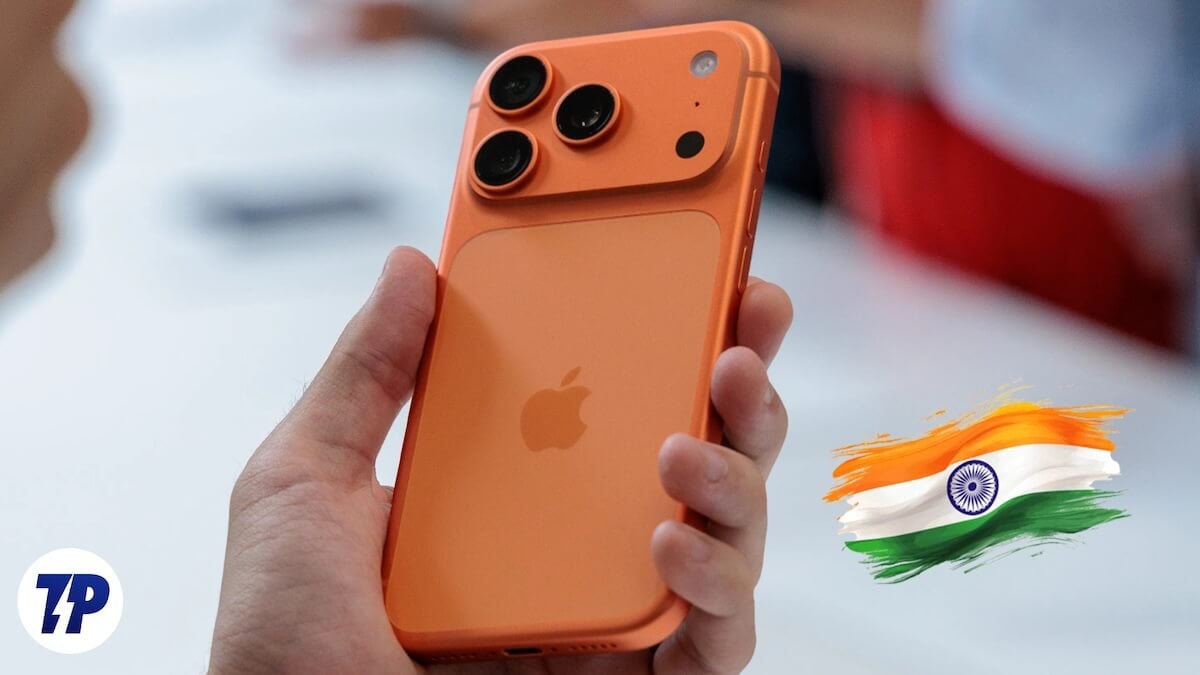
From around 5 percent to almost 10 percent market share…and the highest-selling phone in India!
After hovering around a 3-5 percent share of the market (which in itself is pretty impressive when you consider the pricing of iPhones), Apple had grabbed a surprising 9 percent of the Indian market in Q4 2023, suddenly emerging as a prominent player, even though it still could not break into the top five. However, many considered that surge to have been a blip driven by festive discounts. And that seemed to have been the case indeed, when Apple’s share went back to its usual 4-6 percent level in the first two quarters of 2024. The brand again registered a small increase to 7 percent in the third quarter, and then stunned many analysts by entering the top five brand list for the first time in Q4 2024 with a market share of 11 percent.
To prove that this increase was not a one-off boosted by festival discounts, the iPhone’s market share in 2025 has stayed steadily close to double figures, fluctuating between 7 and 10 percent. In fact, the most shipped phone in the Indian smartphone market in 2025 has so far been the iPhone 16 – it topped the charts in Q1, Q2, and Q3 of 2025, and by all accounts, should top Q4 as well. What makes the iPhone 16’s success all the more remarkable is that it started out the year at Rs 79,999 (about USD 890) and at the time of writing was available for about Rs 66,000 (about USD 735), and both prices are more than twice that of the average selling price of a phone in India, which most analysts say is in the vicinity of USD 295.
In short, the iPhone has replaced phones of the stature of the Redmi Note, the OnePlus Nord, and Samsung’s famous A and M series as India’s highest-selling smartphone. And Apple has become the fourth largest brand in a market where more than 80 percent of the devices are under USD 400 – and it has none in that price zone itself (although the iPhone 13 occasionally reaches that price). Some stunning facts in Q3 2025 were::
- One in every ten smartphones shipped in the Indian market was an iPhone.
- One in every twenty smartphones shipped was an iPhone 16 (it had a 5 percent share of all shipments).
- There were more iPhone 16 devices shipped in Q3 2025 than the entire portfolios of Poco, OnePlus, and iQOO.
Those are staggering numbers by any measure. So what changed things so radically for Apple in 2025 in India?
Not just “premiumisation”!
The rationale offered by many observers and analysts for this growth is twofold:
- Premiumisation: the Indian smartphone market is becoming more premium, and consumers are willing to spend more on smartphones, which has also driven up the average selling price (ASP) of smartphones in general in India.
- Apple’s improved retail presence, iPhone manufacturing in India, and offers and schemes.
Both factors have surely played a part in Apple’s rise in India in 2025, but there is something far more basic at play, too. It involves a very subtle change in Apple’s strategy, and its roots lie in a move made by an Indian operator in 2012.
The lesson of 2012: the iPhone that was sold – and sold out – for Rs 9,999
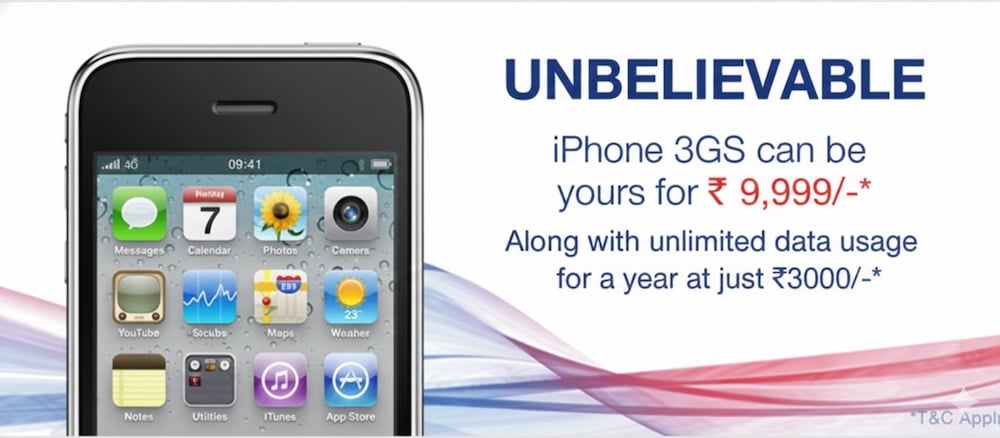
In July 2012, with the iPhone 5 set to be launched, Indian cellular operator Aircel stunned everyone by announcing that it would be making the three year old iPhone 3GS available at a surprisingly low price of Rs 9,999 (About USD 111 now, and about USD 185 then), which was less than a third of the price at which it had been originally launched in 2009, although Apple did come out with a lower priced variant of it in 2011.
While hardcore iPhone loyalists (the ones who lined up for the new iPhone) sneered at the offer, saying that buying an old iPhone hardly made any sense, the iPhones under the offer were literally sold out within hours in many Indian cities. And this was in an era when there was no online delivery and very few finance schemes – you went to a store to purchase a phone. Evidently, thousands of people did just that.
To many reviewers and experts, purchasing an iPhone 3GS with an oldish design and hardware, when a new iPhone was expected soon in the market (the iPhone 5 was released barely two months later), did not make sense. What they did not, however, factor in was the fact that the low price provided many consumers who could not otherwise dream of owning an iPhone, which was considered super expensive and niche, a chance to buy one. “Purana hai to kya hua?, iPhone to iPhone hai,” (“So what if it is old, an iPhone is an iPhone), we remember a consumer outside an Aircel store telling us as he proudly brandished his just-purchased-for-Rs 9,999 iPhone 3GS.
Apple has never and probably will never confirm this, but we believe that the speed of that sale played a major role in its strategy as regards India. It revealed to the brand that while the classic iPhone consumer would always try to go for the latest and greatest iPhone, the aura of the iPhone was such in markets like India that consumers would be ready to purchase an older model if it was available at a lower price.
Old is gold: more iPhones in the market, at more affordable prices!

Perhaps it was just a coincidence, but the years that followed saw Apple not only release more iPhones but also keep older iPhones in the market at lower prices for a longer period of time. From having one iPhone being launched every year from 2007-2012, Apple moved to two iPhones, a Plus and regular variant from 2014 onwards, and slowly added other variants, so much so that in 2025, it launched five iPhones – the iPhone 16e, the iPhone Air, the iPhone 17, the iPhone 17 Pro, and the iPhone 17 Pro Max.
Noticeably, while the brand generally discontinued its super premium Pro models when the new ones were launched, it allowed its more affordable ‘regular’ versions to stay in the market for longer, often at highly reduced prices. Even the iPhones that were not “officially” available from Apple stayed in the market with warranties, with prices that kept dipping. A huge development that helped the brand was the increase in online sales of smartphones from 2014 onwards, thanks to the likes of Motorola, Xiaomi, and OnePlus. With the growing popularity of Amazon and Flipkart, phone brands did not need to open stores or enter into offline retail alliances to reach consumers.
Another aspect of online sales was the concept of “special offers” that comprised special discounts for users of specific credit cards, exclusive EMI schemes, and schemes to exchange old phones. Not surprisingly, given its premium reputation and demand, iPhones generally had higher exchange values, which only made them even more attractive to the extremely price-sensitive Indian market. “Get an iPhone, you can exchange it and get a big discount on the next one,” became staple advice to those purchasing new phones. At the time of writing this, Amazon was offering an exchange value of Rs 14,700 for an iPhone 12 (128 GB) as compared to Rs 10,150 for a Samsung Galaxy S22, if you are looking to swap them for a new OnePlus 15.

In simple terms, by 2024, Indian consumers had greater access to the iPhone at more price points than ever before. And while purists and reviewers criticised the brand for not radically changing its design for years, this actually worked wonders for it as many consumers who purchased older versions felt that “it looks very similar to the new one” – one of the biggest attractions of the iPhone 13 was that it was barely distinguishable from the iPhone from a distance, especially if you had placed a cover over it (most consumers do).
The fact that Apple started manufacturing different iPhone models in India and also opened more stores allowed the brand to skilfully manage its inventories very well indeed. Older iPhone models almost never went out of stock. Equally importantly, the brand improved its service network, making it one of the better ones in a chaotic Indian market. Combined with its excellent record for delivering software updates (even the iPhone 12 got the recently launched iOS 26), this cemented Apple’s aura in India.
2025: Buying an iPhone is not just for aura, but because it makes common sense!
2025 has seen Apple complete its journey from being a niche phone brand to a more mainstream one. It is easy to say this is a result of premiumisation, but it is actually more a case of skilful stock and inventory management and pricing by the Cupertino brand and its partners.

A decade ago, the thought of an iPhone competing with a Redmi or a OnePlus device would have been considered ridiculous – iPhones were premium devices and competed only with the best of Samsung, Google, and the now-history trio of Sony, HTC, and LG. Today, you can get an iPhone 13 for as much as Rs 37,999, which is close to the mid-segment (the OnePlus Nord 5 starts at Rs 33,999). The iPhone has been throwing big wobbles in the budget flagship segment – earlier in the year, people were asking us whether to purchase a new OnePlus 13 or go for the iPhone 15, which was available at a much lower price. A few hours ago, a person asked us whether they should purchase the just-released OnePlus 15R or go for a similarly priced iPhone 16e.
Tech reviewers might shake their heads in disbelief at such queries, but the consumers who make them see value in what an iPhone brings to the table. Yes, the iPhone has an aura, but it is now naive to say that people buy it solely for the “logo” or for “show off.” In a price-sensitive market, an iPhone also makes sound economic sense if you are on a tight budget – you get assured updates, decent performance, good service and support, and good exchange value, even if you buy an older model.
Thanks to its skilful management of models (particularly the older ones), Apple today has enabled the Indian consumer who is in the market to buy a phone for Rs 35,000 or more, to ask the question: “Or should I just buy an iPhone?” 2025 is the year when Apple went mainstream in India, not just because Indian consumers were willing to pay more, but because iPhones were also available for less.

