

In Summary
- The Nothing Phone (3) is the latest flagship phone from Nothing, and comes almost two years after the Nothing Phone (2).
- Nothing has called the Phone (3) its first “true flagship,” and while the phone has the best hardware ever seen on a Nothing phone, it comes with a design that is unusual and a price that many see as way too high.
- While it may come with a design and UI that are unmatched as well as unusual, the Nothing Phone (3)’s biggest challenge is going to be justifying a price tag that is easily matched and even beaten by a number of its competitors.
It is as regular as day follows night. Every few months, there comes a phone whose price shocks a part of the tech community. Not too long ago, Apple and Google took a lot of criticism for their pricing of the iPhone 16e and the Pixel 9a, respectively, and now it is the turn of Nothing to face the music. The brand co-founded by former OnePlus co-founder Carl Pei had grabbed attention in the smartphone market in recent times with its very differently designed devices (with transparent backs, LED lights, and mods).
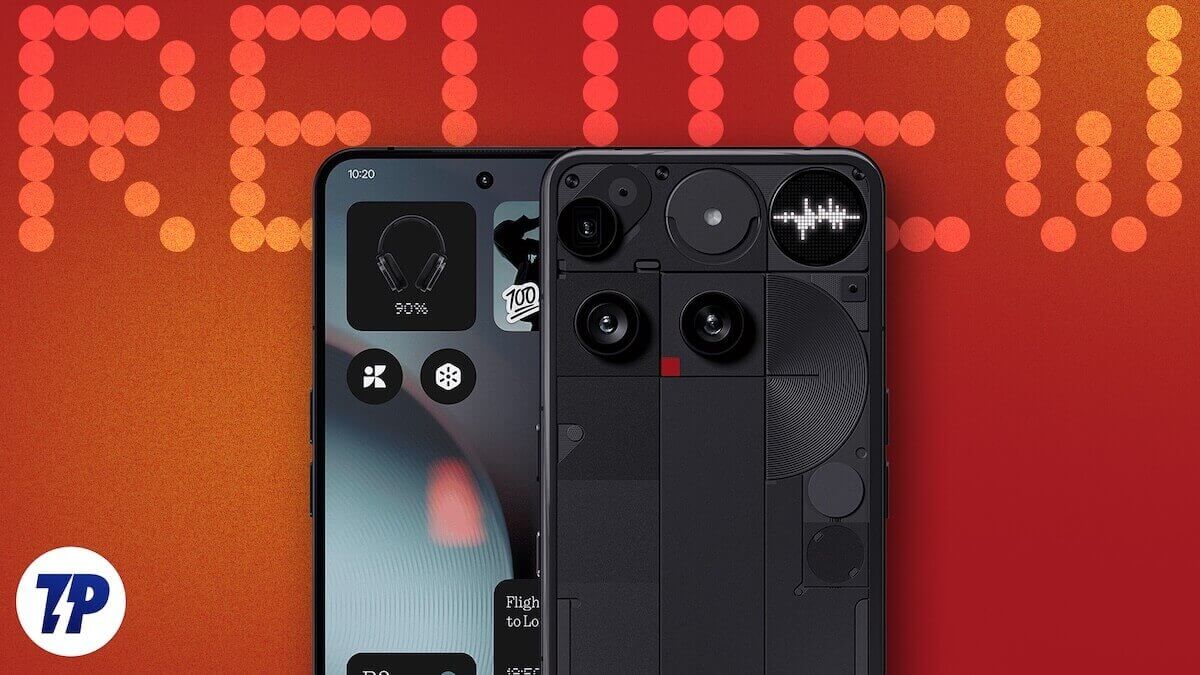
The Nothing Phone (3) also comes with an unusual design, but has entered the spotlight mainly for its pricing. Yes, it is unlike anything we have seen in the smartphone market for a while, but so is its pricing. Will this streak of strangeness give Nothing a foothold in the premium market, or cost it a section of its loyal fanbase? And of course, should you be considering buying the Phone (3)?
Table of Contents
Nothing Phone (3) Pricing: The elephant in the room!
We normally mention the price of a device towards the end of a review, but in the case of the Phone (3), we have no choice but to mention the price right up front, simply because it has been the most discussed aspect of the Phone (3). Nothing has called the Phone (3) its first “true flagship”, and it certainly has given it a very premium flagship-py price tag. The Nothing Phone (3) is available in two RAM and storage configurations as follows:
- 12 GB/ 256 GB: Rs 79,999 / $799 / €799
- 16 GB/ 512 GB: Rs 89,999 / $899 / €899
In simple terms, the Nothing Phone (3) starts at the same price as the iPhone 16 and the Samsung Galaxy S25, and the Google Pixel 9, and is more expensive than the OnePlus 13 (Rs 69,999 onwards) and the Xiaomi 15 (Rs 64,999 onwards). In short, this is a phone with a super premium price tag. As we shall see, this is going to be the Phone (3)’s biggest stumbling block in a market with competitors that offer similar (or better) specs at much lower prices, and in some cases even less than half its price.
Nothing Phone (3) Appearance and design: Nothing like anything…even from Nothing!
The Nothing Phone (3) does not look like any premium phone out there. Actually, it does not even look like any Nothing phone, for that matter. We got the white variant, and it certainly turned heads.

The LEDs on the back that were the trademark of the Phone (1) and Phone (2) are gone, and while the faux transparent look remains in place, it just reveals a series of different-sized objects on the back, ranging from straight panels to circles and dots, and tiny squares.
In fact, the back looks like something you would see on an engineer’s sketch board, which was perhaps the intention. The highlights of the back are four large black discs, arranged seemingly at random. Three of these are on the top left corner and have rings that stick out. These are the cameras, two of which are next to each other, while the third is above them but not inline with them, and is close to the edge of the phone. It is certainly the oddest camera arrangement we have seen on a phone in a while. The fourth disc is on the top right corner and is the largest, and comes with no ring around it. It might be mistaken for a camera by some, but it is actually the Glyph Matrix, a disc of 489 LEDs that displays different symbols and information from time to time, and replaces the Glyph interface of previous Nothing phones. This can be controlled by a smaller white disc below it, close to the middle of the right side. There are also tiny metallic screws on the upper and lower portions of the back, and a tiny flash inside a white disc on the upper part between the Glyph Matrix disc and the standalone camera near the left edge. There is also a tiny red square below the cameras on the back. If all that sounds like a lot, it is because it is. The Phone (3) has a rather crowded back, and while it is certainly unique and different, it will not appeal to those who like minimalistic and elegant finishes.

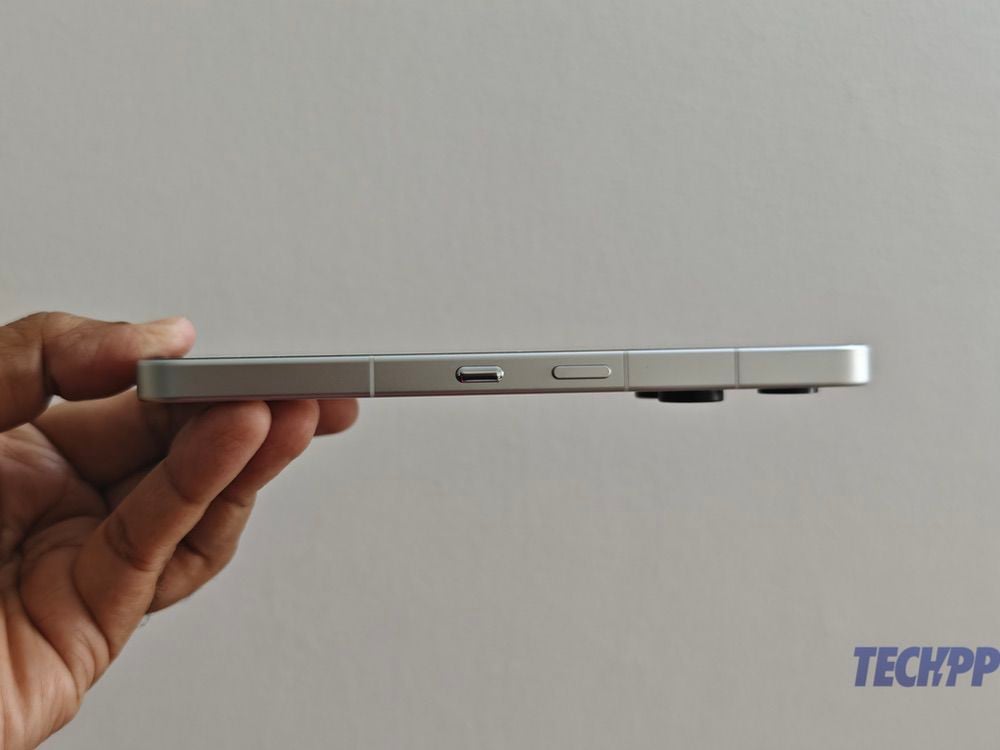
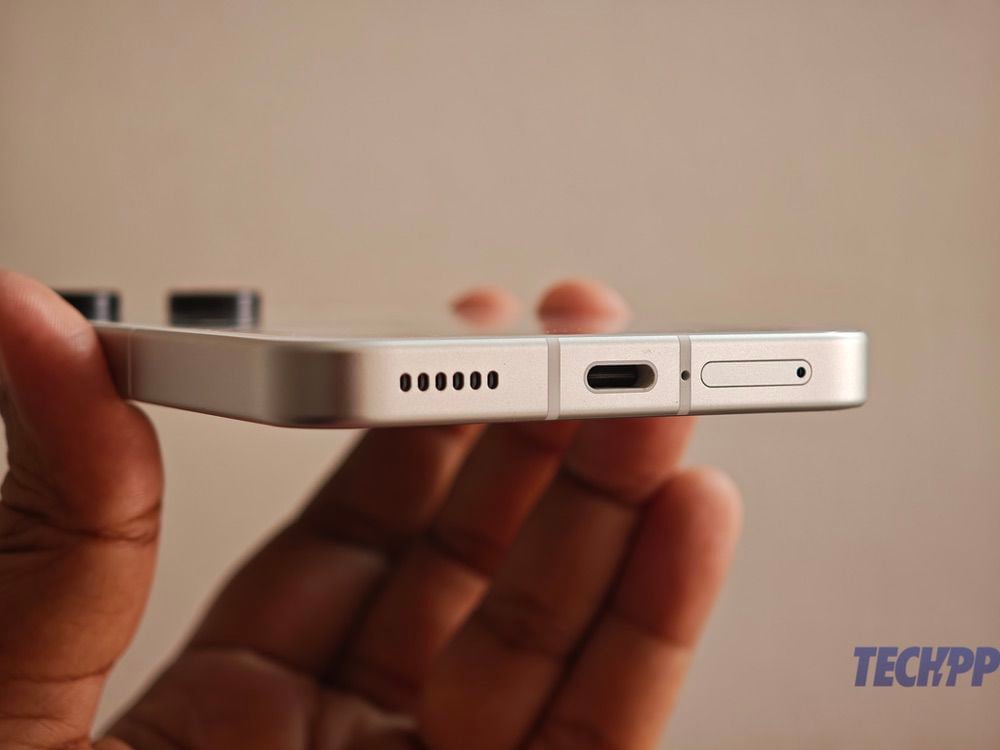
The sides and the front of the Phone (3) are more normal, though. The front is a tall display with narrow bezels, and a punch hole notch in the centre of the top. The sides are straight and metallic, with the right side housing a flat power/display button, and a slightly more rounded Essential Space button – a great touch as thanks to the difference in shape and texture, there is lesser chance of confusing the Essential button with the power button (a problem that had occurred in the Phone (3a) series). The left side has flat volume buttons, one below the other. The base houses the USB Type-C port, a speaker grille, and the SIM card tray, while the top has only a speaker grille.
At 160.6 mm, the Nothing Phone (3) is about as tall as the iPhone 16 Plus. It is not a small phone, and at 8.99 mm and about 218 grams, not the slimmest or lightest either. It is a pretty tough customer, though, and uses premium materials, with Gorilla Glass 7i in front, Gorilla Glass Victus on the back, a metal frame, and IP68 dust and water resistance, ensuring it can survive a fall in the water. All said and done, the Nothing Phone (3)’s very distinct back makes it stand out from the routine phone crowd, though how much you will like it depends on your appreciation of engineering. We would suggest getting the white variant, as the details on the back are less visible in the black one.
Nothing Phone (3) spec sheet and hardware: More budget flagship than premium flagship
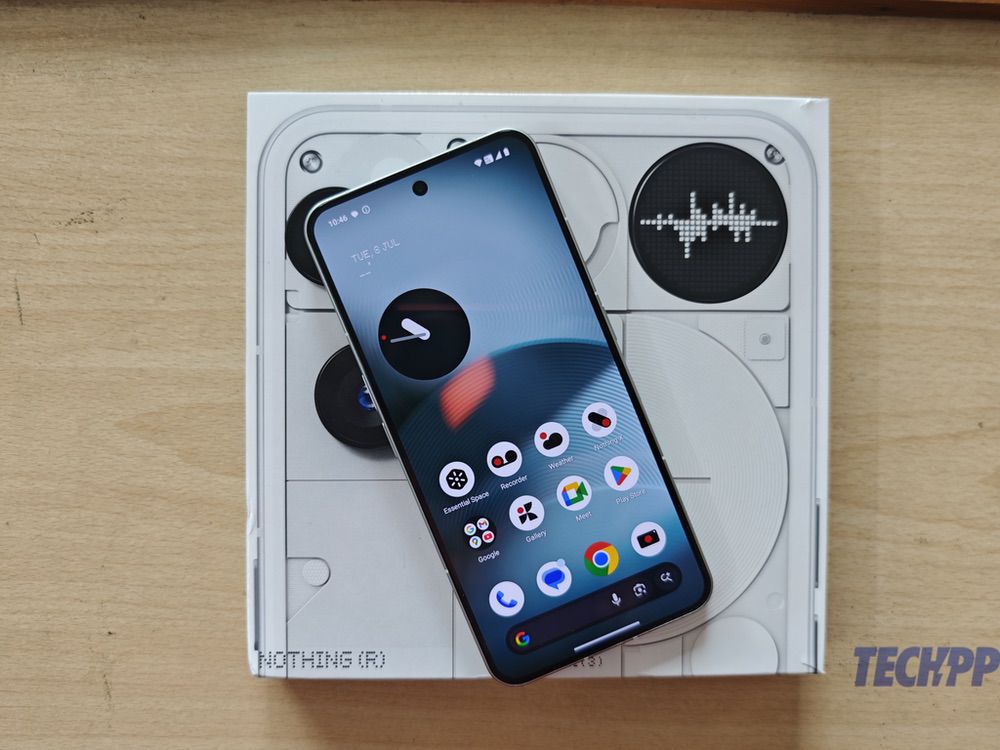
If the Nothing Phone (3)’s outards will grab eyeballs for the right reasons, its innards will get attention for the wrong ones. And it is here that the price of the device comes into play. It’s not as if the Nothing Phone (3) is poorly specced, it is actually a hefty step ahead of the Nothing Phone (2), its predecessor. However, it definitely seems under-specced for its price.
The 6.67-inch display is an AMOLED one with a resolution of 2800 x 1260, a refresh rate of 120 Hz and a peak brightness of 4500 nits, and a typical brightness of 1600 nits. That’s pretty decent, but the display is not an LTPO one, which means it cannot vary between 1-120 Hz depending on the content being displayed – it is unlikely to be noticed by many but is an odd decision when one considers both the Phone (1) and Phone (2) had LTPO displays, and that such displays are common among Android premium flagships and even budget flagships (flagship killers).
Then there is the matter of the processor. The Nothing Phone (3) runs on the Qualcomm Snapdragon 8s Gen 4 processor, which is pretty much a top end processor, but is seen more commonly in budget flagships like the Poco F7 and the iQOO Neo 10, and is considered a step below the Snapdragon 8 Elite that most premium Android phones come with. This is paired with RAM and storage variants of 12 GB/ 256 and 16 GB/ 512 GB. Nothing has gone for LPDDR5X RAM and UFS 4.0 storage, which is what one expects in a premium device, although the decision to go with USB 2.0 connectivity is a surprise, given that most premium Android flagships use the much faster USB 3.2.
The same take of “good enough but not on par with others” continues in the camera department. The Phone (3) sports a 50 megapixel main sensor with OIS, another 50 megapixel telephoto sensor with OIS and 3x optical zoom, and, for the first time for a Nothing flagship, a third camera on the back – a 50 megapixel ultrawide. The selfie camera also gets bumped up to 50 megapixels. All of the cameras support 4K video, but interestingly, the telephoto sensor on the Phone (3) is actually smaller than the one on the Phone (3a) Pro which was released earlier this year, The ultrawide and the front sensors also do not come with autofocus, although those seem more like missed opportunities than deal breakers.
The Phone (3) also packs in a large-ish 5500 mAh battery with support for 65W wired charging and 15W wireless charging, but with no charger in the box, which again puts it behind the flagships from OnePlus, Xiaomi, and Vivo. Also on board are stereo speakers and all the connectivity options you would expect on a flagship, including 5G, Bluetooth, Wi-Fi, and NFC.
The one department where the Phone (3) comfortably holds off the competition is in software and interface. The device comes with Nothing’s super clean, uncluttered Nothing OS 3.5, complete with retro icons, on top of Android 15. This is accompanied by an assurance of five years of OS and seven years of security updates. Then there is the Glyph Matrix, which adds a new dimension to the Glyph UI seen on the back of other Nothing phones, and also puts a spin on the user experience, as well as Essential Space, which lets you save and interpret what’s on the display.
All this would have added up to being a very good spec sheet for a phone at half the price of the Phone (3) – the budget flagship zone – but at its current price, it seems very underwhelming.
Nothing Phone (3) cameras: Point, shoot, zoom!

In cameras, the Phone (3) follows the same broad camera pattern as the Phone (3a) Pro released earlier this year: a good main sensor, a very good telephoto sensor with macro capabilities, and steady enough ultrawide and selfie cameras. In terms of performance, we got very good pictures from the main and telephoto sensors, although all three cameras seem to handle color differently. Those who prefer more detailed and realistic colors should stick to using the main camera, although some might find the output to be a little dull by social media’s “popping colors.”
The telephoto is the star here, delivering brighter colors and also doubling up as a goodish macro snapper. The phone’s camera app has a dedicated macro mode, and you can get very good close-up pictures from 4-5 inches (the app prompts you to move back if you are too close). In terms of zoom, we got very good results with plenty of detail at 3x and 6x zoom, and actually got very usable snaps even at 10-14x zoom. Go beyond that, however, and the noise creeps in. We also found the main sensor to be a much better performer in low light conditions, with the telephoto often getting ‘noisy’ even at 3x zoom – perhaps the bigger sensor helps.








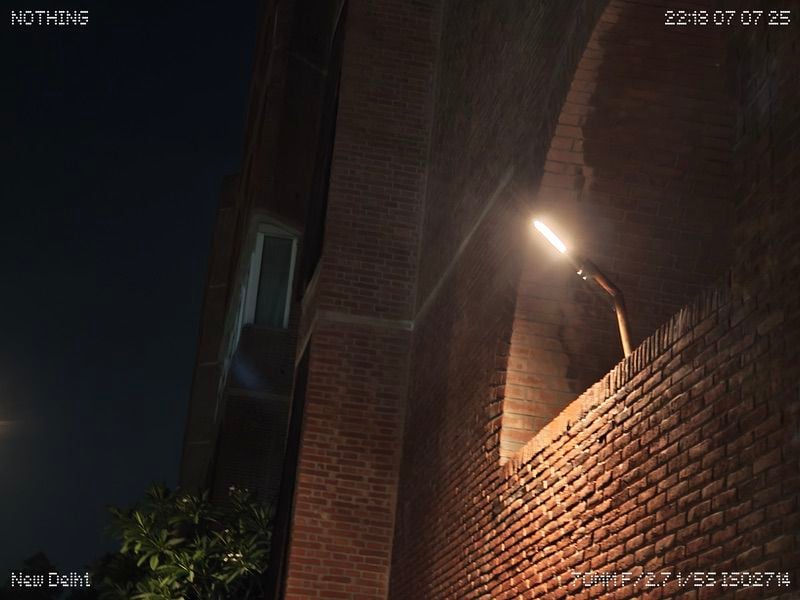


The ultrawide delivers some good snaps, but again has colors on the slightly dull side – it is great for a different perspective, though. The 50 megapixel selfie sensor is surprisingly realistic, and does not get as aggressive as some others when it comes to smoothing out skin and brightening complexions. If you find the results too real for social media comfort (the colors might seem a little dull), you can use the retouching option while shooting to get better-looking, brighter, and more richly colored snaps. Video quality is very good on the main and the telephoto sensor, and is middling on the others.
All said and done, if you liked the cameras of the Nothing Phone (3a) Pro, you will like the ones on the Nothing Phone (3). There are a few color inconsistencies between the sensors, but we expect Nothing to tackle those with an update or three. However, while the Phone (3a) Pro is pretty much the camera boss of its segment, the Phone (3) is actually a step behind the likes of the OnePlus 13, the Xiaomi 15 and the Galaxy S25, although its telephoto sensor does give it an edge over other premium players like the iPhone 16 and the Pixel 9. No, this is not a camera phone like the Xiaomi 15 or the Vivo X200, but with some careful handling, you can get some great snaps from it.
Nothing Phone (3) performance: One for clean Android fans!
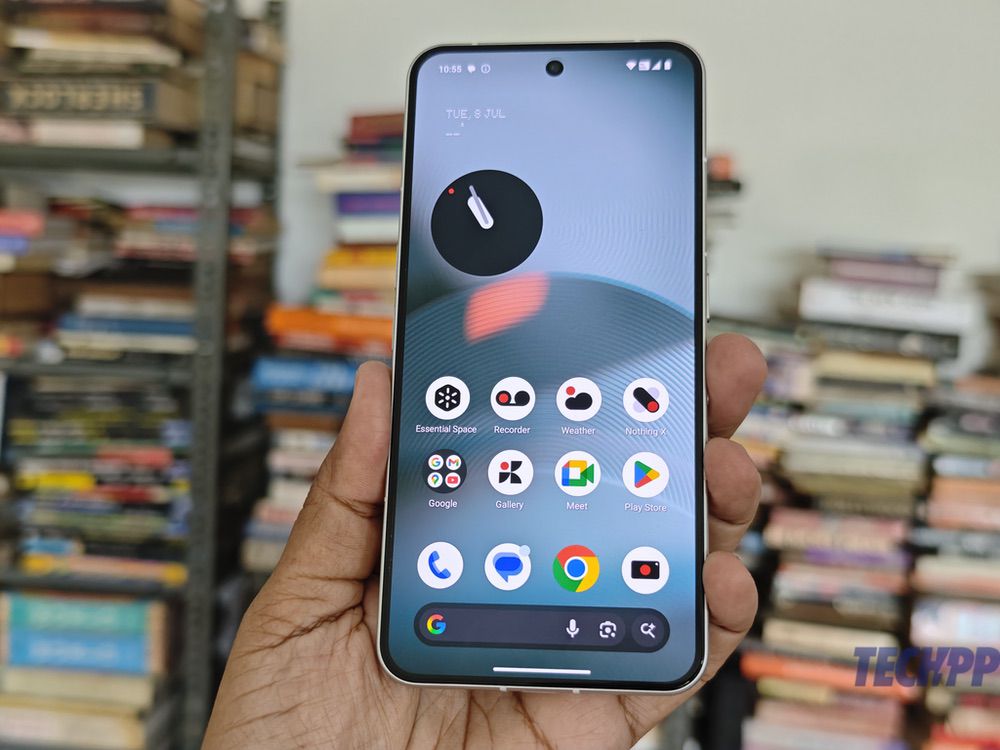
The Nothing Phone (3)’s performance is pretty close to what you would expect from a premium-priced phone. The Qualcomm Snapdragon 8s Gen 4 processor is a little below the Snapdragon 8 Elite that we see in most Android premium flagships, but it can handle most high-end games at high graphics settings. We got some very good sessions of Call of Duty and Asphalt Racing, and even Genshin Impact ran smoothly for most of the time, although the odd lag did creep in when there were multiple characters on the screen. The 6.67-inch display is not as bright and colorful as the ones we have seen on the Galaxy S25 and the OnePlus 13, but it is very good for viewing content (shows, films, etc.), with the impressively loud stereo speakers making the experience more immersive. The Phone (3) is certainly not a gaming or multimedia beast, but can handle pretty much everything most users would demand from it.
It is, however, in regular day-to-day performance that the Phone (3) really shines. NothingOS might be a little too plain for some, but those who appreciate clean interfaces will love its simplicity and the total absence of bloatware, giving it a very Pixel-ish feel. Tasks like Web browsing, social media doomscrolling, and messages and mails work smoothly, and one can easily run more than a dozen apps on the device without any problems whatsoever. You also get all of Google’s AI tools, including Gemini, Circle to Search, and image editing tools. Nothing has also added more editing options to its rather plain Gallery app, and of course, there is its own Essential Space, which lets you save screenshots, analyse them, and even save voice notes by just clicking a button. At a time when most phones tend to overwhelm you with their features, Nothing keeps things smooth, simple, and speedy.
Nothing Phone (3) Glyph Matrix: More play than work right now
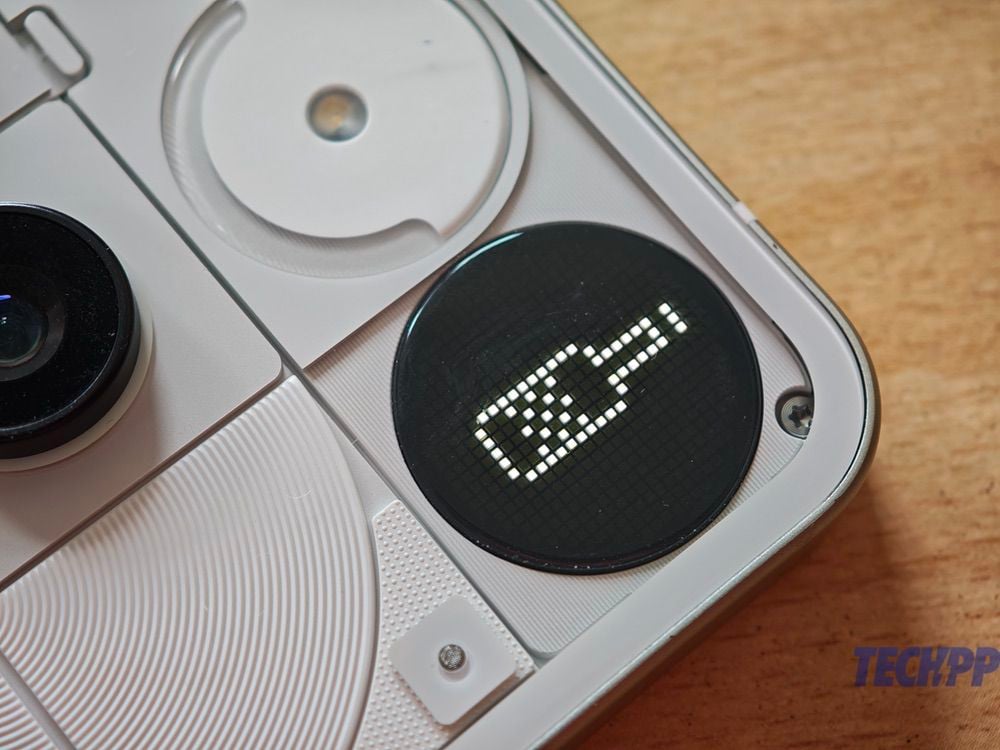
The Glyph Matrix on the back of the Phone (3) is going to be as divisive as the phone’s design. It is certainly not as noticeable as the Glyph lights on previous devices, and in our opinion, has limited utility. It certainly is easier to notice the back of your phone lighting up than seeing icons on a relatively small disc. So while you can see notifications and animations on the small display, noticing and remembering them is a bit of a task. In terms of functionality, perhaps it would have been better if Nothing had opted for a proper display on the back, such as the one we saw on the Xiaomi 11 Ultra a few years ago. It might not have given us the sort of retro feels that the Glyph Matrix does, but it was far easier and more useful simply because it was simpler to read and understand.
Nothing also has a feature called Glyph Toys, which lets you place elements like a clock, a stopwatch, and battery status, games like Spin the Bottle and Rock, Paper, Scissors, and even a selfie mirror on the display on the back. You can scroll through them by gently pressing the disc below the display, which has a slight haptic feedback (it is not a smooth performance, and you need to get the hang of just how much pressure to put and when, to get results).
Once again, this is something that one needs to get used to, and at the time of writing, it is more of a party trick than of actual use. After all, it is easier to actually spin a bottle than use the Glyph toy meant for it, the selfie mirror shows you a pixilated image which retro lovers will adore but which is of little use while taking a selfie using those rear cameras, and even rock, paper and scissors is more fun in real life. We ended up having the clock or battery status on the Glyph Matrix. More utilities and toys are expected on the Glyph Matrix in the coming days, but at the moment, it seems a bit like a low-resolution monochrome display on the back of one’s phone – like the design, it is currently more flashy than functional.
Nothing Phone (3) Battery and charging: A day tripper with fast-ish charging, but no charger
The Nothing Phone (3) comes with a 5500 mAh battery, which can easily see off a day of normal to heavy use. The phone comes with support for 65W charging, but there’s no charger in the box. Nothing’s own CMF charger got the phone from 0 to 100% in about an hour, which is decent without being exceptional. Also on board is 15 percent wireless charging as well as 5W reverse wireless charging. While these figures are comparable and in some cases even better than those seen on the likes of the Galaxy S25, iPhone 16, and the Pixel 9, they are inferior to what the OnePlus 13 offers at a (much) lower price. It is again a case of “good enough, rather than the best,” a recurring theme in the Phone (3) story.
Nothing Phone (3) Review Verdict: Pay a premium for being different
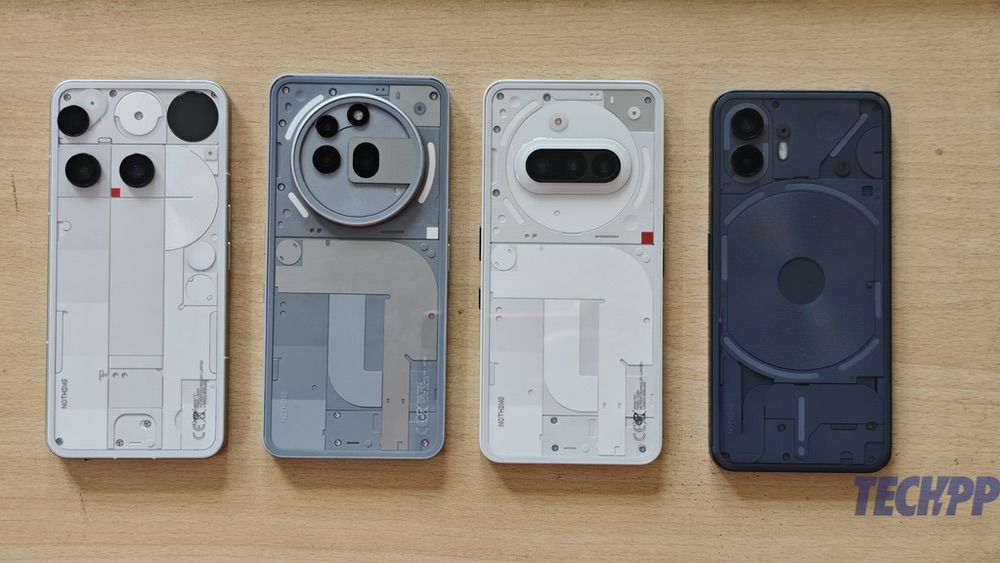
So, should you be considering purchasing the Nothing Phone (3)? We are going to be very blunt: its general performance and spec sheet do not justify the Rs 79,999 price tag that accompanies it. There are other phones out there that can deliver as much or more for a similar or even a much lower price. So if its specs and performance can be matched and even beaten at a lower price, why would anyone want to get a Nothing Phone (3)? The reason is simple: it is quite simply the most “different” phone in the premium segment in terms of both appearance and functionality.
In simple terms, it looks and works differently from every other phone out there. It does have its rough edges, but given Nothing’s excellent track record of updates, those are likely to be ironed out in the coming days. And with a genuinely useful Glyph Matrix and improved cameras, the Nothing Phone (3) could become a very different kettle of fish in the coming days. As of now, the Nothing Phone (3) is cheese in a chalk factory – buy it if you want a radically different smartphone experience. And are willing to pay a bomb for it.
- Very different design
- Clean, uncluttered interface
- Glyph Matrix is a new way of communicating
- Smooth performance
- Good main and telephoto cameras
- Decent battery life
- That price
- Very different design might NOT appeal to some
- New Glyph Matrix takes some getting used to and is not very practical
- That price (well, it is worth repeating)
- Processor not the best in the segment (and USB 2.0)
- No charger in the box
- One more time, all together…THAT PRICE!
| Design & Appearance |
|
| Software |
|
| Cameras |
|
| Performance |
|
| Price |
|
|
SUMMARY
While it may come with a design and UI that are unmatched as well as unusual, the Nothing Phone (3)'s biggest challenge is going to be justifying a price tag that is easily matched and even beaten by a number of its competitors |
3.7
|

