

In Summary
- Nothing, the brand co-founded by Carl Pei in 2021, has recently launched its latest phone, the Phone (3a) Lite.
- For many observers, the Phone (3a) Lite reflects the changes that have taken place in the brand this year, ranging from controversies over price to changes in software to a much larger product portfolio.
- Whether it is growth, change, or simply creative confusion, what cannot be denied is that the brand that started off to make tech fun is getting increasingly mainstream.
When Carl Pei, one of the co-founders of OnePlus, took the wraps off his new initiative, Nothing, in 2021, he said it was his aim to make tech fun again. Well, in 2025, he certainly made it very interesting. Hardly a quarter passed without Nothing being in the news. Whether this is a sign of the brand scaling new creative heights or a desperate attempt to stay in the news depends on your perspective. But as the dust settles on Nothing’s latest product launch, the Nothing Phone (3a) Lite, it is difficult to run away from the conclusion that Nothing has indeed changed in some ways. Whether for the good, the bad, the ugly, or the exquisite, only time will tell, but this Nothing is something different.

If that sounds too dramatic, consider the fact that at the beginning of 2025, the brand had a total of five phones in its portfolio (Phone 1, Phone 2, Phone 2a, Phone 2a Plus, and CMF Phone). It has so far released the same number of phones in 2025 so far – Phone 3a, Phone 3a Pro, Phone 3, CMF Phone 2 Pro, and now Phone 3a Lite. What’s more, the brand, which had a total of 3 TWS under the CMF branding until the end of 2024, launched three CMF TWS at a single event in 2025, all priced close to each other.
As we come to the end of 2025, the brand that until the end of 2024 was all about superb tech that was affordable too, suddenly has no fewer than four devices that can be safely termed premium – the Phone 3, the Headphone 1, the Ear (3), and Ear (Open). And after focusing on the Indian market where Pei is revered and where the brand has achieved staggering growth (and has also tie-ups with an IPL team and leading film stars), the brand is clearly looking to expand horizons – its last three devices have not even been launched in India.
Nothing Phone (3a) Lite: sign of the New Nothing?
The Phone (3a) Lite in many ways encapsulated the new Nothing, which seems to be trying to marry commercial compromise with intelligent innovation. While its design has the trademark Nothing faux-transparent back and glyph UI, its specs are very similar to the CMF Phone 2 Pro launched a few months ago, with a similar display, processor, main-ultrawide-selfie camera combo, battery, and charging speeds. Even the glyph UI had shrunk from covering a large part of the back of the Phone (1) to a solitary LED, reminding us of the notification lights BlackBerry phones used to have in years gone by. Nothing also shocked many of its followers when it included a 2-megapixel macro camera on the phone, a feature it was seen to have mocked in the past.
But nothing – pun unintended – captured the contradictions that have appeared in the brand as much as the software on the phone: at first glance, it had the same retro and uncluttered look that had made it the closest thing to Android on Pixel, but a closer look revealed it also had some third party apps preinstalled, ending the era of clean Android on Nothing’s non-flagship devices. It was also interestingly not immediately launched in India, a market for which it seemed tailor-made.
Starting radically, middling oddly, and ending conventionally
Ironically, the year had begun with perhaps Nothing’s most influential device ever, the Phone (3a) Pro. Although Nothing had grabbed attention with the transparent design, glyph UI, and clean interface of its phones from the very outset, none of the changes it brought to the table actually became major trends. The Phone (3a) Pro changed that by bringing a very good telephoto camera to a phone priced in the upper mid-segment – a change that was so notable and in best Pei style, so well communicated, that other players in the market had to follow suit, and “yes, but does it have a telephoto” joined the list of standard queries of those purchasing not just mid-segment but even high-end phones.
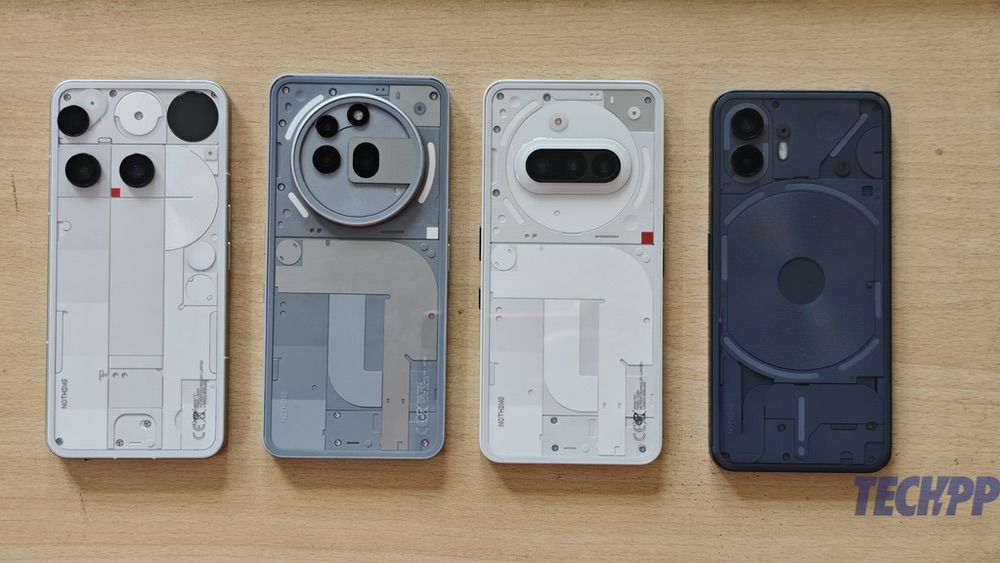
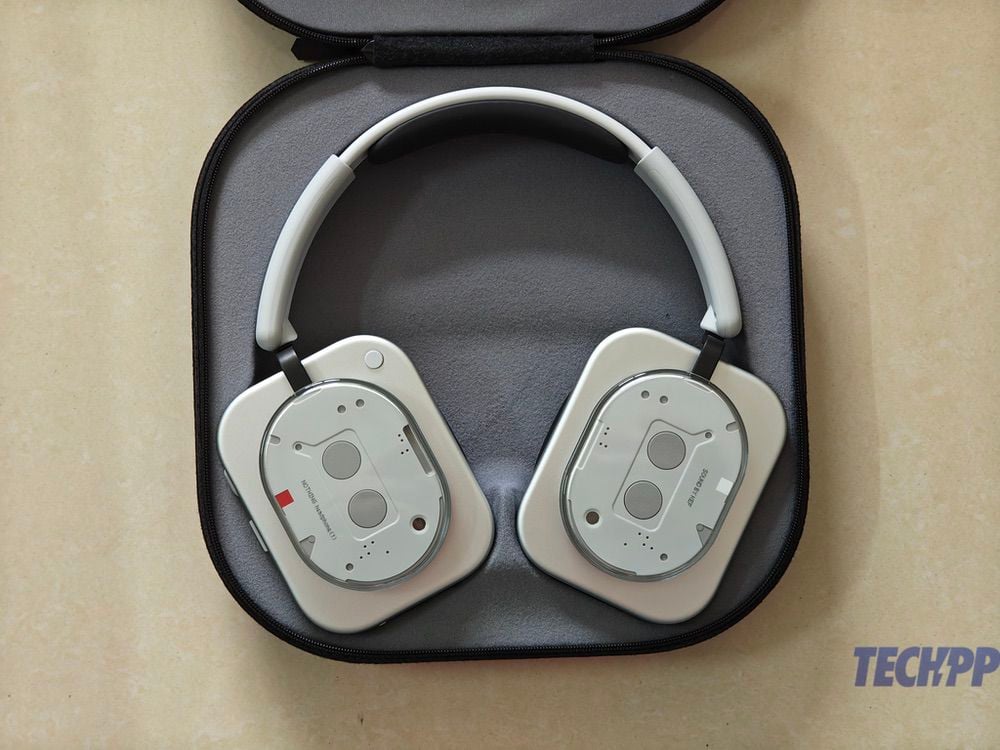
The period that followed has, however, been distinctly odd. The brand tried to convince the world that a phone with an asymmetrical camera setup and a Snapdragon 8s Gen 4 chip was worth USD 799. And then that headphones with a transparent-ish design with a cassette seemingly etched on them were worth USD 299, even though its sound right out of the box was rather iffy. Then there came the embarrassment of a sudden drop in the price of the Phone (3) on Flipkart, where it was offered for less than half its launch price for a while – something that has never happened with a Nothing product within a short time of its launch. And even as this is being written, the price of its Ear (Open) earbuds is fluctuating between Rs 9,999 and Rs 17,999 at different outlets in India, where it was launched more than a year after its initial release for some reason.
We need to stress here that we do not know what drove these decisions. In fact, given Pei’s stellar track record with OnePlus and Nothing, we are sure he and his team know what they are doing. It all just does not seem to fit in with the “make tech fun again,” pre-2025 Nothing. This “not that great a processor but look at the cameras,” “we cannot control the price charged by retailers,” and “we have to include third-party apps for reasons of controlling costs” is a script that we tend to hear from other brands.
Growth, expanding horizons, or just getting comfy with commercials?
Of course, all this might just be part of what many call “growth.” A brand cannot be expected to stay the same throughout its existence. Hey, Apple started out with one iPhone per year, and look at them now – they released five in 2025. As for higher prices, haven’t the likes of OnePlus and Xiaomi also followed the path of (sound the trumpets) “premiumistation.” Nothing isn’t doing anything that other companies have not done or are not doing. So what is the problem?
Well, actually, that is the problem. Nothing was never really supposed to be “another” tech company. In fact, its co-founder Carl Pei had clearly stated that it had been formed to help make tech fun again. And while many of the brand’s products have polarised opinions, there is no doubt that they have changed the tech narrative. Nothing’s phone series has drawn greater attention to design and interface than anything else in recent times, and its flagship TWS have shown that you can get close to premium sound and ANC at prices below USD 150. To see a brand that was a breath of fresh (or well, differently scented) air in an increasingly predictable industry is disappointing.
Still innovative, but whatever’s next?

To be fair, Nothing has retained a strong innovative streak even in the midst of this change. It did try to come out with mods for the CMF Phone 2 Pro, the sound quality on the CMF Buds 2 was magnificent, the decision to add a microphone to the case of the Ear (3) is so out of the box, and the ability to easily swap earpads on the CMF Headphones Pro is something that we have seen only on high end headphones from Dyson and Apple. And while the Phone (3) and Headphone (1) drew criticism for their pricing, both were seen as innovative and anything but run of the mill.
The flame of innovation still burns at Nothing, but the shadows of commercial compromise are growing around it. How Carl Pei will balance the brand between the aims of making tech fun and making more revenue in 2026 could well define the brand’s future. Who knows, he might take the brand in a whole new direction. After he is the OG Never Settle guy.

