

I know the reality about the existence of Heaven,
But it is a nice way to reassure the heart…
So wrote famous Urdu poet Mirza Ghalib when asked whether he believed in Heaven. Replace the word “Heaven” with “Android updates,” and you would be summing up the sentiments of a number of smartphone users. A famous cosmetic company had once said that it sold “hope” – the hope of a better appearance that would lead to a better life. Well, Android smartphone manufacturers seem to have taken a leaf out of that Book of Hope when it comes to software updates.

In the beginning…update, what update?
For more than a decade after the arrival of Android, most brands seldom used to commit to delivering new versions of Android to a smartphone. At the most, a brand might give an assurance of updating a phone to a new version of Android if it was released with an older version, but that used to be it. The concept of monthly or bimonthly Android security updates did not exist. Software was largely something you got on the phone, and the greatest concern used to be about whether its version was the latest or not. Even after Google started releasing regular monthly security updates, general consumers’ interest in them was relatively limited, and brands did not push them as a product feature.
It was not as if Android phone consumers did not value software. They did, but unlike iOS users, they were not used to update cycles – a fact borne out by severe Android fragmentation, with different devices running different Android versions. And brands did not help matters by not promoting regular updates as a product USP. Even Google’s Android One initiative that revolved around affordable phones that got regular updates did not strike a chord with the public. Software updates were not a point of discussion unless you happened to be very geeky indeed.
Samsung and the software update assurance that many copied, few implemented
It was very apt that the brand that changed this scenario was also the one that played a major role in making Android mainstream more than a decade ago. In early 2021, Samsung announced that it would be providing four years of software and security updates to its phones. What’s more, it promoted the announcement heavily. An announcement of this level from a market leader made software updates a product feature. Within no time at all, other brands also started promising them, although of different durations at different price points.
All of which should have been good news for the consumer. After all, their devices would now have updated software, which generally results in better performance and features for a longer period of time. It should also have logically cut down heavily on Android fragmentation, bringing more people to newer operating systems. But has that actually happened? A look at Statcounter’s global statistics for different versions of Android running on devices paints a rather different picture.

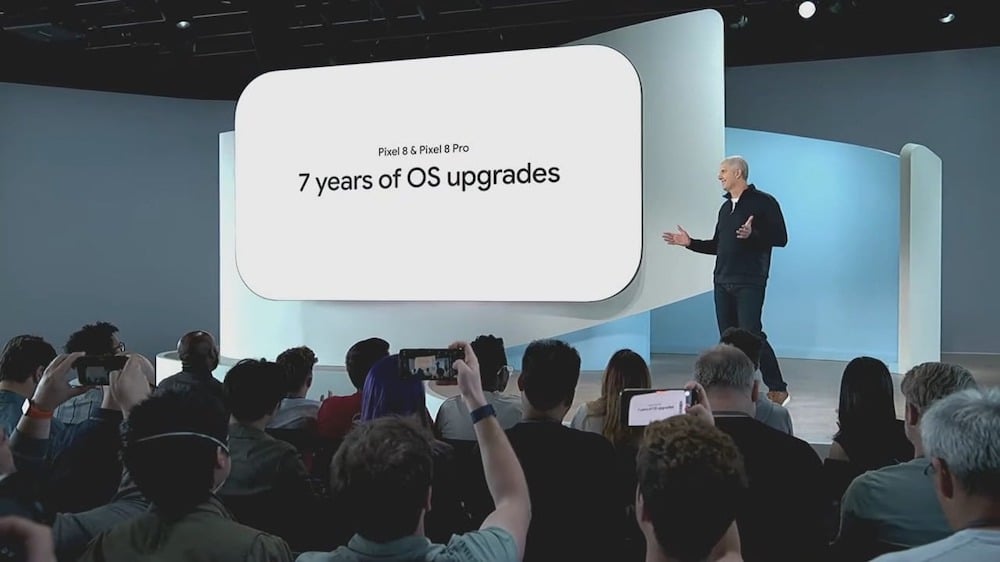
There are more than twice as many devices running Android 11 and 12 as compared to Android 14, the latest version of Android. Ironically, brands are still releasing phones running on Android 13, with assurances of a number of years of software updates. In fact, there now seems to be a rivalry of sorts among brands about the number of years for which updates can be provided. While most brands seem content to provide around four years, Samsung and Google have upped the level and promised a whopping seven years of updates to their flagships – a move which has invited criticism from some quarters (most notably OnePlus) for being unrealistic and of little value as the hardware of phones seldom is capable of supporting new software features by that time.
A spec rather than a practice?
Our biggest concern, however, is over software update commitments becoming more of a spec than an actual practice. While it is laudable to see brands commit to delivering new versions of software to their consumers for a specific number of years, the absence of a well-mapped schedule means that these updates often arrive at the brand’s own speed. In fact, many phones released last year on Android 13 have yet to be updated to Android 14, despite high-profile software update promises from their brands.
As a consequence, Android remains a very fragmented OS in spite of software update commitments, with Android 14 still barely running on 10 percent of devices. Even a device as premium as the OnePlus Open has only now been updated to Android 14, and some brands have released roadmaps that show Android 14 arriving on the device in Q2 2024, more than six months after the release of the OS. Even the security update scenario is not the greatest, with a number of phones still stuck in 2023 in that regard, notwithstanding brand commitments.
It is common to see brands with phones running different versions of Android and with different security updates in their portfolios. Yes, we are aware that it is not easy for brands to roll out software updates for devices with vastly different spec sheets, but hey, they are the ones making software update commitments.
Of course, saying, “We will update your phones to a new OS four times in the next four years, but this might be 7-8 months after that OS has been released,” might not sound quite as attractive to a consumer. This is why brands generally prefer to stay quiet on update schedules while launching phones and simply stick to assuring users of “three/four/seven/37865 etc. years of updates.” This basically reduces Android update commitments to being something that needs to be mentioned on a spec list rather than implemented – it exists to reassure users but comes with no schedule or any penalty for its non-implementation. It also can reduce criticism while announcing a phone on an older version of Android.
Android Update commitment: More hope than software dope?
To be brutal, most Android update commitments right now are like a pre-election promise by a political party, designed to get votes rather than be actually put into practice. And that is not a healthy trend at all. The fact that Android remains heavily fragmented in spite of software update commitments by brands just shows how effective these commitments actually are.
Perhaps brands could reinforce their software update promises by offering to reimburse their consumers if the updates are delayed by a certain period of time – perhaps some extra online storage or a free accessory if a security update is delayed by more than a month or if an OS update is delayed by more than three months? We do not know the solution, but we do know that right now, a commitment to update Android on a device seems to be more about numbers rather than actual implementation. Many of us who purchase a phone with assured software updates today do so with the hope that the brand will update the phone efficiently and effectively within a reasonable amount of time. See what we meant about “selling hope?”
Should brands refrain from software update assurances altogether? Should there be some penalty for unreasonably delayed updates? Should Google itself push brands for more timely updates, if it can? We do not know the answer, but until updates get really timely, our reaction to any brand (other than Google itself) offering a number of years of software updates would be the same as that of Mahatma Gandhi to Stafford Cripps in 1942, when the latter offered India Dominion Status at the end of the Second World War:
A post-dated cheque on a failing bank.

